From an Argentine astronomical institution, through which great professionals have passed as is already evident from its name, pseudoscientific discourse is promoted. A real embarrassment of astronomical proportions.
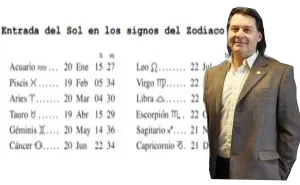
In the Yearbook published by said institution (OAFA, Félix Aguilar Astronomical Observatory) a section titled Phenomena is included. As clarified before the start of that section, the information indicated there comes from another institution:
We thank the following Institution for sending the publication indicated, which has been used for the preparation of this publication:
Royal Institute and Observatory of the Navy, San Fernando, Cádiz, Spain, "Astronomical Phenomena".
On page 12 of the 2016 yearbook the following information appears:
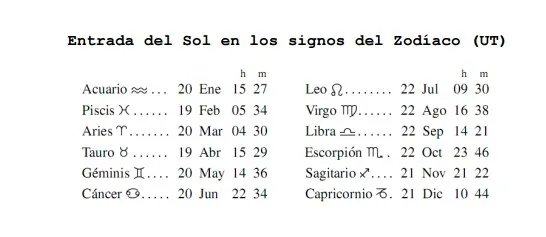
The information CANNOT be, in any way, astronomical. The sun does not transit, in an apparent form, the CONSTELLATIONS indicated on such dates. In fact, as noted, it is not indicated that it reports the (apparent) entry of the Sun into the constellations, but into the signs of the zodiac, that is, an astrological concept.
The yearbook is under the responsibility of Claudio Carlos Mallamaci and José Alberto Pérez. Could it be a mistake?
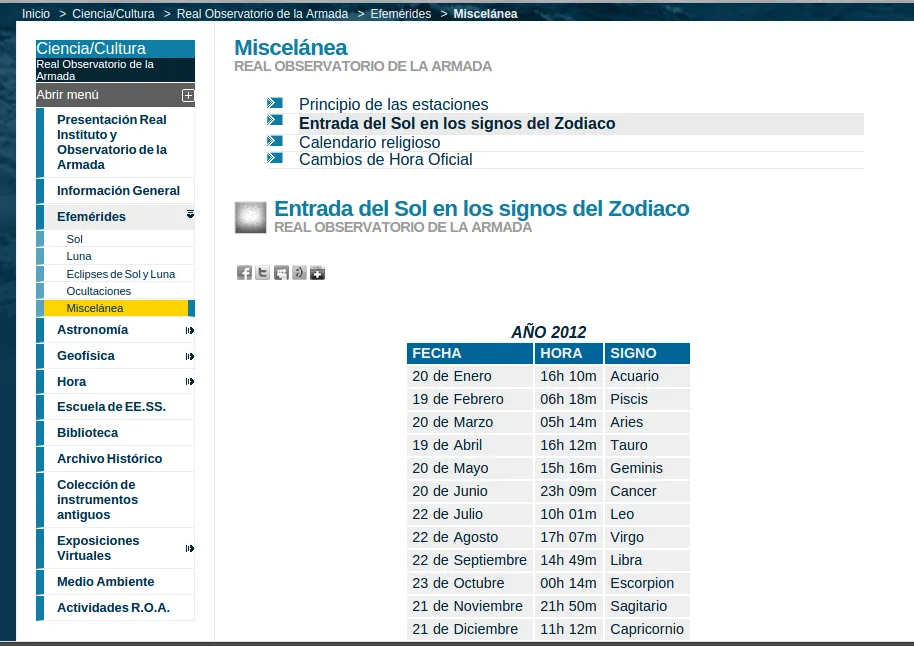
On the page of the Royal Institute and Observatory of the Navy of Spain this information is also indicated, although outdated:
During the year 2014, when I noticed this contradictory information, I maintained email communications with one of the professionals in charge of the yearbook, who acknowledged that such information is not astronomical, but astrological.
At the same time, he justified the publication with arguments that could be described as childish, naive, or simply vomit-inducing.
At that time, Mallamaci explained to me (as if I were a neophyte):
Why do we give the date of the Sun's entry into the signs of the Zodiac and not with respect to the constellations? Simply because the Yearbook is for general use and there are people who are interested in knowing at what moment the Sun enters each sign. Obviously these are people with an interest in astrological matters, which does not mean that our observatory supports the activities or principles of astrology. It is simply general information that indicates at what time of the year the Sun is in a certain place in the sky; nothing more than that. On the other hand, indicating the moment when the Sun passes through the different official constellations of the ecliptic does not make much sense from an astronomical point of view, because those who work with the position of the Sun (or any other celestial body) obtain this information from the mathematical equations that have been developed for that specific purpose. Do not forget that the issue of knowing the Sun's entry into a sign of the Zodiac is only of interest with a domestic precision of daily life, while the scientific knowledge of the positions of the members of the Solar System is something much more delicate and requires a specific calculation appropriate to the goal pursued by the researcher.
Note the childish argumentation:
1- That information, recognized as astrological, is published because there are people who are interested in it, BUT that does not mean the observatory supports such activities! Isn't it information in support of those who ignore the difference between astrology and astronomy? And doesn't such supportive information contribute to generating greater confusion, given that it is published by an astronomical observatory without making any comment about it?
Because such a yearbook could be taken advantage of and used for teaching: The supposed passages of the Sun through the supposed signs are published and, next to them, the "real" data of the Sun's apparent passage through the constellations (which coincidentally have the same name) in order to show that astrology and astronomy are different things, as Dr. Alejandro Gangui has done, for example, in one of his books.
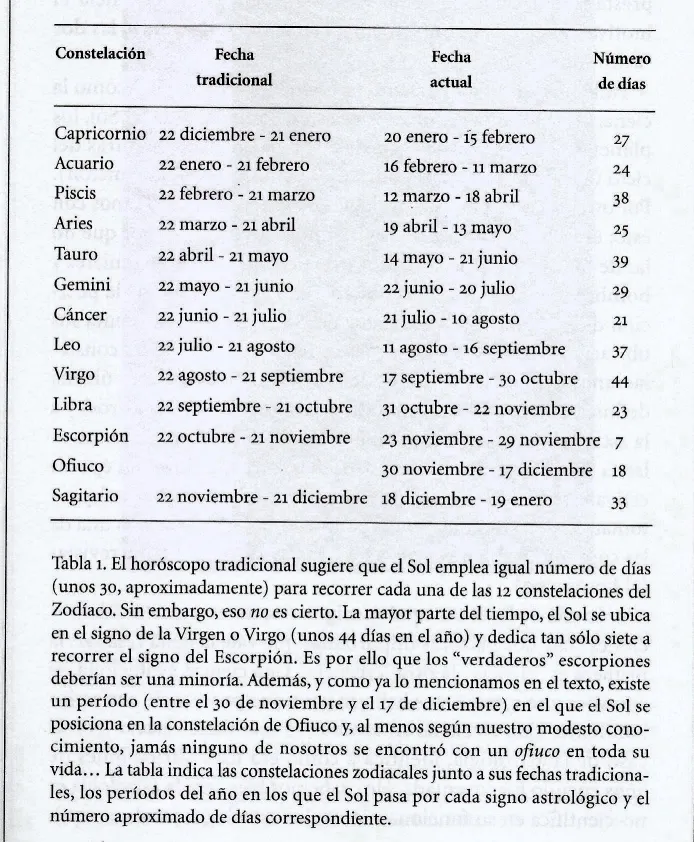
However, the publication of the "astronomical" data would be irrelevant because those who work with the position of the sun obtain that information from mathematical equations that have been developed for that purpose. Yes, and how are the supposed positions of the sun through the "signs" obtained? They are also obtained with equations, but since the people interested in that data have no interest or knowledge in such calculations, the results of them are offered.
Amateur astronomers use the constellations as a reference, although at a professional level that is a practice in disuse. There are several designations for astronomical objects. In the case of stars, a custom that comes from the past and continues by tradition is to name those that "are part" (apparently) of the constellations according to their brightness, in descending order, using the Greek alphabet. Thus, the brightest star in Orion is called Alpha Orionis (using the genitive) or Alpha of Orion. The second brightest star is called Beta Orionis or beta of Orion. There are some exceptions that are not relevant here.
To navigate the sky, we amateurs still use the constellations as a reference. The specific data of the "entry" or transit of the Sun through them is certainly not very used, except precisely to show that astrology and astronomy are different things. As I have said on other occasions, these differences only serve to show that by using different conventions, they are different practices. One cannot say, just because of this, that astrology is not science. It is not, but for other reasons that would have to be argued better, it is not enough to show the differences in conventions. But among those people for whom astrology and astronomy are the same (and there are such people), they serve to begin to show the difference. (See The Problem is Not Ophiuchus)
In a later email, the astronomer says:
Using references like the one mentioned does not imply automatic validation of popular beliefs. As an argument for this, consider the fact that the International Astronomical Union continues to identify constellations (which I insist, are a fictitious human construct), and the stars contained within them, with names or references derived from ancient concepts, often linked to mythological beings; for example, Orion, Perseus, Centaurus, Hercules, etc. Thus, for instance, the Apparent Places of Fundamental Stars, published by the Astronomisches Rechen Institut in Heidelberg (Germany), presents the positions of 64 stars from the so-called FK6 Catalogue (Sixth Fundamental Catalogue), and identifies them -in addition to their own number- with a reference to the constellation they belong to. For example, u-Andromedae (star No. 1045), e- Orionis (star No. 210), s-Centauri (star No. 464) or 72-Herculis (star No. 1456), among others. In no case does the IAU promote or accept that a beautiful nymph Andromeda, or a hunter/warrior Orion, or a Centaur half man half horse, or an extraordinarily strong man like Hercules, exists or has ever existed. It is simply a way of identifying regions of the sky following an ancient designation, but nothing more; in no way do scientists intend to impose acceptance of the existence of these beings or whatever one might call them. In a similar way, the band around the ecliptic through which the planets, the Sun and the Moon "move" is identified. But there is no hidden esoteric pretense [sic] in it.
All true, but it attempts to justify what the IAU (International Astronomical Union, UAI in Spanish, Unión Astronómica Internacional) does NOT do: it does not publish astrological data as the OAFA does thanks to Mallamaci.
A vain attempt to justify the unjustifiable, with a logical appearance, but which in reality is an invalid argument.
CONSERVATIVE LIBERALISM
We live in modernity: this is supposed to imply the dominance of liberal thought, both in politics and economics, but it has other consequences in the rest of social relations. Bourgeois liberalism opposed the conservatism of the nobility and clergy dominant in the medieval feudal regime. In the Ancien Régime, the power of the nobility was sustained ideologically by considering that the nobility was part of a special caste: the monarch was a representative of divinity.
We can be critical of liberal thought in many aspects, but it is difficult for such a form of thought to be surpassed if that ideology has not yet managed to be a surpassing of conservatism. Magical thinking continues among us, among the masses.
But the fact that this thinking is still part of supposedly "scientific" institutions is a scandal of astronomical proportions, which is attempted to be justified with invalid reasoning, revealing how strong idealism is in a part of the scientific community in modernity.
A clear example that possessing knowledge in astronomy does not necessarily imply having critical thinking. Rather, it is a compelling example of how magical thinking is part of the cultural heritage of "scientific" modernity in a society as conservative as it is idealistic.
An astronomical disgrace that continues to be published on the official website of an astronomical observatory. The professional astronomical community, what attitude will it take regarding this?
In any case, just as the OAFA has the freedom to publish astrological data, without any clarification on the matter, I also have the freedom to express my point of view. And, since it is a public topic (the almanac is publicly accessible, as is this post), perhaps the rest of society can also form an opinion on the matter.
Sources and related links
- Sun's entry into the Zodiac signs REAL OBSERVATORY OF THE ARMADA
http://www.armada.mde.es/ArmadaPortal/page/Portal/ArmadaEspannola/ciencia_observatorio/prefLang_es/03_Efemerides--05_Miscelaneas--02_Zodiaco_es - Félix Aguilar Astronomical Observatory
http://www.oafa.fcefn.unsj-cuim.edu.ar/OafaNew/index.htm - 2016 Almanac of the OAFA
http://www.oafa.fcefn.unsj-cuim.edu.ar/OafaNew/CirculoMeridiano/Anuarios/Anuario_2016.pdf - Voces paralelas: THE FILIPPA - MALLAMACI FORMULA WAS PRESENTED (05/04/2012)
http://www.vocesparalelas.com.ar/v1/iu/publico/noticia.php?id=12675 - ADVISORY COUNCIL ON ASTRONOMY AND SPACE SCIENCES
http://www.mincyt.gob.ar/ministerio/consejo-asesor-de-astronomia-y-ciencias-del-universo-113
About the images
Screenshots of the OAFA and Royal Observatory pages.
Combination of images from OAFA Almanac 2016 and photo from the note in Voces paralelas.