In the mass media we find critiques of art, in literary, musical, cinematic matters. Also opinion articles, sometimes very light, on politics and economics. Is it possible to make a critique of science? I maintain that it is not only possible, but necessary. But, from where?
I learn that Daniel Golombek is publishing a book on astronomy. According to the review that reaches me, it would be a work about the great observatories of the 20th-21st century, like Hubble. It is impossible to give an opinion on an unread book, but I dare to venture that it will not be a "critical" work. Being a critic of science is not common currency. For some time I have been developing a text about the great observatories, but from a critical position.
The topic can be approached from many perspectives. For example, from the "utilitarian" point of view. Let's see an example.
A critical look at the Great Observatories of Modernity
It tends to be said that in capitalism, that is, in modernity, everything that is done (or almost everything) tends to seek an economic return. Certainly, ordinary citizens do many things whose goal is not to make money. But from an institutional point of view, in general, that tends to happen, although it would be simplistic to present it that way. In some cases, what is done has multiple meanings or objectives and sometimes they are confusing. For instance, there are many "journalistic" articles that if we analyze them well are nothing more than "advertising".
The CSR actions that companies develop, if we analyze them well, are a marketing tool. It may seem that the objective is one, when it is another.
In the case of the great observatories, what is their objective? Many of these telescopes are used to study exotic, distant objects, like black holes. Research on these objects, in the very, very long term, could be "capitalized" into actions with social impact, such as using such objects to produce electrical energy in a galactic society. Clearly that is not the case today. So such studies seem to have as their sole objective "understanding the universe" and not obtaining an economic return.
Since the great observatories are generally used for that type of research, one could conclude that the National States of the world use enormous amounts of money to do something that would not have an economic return, but to expand knowledge. A quick objection to such an analysis is that such knowledge does not usually reach the general population. But beyond that, is it true that the great observatories -which cost billions of euros/dollars- are made out of "love for science"?
No. It is false. It is very easy to prove it: Let's take ESO, the European Southern Observatory, as an example. It is a consortium of European countries + Brazil. Each State puts an amount of money -a percentage of its GDP- and with the pooled money they decide to create and maintain large telescopes in the Southern Hemisphere, particularly in Chile.
Let's follow the money trail: it comes from European citizens (and now also from Brazil), is pooled in ESO accounts and with that money telescopes are created. How are they created? The money is used to do preliminary studies, design the observatory, scientific and economic feasibility studies are done, and finally, when everything is thought out, they are built. To build it, companies from those member countries are called upon. That is, those who build the great observatories are companies.
Therefore, the money comes from citizens -through taxes- goes to ESO which then redistributes the money among companies, generally from those member countries. It is easy to realize that Germany, which is the country that contributes the most money, is also the one that receives the most later, since it has highly prestigious technology companies capable of building cutting-edge facilities. The money returns to the countries, but not to the citizens, but to the companies. And the companies do not build such telescopes (the parts they have to build) ad honorem, but rather obtain an economic return. Building large telescopes is a fabulous business.
It will be said that, in return, this creates many jobs. It's true. Drug trafficking does too. The argument about job creation should not be used lightly.
Meanwhile in those same countries and others, poverty does not decrease, it even grows. The United States not only has a problem with the obesity of its inhabitants, it also has a problem with malnutrition. Something similar happens in Argentina: a lot of food is produced, but there are very serious food problems in the general population.
The consequences of the critique
However, once this argument is deployed -which can be explored more deeply- a question arises. Does this mean that great observatories should not be built? Does it mean that someone who says they are an astronomy enthusiast is, at the same time, its detractor? Is the goal that astronomy not be done?
Another questioning of the previous analysis would be given by the argument of suitability, an easy version of the principle of authority. Since the one making such an analysis is not a "scientist", then it would be invalid. Thus, no critique of science is possible.
If we review the major Argentine newspapers, we will not see any "critique" of science, neither local nor global.
As if this were not enough, on internet sites and in other publications, such as magazines, we will find "critiques" not only of science, but of rationality. Critical stances (or impostures) of modernity that appeal to the "non-logical", to the irrational, to the merely emotional, to "millennial" texts. That is, magical thinking is opposed to scientific thinking. That is not my case.
That is, the exercise of critical thinking would be limited to:
1-Accepting science unconditionally
2-Denying science unconditionally
It is a false dichotomy. Science is necessary to understand reality. But, why do we want to know reality? To be able to transform reality. Transform it in favor of whom? Here lies an "extra-scientific" problem: it is a political problem. But it is not a problem outside of science, but rather it runs through all human practices or, to put it another way: all human practices are traversed by this dilemma, so such a question is not a matter of exclusive study by scientists. Rather, it is an object of study for sociologists (who also do science) and philosophers. But also for the rest of society. The division of intellectual labor undermines the development of critical thinking in social matters.
The critique of science in modernity
I find an article titled "The Critique of Science" published in the magazine Profesiones [1] by Antonio Lafuente. [2]
I extract some paragraphs from that article:
(...) Scientists tend to behave as if the only meaningful relationship with their work were approval—which normally would imply the implicit recognition in a citation—or rejection—which normally would require from the critic more and better data to support their suspicion, doubt, or opposition—. In short, either you cite or you stay silent, but if you say something you have to do it from the laboratory. And it is thus that, although it may seem incredible, almost no one can speak about science. Those who do are immediately labeled as ignorant or, worse yet, as anti-scientific, which in our world is like being uncultured and socially dangerous.
(...) If every day decisions are made aimed at minimizing risks, conserving nature, managing resources, or balancing the distribution of evils and all these initiatives that end up reaching the Official State Gazette—or equivalent publication—have to first pass through laboratories, seminars, papers, committees, congresses, forums, and international panels, how can we not accept the need for a critique of science?
(...) Defending the need for a critique of science is easier than exercising it. Doing it well is much more difficult. Just as the history of the Church should not be written by priests, nor that of Real Madrid by convicted merengues, the critique of science is a job for which one surely needs to be a lover of science, but not a scientist. Its purpose is explained quickly, as it would consist of understanding how deeply interconnected science is with politics, and exploring how technologies are shaping our world and our way of feeling, thinking, and acting. Science is an activity of a controversial nature. And thus, disagreement is a key instrument in the collective shaping of scientific assertions. So much so, that we would do very well to suspect low levels of excellence where doubts, errors, and failures are lacking. However, they are rarely made public. Most often, only an endless and cacophonous praise is heard, which wants to see in scientists a kind of civilizational Atlases.
(...) Perhaps, because the drift of scientists towards supposedly objectivist and apolitical positions—that is, on the margins of worldly affairs—is coming to an end. Everything seems to indicate that in such a complex world they will have to step down from the pedestal and get involved in public affairs.
I recommend reading the full article, which includes an analogy that, despite having been used many times, does not cease to be useful.
As Lafuente says, it is easier to conclude that a critique of science is necessary than to exercise that critique. Being critical is to doubt, but not only to formulate questions, but with the aim of answering them. Being critical has consequences.
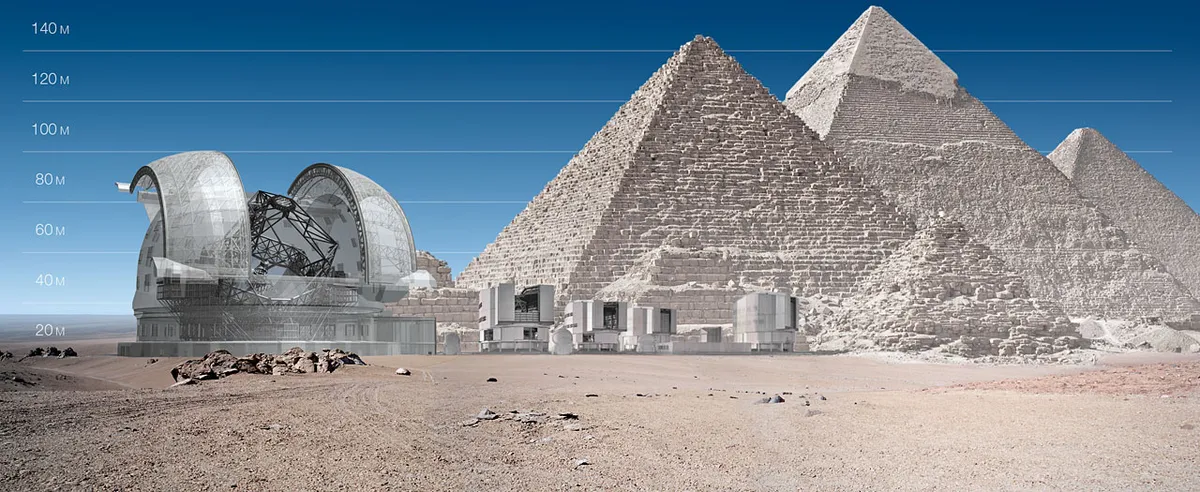
To argue that the Great Observatories of modernity are -in a sense- like the Great Egyptian Pyramids would be almost a scientific "heresy" that would quickly be labeled as "anti-science" or it would imply that behind this stance lies the desire to stop doing science and instead do religion.
Nothing could be further from the truth. The Great Observatories are, among other things, symbols of power, not of the Kings or Pharaohs of the first Egyptian dynasties anymore, but of the Modern Nation-States.
The inhabitants (and leaders) of such States will feel proud (and powerful) to possess great cutting-edge observatories, whose cost is astronomical, while the same inhabitants suffer from low wages, layoffs, health, transportation, and infrastructure problems necessary for living. But that is justified by corruption and, ultimately, that poverty has always existed or similar arguments.
Astronomy cannot be justified only because we like it. One might ask: why do we like, are we interested in, thinking about galaxies and clusters, but NOT in issues that do affect our daily lives?
Asking what is astronomy needed for? is not a "heresy". If we astronomy enthusiasts claim to have critical thinking—unlike astrologers—how can we maintain that this is true when we are not capable of thinking critically about science and society?
Sources and related links
- [1] The critique of science, Antonio Lafuente, Revista Profesiones No. 141, January-February 2013, pp. 48-49. The complete issue can be downloaded on Issu.
- [2] Center for Human and Social Sciences: Antonio Lafuente
- About.me: Antonio Lafuente
About the images
- The E-ELT and the VLT compared with the pyramids of Giza. Credit: ESO.