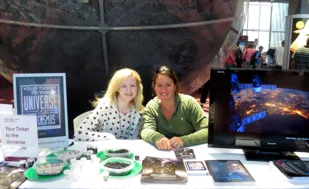
2015 has been declared the International Year of Light and Light-based Technologies (IYL2015) by the United Nations. Two women who are part of the Chandra X-ray Observatory Research Center tell us about the Light beyond the bulb project.
What follows is a translation done by me of a text published on the Chandra blog.
"There are many forms of light that make up the electromagnetic spectrum, from radio waves to gamma rays, but only one part that the human eye can naturally detect, known as optical or visible.
There are countless ways in which forms of light impact us in daily life. We can imagine sunlight coming through a window in the morning, but beyond that, light is also responsible for news broadcasts on the radio and the phone calls that just arrived on our cell phone. From the mundane to the majestic, light surrounds us. It can do wonderful things.
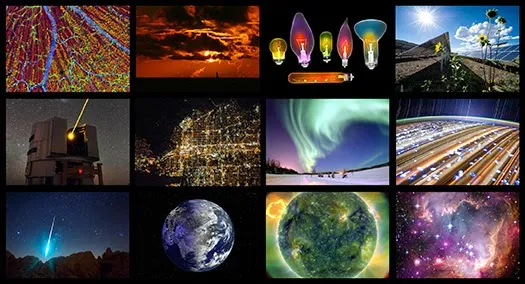
So we decided to develop a project with key partners so that everyone learns about light. We called the project Light: Beyond the bulb and its goal is to have an online collection of beautiful images to show the enormous spectrum of things that light does. It is only a sample, since it would be impossible to represent everything that light really does, but the collection provides some of the most amazing examples we could find: from brain images to bioluminescence, from lasers to light pollution, from auroras to astronomy.
The aim is to share these images and stories about light both through the internet and in physical sites."
The project Light: Beyond the bulb is on the internet and its image catalog, although small, is incredible.
Although radiation influences our daily life and its generation, distribution and consumption should be a matter of interest for everyone, in terms of citizen astronomy a notable topic is light pollution.
This problem appears with industrialization. Neither this nor any other problem will we solve by "going back to the past," that is, setting aside industry. Because, in fact, that is not the problem. The crux of the matter is what we use science and technology for, what kind of industrial development we want. If we want luminous signs to sell us advertising; if we want huge illuminated stadiums, without a roof, that is, if we want what is not necessary, really.
We will be told that all that creates jobs. Drug trafficking and weapons creation do too.
We study the rivers of Europe in school, but we don't know the constellations. And, in fact, unless we live in places far from large urban centers, we will only see a few stars.
Light pollution also has other consequences, both for people and for other living organisms.
As if that weren't enough, energy is not abundant and it costs a lot to generate it.
A good short documentary in this regard is Lights in the Night - The Loss of Darkness made by the International Dark Sky Association. There are other audiovisual productions that we have recommended previously and that we will return to throughout the year.
"The Year of Light" at IAFE
Dr. Diego Arbó
Institute of Astronomy and Space Physics (CONICET-UBA)
Wednesday, April 29, 2015, 18 h
Classroom of the IAFE Building - Ciudad Universitaria
The Session of the United Nations General Assembly proclaimed 2015 as the International Year of Light. Since the Renaissance the analysis of light has been fundamental for art and the sciences. Its nature has aroused great interest since antiquity and even today generates controversy. Wave or particle? Its interaction with matter played a fundamental role in the formulation of quantum physics and thanks to its study it has been possible to determine not only the constituents of stars and other planets, but also the very expansion of the universe.
The applications of a particular type of light called laser beam are very broad and for example allow us to measure the distance to the Moon with a precision of centimeters and photograph the movement of atoms on scales of trillionths of a second.
More info at IAFE.
Sources and related links
- IYL2015 Blog: Taking Light Beyond the Bulb
- Chandra Blog: Light: Going Beyond the Bulb
- Light: Beyond the bulb
- International Year of Light 2015 (IYL2015): http://www.light2015.org/Home.html
About the images
- Initial image: Credit: IYL/Light Beyond the Bulb
- Photograph from IYL2015 Blog