About a series of articles linking date of birth with people's health. What is scientific about such studies and what is astrological?
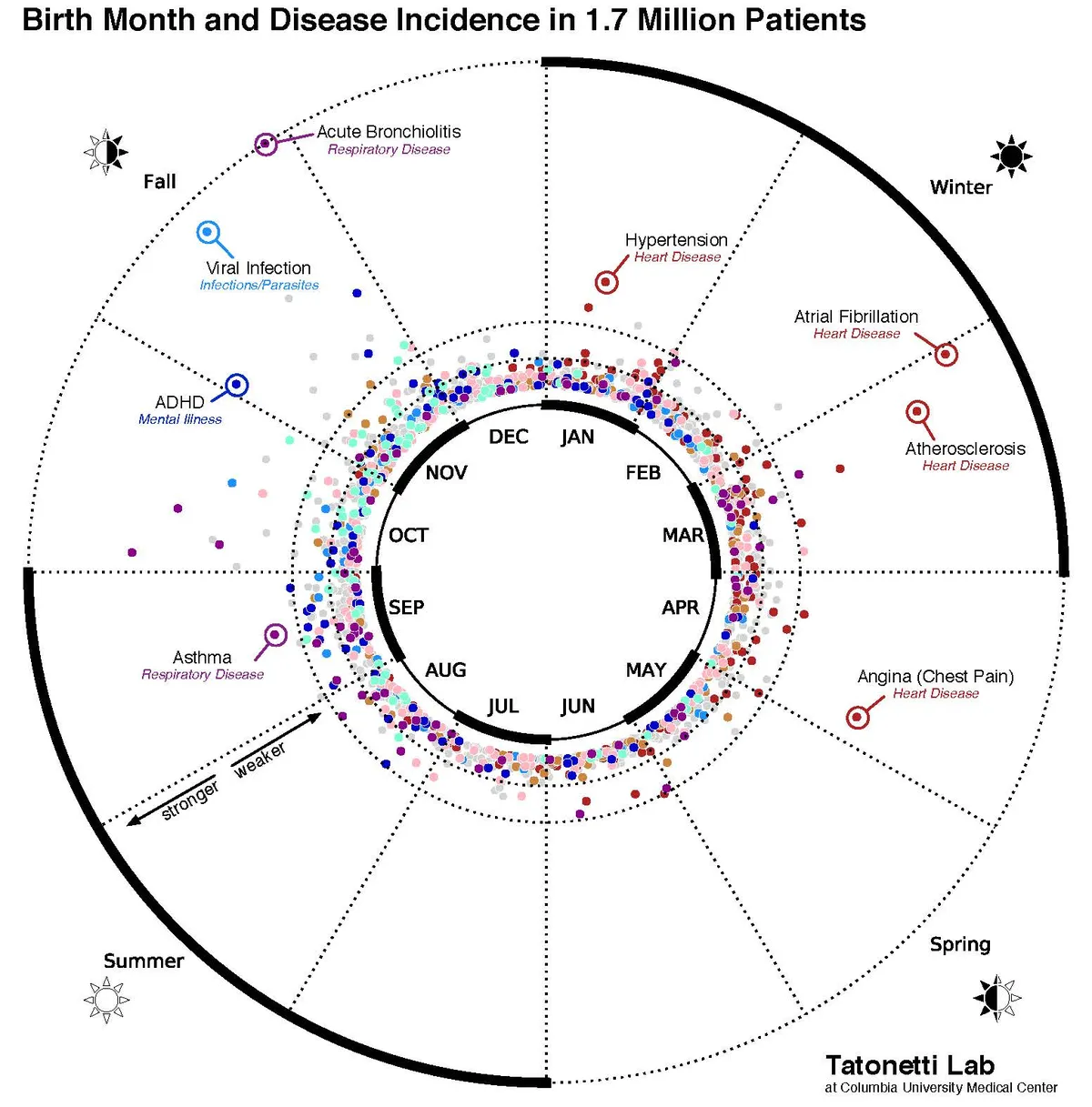
Recently the website Clarin.com published a note titled "What disease are we more prone to, according to birth month" [1]
The note reports on a scientific study conducted by "Scientists from Columbia University in New York".
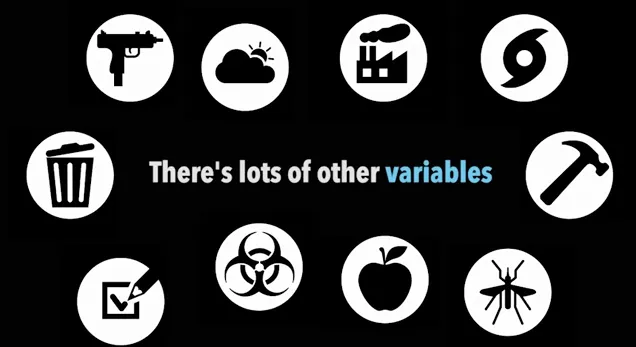
In the middle of the article it states: "It is important not to worry about these results," warned the study author, Dr. Nicolas Tattoneti. "Although we found significant associations, the risk linked to birth month is relatively minor compared to the influence of certain variables like diet and exercise," he added.
The note in question on the clarin.com site has no byline and does not clearly indicate in which specialized journal the scientific article (paper) was published. But since it does mention one of the study authors, it is easy to find out that such research was published in JAMIA (Journal of the American Medical Informatics Association) and that there is a web version published on 06-03-2015 with a Creative Commons license, meaning that -although in English- the content is fully accessible in that format.[2]
Furthermore we can find out that the research institute where the study was conducted issued a press release about it. [3]
Thus we learn that it is clearly a statistical study. Which in itself raises a series of issues to consider, namely:
1-A study of this type seeks and finds correlations, that is, the apparent relationship between two variables. This method is part of what is known as scientific thinking, but such thinking is a process, it does not begin and end with a statistical study. A correlation is not a causal relationship, which is ultimately what the sciences seek to establish. Let's show a classic example:
If we did not know the causes of rain and wanted to find them out, one possibility would be to go outside every time it rains. We would find that the temperature changed every time it rained. The same will happen with the other variables, except one: every time it rained there was a strong presence of clouds.
We have found a correlation. IN NO WAY is it possible to reverse the conclusion, that is, we could not state from this type of study that: Every time there are clouds, it rains. Because what we did was go out only when it rained, therefore the only possible conclusion is: every time it rains, there are clouds.
This correlation would suggest to us the possible connection between clouds and rain, but we still would not understand the CAUSE of the rain. It might allow us to make some predictions: if there are clouds, just in case, take an umbrella, but that DOES NOT MEAN that because there are clouds it will necessarily rain. That is not a valid conclusion from our study.
However, that work makes it possible to study the possible interconnection between those two variables to propose new observations. Thus, we could now do a new study, but instead of going out every time it rains, we will go out every day, rain or not. We will be surprised to find that perhaps one third of the year there are clouds, but it does NOT rain.
This second study makes something clear: clouds might have something to do with rain, but the mere presence of clouds does NOT cause rain. Therefore, if clouds have something to do with it, then there must be another simultaneous cause that together with the presence of clouds causes the rain.
This is so because there are effects that arise from a combination of variables. And as we already know how rain is generated, we know that is precisely the case. The presence of clouds, therefore, is NECESSARY for it to rain, but it is not SUFFICIENT.
A "scientific law" requires necessity and sufficiency.
2-Scientific research is a process that includes different related studies on a topic over time. Research is not a single study, but a series of studies. Sometimes these words are used interchangeably: research and scientific study, but it is advisable to establish this difference: a study is part of the scientific research process and a single study does not allow reaching solid conclusions.
3-Statistical studies can have scientific value in finding probable relationships between two or more variables, but they do not indicate the causes of such relationships, so they can never be considered "research," but as studies that are part of a larger process. Therefore, the conclusions of a statistical study are partial and provisional. For this reason they should not be exaggerated or taken as definitive or firm word.
4-Statistical studies can be "deceitful" even if there is no bad intention on the part of the researchers. Particularly when these studies become massive or popular through the media which exaggerate the results elevating them to the status of "evidence" considered as "irrefutable proof".
5-Statistical studies should be interpreted with caution. On this point it is worth noting a rich debate established in respective publications, namely:
In an article published in Investigación y Ciencia [4] the misuse that some scientists make of the p-value in statistical studies is raised. In this regard there was a response [5] which, if we read it carefully, is not a sum of counter-arguments to the previous note, but a reinforcement of it, insofar as the p-value is not a factor to consider "in itself" and in any case the problem then is not in the use or not of such value, but the way it is used. It is questionable that a research only takes into account such value and not other variables.
The p-value is used in statistics to evaluate how significant a result is. To be simple about it (since the interested reader can delve into the topic in the cited articles): Let's say there are people whose ring finger is longer than their index finger. What is the probability that they are unfaithful? "A priori", 50%. Either they are unfaithful or they are not. But if I find that in the sample 67% are unfaithful, is that significant?
If it is, it would imply that there is something more to investigate there. It does NOT mean that there is a causal relationship between the two variables.
In search of causes, models
Now then, if we reach the conclusion that there is a correlation between those who have a ring finger longer than the index finger and infidelity, what model could explain that, if true?
One model could be the following: It has been shown that in men the ratio between the length of the index finger (second finger, 2D) and the fourth (4D), the ring finger, is different from that in women. And it has been said that this would be due to prenatal testosterone levels. Perhaps then, among unfaithful people (regardless of sex) there is also a difference in the size of these fingers, if such infidelity is associated with levels of that hormone.[6]
However, does behavior -in this case related to mating- although somehow conditioned by hormonal issues, only be explained by such factors, or is behavior emergent from a series of factors?
Because if it were literally as proposed, then no SOCIAL incidence will change the PREDETERMINED fact that a person with high testosterone levels is unfaithful. With only a minimum of knowledge in social matters, it is possible to conclude that taking this hypothesis as literal, as an explanation for infidelity, is false. Human behavior cannot be explained exclusively by genetic, hormonal, natural, biological mechanisms.
Date of birth and "destiny"
For all the reasons stated, it is at the very least insufferable that studies like the one mentioned at the beginning are taken to conclude that astrology is true, as is directly and indirectly suggested in some media outlets[7].[8]
First, seasonality and zodiac signs are different things. According to astrology, a person is a Leo when born while the Sun passes through that supposed "sign" which is NOT the constellation of Leo, but is next to it (for reasons that astrologers explain very poorly or do not explain).
And this is true for people born in the Northern Hemisphere as well as those born in the Southern Hemisphere, and those born at the Equator, despite the fact that when it is summer in one Hemisphere, it is winter in the other.
If what influences a person's health is seasonality, then astrology is FALSE. If what influences it is the climatic condition (humidity, temperature, pressure) then for a person born on August 7 in the Northern Hemisphere (summer) the seasonal conditions are the opposite of those for a person born on the same date in the Southern Hemisphere (winter).
Second, even if there is a seasonality factor, it is certain that it cannot be the only factor, and perhaps it is not even remotely the most important.
Let's take another variable into consideration, the economic variable:
Two people are born in the northern hemisphere in spring. According to this study, there is a tendency given by seasonality for these people to suffer from angina.
In this regard, questions:
1-Do people born in other months not also suffer from angina? If so, then we cannot explain the appearance of angina exclusively by a seasonal factor given by the date of birth (as in the case of the first study assumed in the rain example)
2-If two people, one with a lot of money and another with very little money, born during the same season, are going to have the same (theoretical, abstract) predisposition, the tendency will become concrete by virtue of other variables that are NOT the date of birth. Having enough money to dress warmly, get vaccines, eat healthily and with sufficient and necessary nutrients, as well as the possibility of living under a roof or not, are variables that surely better explain the appearance of angina than the supposed natal predisposition.
3-If such predisposition is scientifically true due to environmental factors understood exclusively as seasonal, both people, with such information, could specifically prevent such a disease. That is valuable scientific knowledge, but which only becomes concrete for reasons that are NOT the date of birth.
4-It is good that we know in advance if it is going to rain, but to prevent getting wet, knowing is not enough, specific resources are needed. It is good for people living on the street to know if there will be rain, in advance, but the concrete possibility of not getting wet is less than that which we who live under a roof have. That is the concrete reality, which is not subject only to extra-human or natural phenomena, but is also subject to social relations.
5-When we try to explain what happens to us people (individuals and societies) by virtue exclusively of natural phenomena (environmental, genetic) and not of social relations, we return to the thinking of the 19th century.
The "destiny" of people and societies is in the hands of those people and societies. Of course, there is not much we can do about volcanoes, earthquakes, tsunamis, asteroids on a collision course with Earth, natural climate changes. It is also clear that at least in part, such climate changes are caused by the desperate race for economic gain by the captains (capitals) of Industry.
Explaining what happens in a society because of something "supra-human" is to understand nothing. It is as if all the scientific progress achieved by humanity in the last four centuries were worth nothing.
This is what we arrive at when we believe that scientific advances, in this case specifically computer science, can replace the added value of critical thinking. I point this out because those who carried out the cited research have done so by appealing to "big data" and "data mining", that is, using computer procedures to "dive" into databases in search of possible relationships between variables. It's not that the tool should not be used, the problem is assuming that the tool replaces research.
Scientific stigmatization?
In recent decades, the term stigmatization has been trivialized. Let's take, in any case, the concept of pre-judgment.
Let's do this experiment:
Let's take the data of the athletes who won the 100-meter dash races in recent years:
For example, let's take the list on Wikipedia about the Olympic medalists in that discipline [9]:
And let's see if there is any correlation, for example, ethnic (to simplify, are the majority black, white, Latino, Asian?)
Suppose we find that most are 'black.' What would that mean? Does it mean that black people have a different genetic predisposition than 'white' people?
Suppose among the bronze, silver, and gold medalists we find a 'significant amount' of Jamaicans. Does that mean that by being born in Jamaica people possess an innate tendency to run fast?
Let's do another thought experiment. Let's take traffic accident statistics and see if there is any regularity, for example by sex. If we find that 76% of accidents are caused by women, does such a CORRELATION imply that women have less ability than men to drive cars? Or could such statistics be explained in another way, which is neither genetic nor seasonal?
What I try to show with these assumptions is that exploring reality in a superficial, that is, apparent, way often leads us to create prejudices. And such preconceptions, when they settle in social semiosis, produce harmful consequences for the subjects involved in those collectives.
If from the study in question (the birth date-disease correlation) we conclude that those born in spring are susceptible to having tonsillitis and therefore we discriminate against them (for example for a job position), would we not be fostering the stigmatization of those people? And do those preconceptions not suppose that we conceive human life as PREDETERMINED by NON-Human reasons?
I quote Alan Woods and Ted Grant in Reason and Revolution (1995)[10]:
Scientists and other intellectuals are not immune to the general trends of society. The fact that most of them declare themselves indifferent to politics and philosophy only means that they fall prey more easily to the common prejudices that surround them. All too often their ideas can be used to support the most reactionary political stances. This is made patently clear in the field of genetics, where a genuine counter-revolution has taken place, especially in the U.S. Through supposed scientific theories, attempts are made to 'prove' that the cause of criminality lies not in social conditions, but in a 'criminal gene.' It is claimed that the disadvantages suffered by blacks are due not to discrimination, but to their genetic makeup. Similar arguments are used for the poor, single mothers, women, homosexuals, etc.
Scientific knowledge has social consequences. And, of course, also the improper communication of such statistical studies not properly explained in mass media with high influence on the general population. Communication is not harmless.
Sources and related links
- [1] What disease are we more prone to, according to birth month; Clarin.com, 06-10-2015, unsigned on web.
- [2] Birth Month Affects Lifetime Disease Risk: A Phenome-Wide Method
Mary Regina Boland, Zachary Shahn, David Madigan, George Hripcsak, Nicholas P. Tatonetti
Journal of the American Medical Informatics Association Jun 2015, DOI : 10.1093/jamia/ocv046 - [3] Data Scientists Find Connections Between Birth Month and Health; Columbia University Medical Center (CUMC); 06-08-2015
- [4] Nuzzo, Regina; The slippery value of p; Investigación y Ciencia, December 2014, No. 459 (on web, partial text)
- [5] José Antonio López Cerezo; The academic world against p; about the article What is the p-value accused of? By Ana Muñoz van den Eynde, on Scilogs
- [6] Clarin.com: Faithful or unfaithful? You have to look at their hand
- [6b]: Stay or stray? Evidence for alternative mating strategy phenotypes in both men and women; Rafael Wlodarski, John Manning, R. I. M. Dunbar
DOI : 10.1098/rsbl.2014.0977 - [6c] What is that about the 2D:4D index?, on Puerta a mi mente.
- [7] Horoscope health risk: Study says month of BIRTH affects which illnesses you will suffer; NICK GUTTERIDGE; 06-10-2015, Express.co.uk.
- [8a] Pijamasur.com; Finally science accepts correspondence between birth month and a person's health; 06-10-2015
- [8b] Pijamasurf.com: Your zodiac sign is linked to your health (Study); 11/20/2013.
- [9] Wikipedia Appendix: Olympic medalists in athletics (men's 100 meters)
- [10] A.Woods and T.Grant: Reason and Revolution (1995, p. 38): read from Scribd
About the images
- Initial image credit: Dr. Nick Tatonetti/Columbia University Medical Center CUMC Newsroom
- Screenshot of the YouTube video of the CUMC press release.