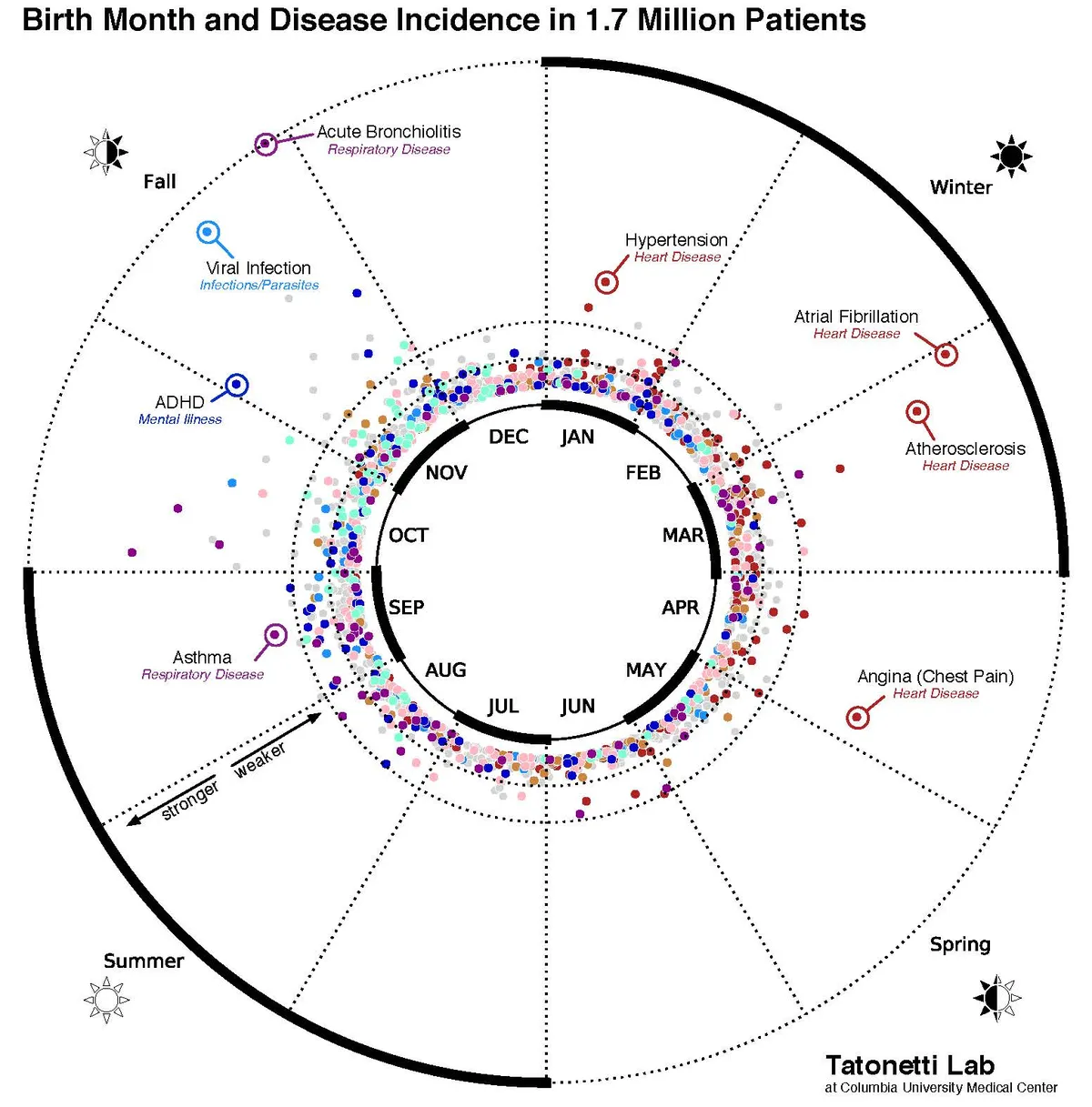
Not only do prejudices exist about race, sex, politics and religion, but we also differentiate ourselves with falsehoods of supposed cosmic origin. And those who do so through speeches in some cases, paradoxically, are against prejudices.
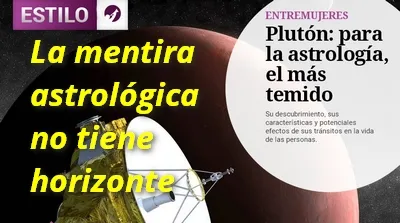
Clara Gualano writes in Entremujeres.com, a Clarín site [1], a note about the astrological influence of Pluto on people. Such supposed influence had not been noticed by the aforementioned astrologers until the discovery of the now dwarf planet in 1930 - despite astrology having millennia. Of course, such a discovery was made by scientists, not by astrologers who do not do science.
Astrologers lie. Whether they are convinced, but mistaken, whether knowingly they want to profit from the ignorance of others, whether for both reasons.
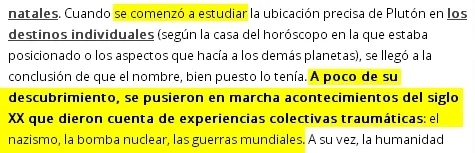
Clara Gualano fights against prejudices. In a blog titled Astrólogos Argentinos Tendiendo Puentes (something like astrologers nac&pop) [2] Clara says she is a Licenciada en Letras from the UBA and a collaborator in the Suplemento Soy of Página/12.
In that supplement published on Fridays, Clara wrote a note with the title Maternidades para armar [3] in which she points out:
Although the Law of Human Assisted Fertilization has improved the situation of many co-maternal families, its enactment has not been enough to face a bureaucratic system that takes advantage of certain legal loopholes to hinder access to rights. What are the prepaid health plans that refuse to cover the techniques based on? What to do in the face of others' prejudices and one's own fears regarding the place of the non-gestating mother? (The bold is mine)
Faced with bureaucratic barriers, Clara wants to do something. Such barriers are generated, among other reasons, by prejudices. And in the face of such pre-judgments Clara fights. Something must be done. Therefore, she does not accept her destiny pre-written by the "planets" in the sky at the moment of her birth.
Prejudices in daily life
Forming false ideas is not a matter of a few minority fools. It's a matter of almost everyone in daily life.
I see a person coming who seems to me to be a man. He has painted lips and is wearing a skirt. I think: "He is gay". It is a prejudice. Why?
1-Perhaps he is not homosexual, but it is possible that he is a man coming from or going to a costume ball. Not every man with painted lips and skirts is gay.
2-Not every gay man wears skirts and paints his lips.
3-The use of makeup (and its non-use) are aesthetic marks. A univocal relationship cannot be established between aesthetic marks and sexual tendencies. There are no reasons to do so.
4-If it were true that that man is gay (that is, if the reasoning had a "true" conclusion), it would equally be an invalid reasoning because one cannot logically arrive at such a conclusion from such premises.
5-If it were true that such a person is homosexual, so what? About his abilities I cannot say anything. What that person does in his personal and intimate life does not have to matter to me and, I reiterate, it has no bearing on his abilities, talents and personality.
As long as I form the first idea and it remains as an idea (that is, not carried into action, not operative) I cannot say there is discrimination, at least not effective.
If in addition to forming the first idea I am also capable of forming the remaining ones, even less.
We form ideas like the first one many times. Even scientists. It's human, it's social. The "bad" thing is not in forming those first ideas, but in sticking with them. That is why the RAE defines prejudice as:
1. m. Action and effect of prejudging.
2. m. Previous and tenacious opinion, usually unfavorable, about something that is poorly known. [4]
But Clara not only sticks with those ideas, but she spreads them. She fosters prejudices and discrimination, even though she later says she is against gender discrimination.
Poor Clara. She has everything but clarity.
On io9 there is an article in English by George Dvorsky about why astrology is not harmless [5]. There is a translation of the article on the blog Pedazos de carbono. [6]
I extract some paragraphs from the translation:
As sociologist Julia Hemphill from the University of York comments, there is an explanation for this phenomenon: women are a specific target of popular media. "Astrology is a non-experimental epistemology that is sold to women as a way to understand the world and themselves," comments Hemphill, "you just have to open a women's magazine and you will inevitably find at least two pages dedicated to astrology."
Indeed, there is a gender bias regarding astrological discourses in modernity, at the level of mass communication. [7]
Another quote from the same translation:
More conceptually, belief in astrology implies believing in cosmological predetermination; it is a form of determinism—but completely false. In the original Cosmos series, Carl Sagan argues that astrology continues to survive and thrive because
"it seems to give meaning to the routine of our daily lives. It pretends to satisfy our desire to feel personally connected to the universe. Astrology suggests a dangerous fatalism. If our lives are controlled by celestial traffic lights, why try to change anything?"
Astrology is a form of predeterminism like that also held by religions. In both cases, paradoxically, while it is indicated that for non-human reasons we are predestined, it is also affirmed that we have a certain degree of freedom.
Another quote:
As Benjamin Radford noted for Discovery News, astrology has similarities with racism:
"Both racial and astrological stereotypes are based on a framework of beliefs that basically says: 'Without even knowing you, I believe something about you. I can expect such a type of behavior or characteristic from all members of a certain group of people (Jews, African Americans, Aries, Pisces, etc.)' When an astrologer knows a person's zodiac sign, a list of assumptions (prejudices) about that person's way of being will inevitably come to mind. In both cases (astrology and racism), prejudices will cause people to seek to confirm their expectations."
The racism that was part of Nazism included pseudoscientific considerations and forged another form of biological predeterminism.
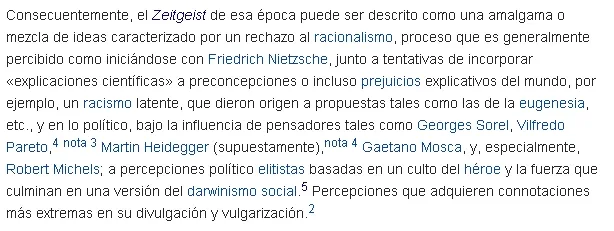
Forer effect
The original article and the translation refer to the Forer effect:
This brings up an excellent point: people who follow astrology are often victims of a selective perception effect, where they only see what they expect to see, and discard what does not match expectations.
What is the Forer effect?
The Forer or Barnum effect is also known as the subjective validation effect or the personal validation effect.
Psychologist B. R. Forer found that people tend to accept vague and general personal descriptions as exceptionally applicable to themselves without realizing that the same description could be applied to anyone. Consider the following as if it were presented to you as an evaluation of your personality.
Forer gave a personality test to his students, ignored their answers, and gave each student the above evaluation. He asked them to rate it from 0 to 5, with “5” meaning the recipient felt the evaluation was an “excellent” assessment and “4” meaning the assessment was good. The class's average rating was 4.26. This happened in 1948. The test has been repeated hundreds of times with psychology students and the average is still around 4.2.
Its accuracy amazed his subjects, although his personality analyses were taken from an astrology column in a newspaper stand without regard to their sun signs. The Forer effect seems to explain, at least in part, why so many people think pseudosciences “work.” [8]
The struggles of the debates
Never, in any way, will I advocate from here for banning speeches like Clara's. They are not fought with censorship, but with arguments, with debates. Not with silence, but with dialogues that of course possess a strong tension, the tension of the search for truths. Communication is not harmless and there are messages that are harmful, but they are not fought by banning them, as Stalinists and some current politicians think. [9]
The astrological discourse already comes from the ancien régime, it is therefore a conservative discourse, typical of monarchist ideology, of the nobility as the ruling class. Then came another ruling class, the bourgeoisie, which also uses these reactionary discourses, now turned "progressive" in post-modernity because this type of discourse encourages leaving things as they are, after all, they are already pre-determined by superior forces. Yesterday's revolutionaries are today's reactionaries.
These types of predeterminist discourses, whether they have an astrological or magical root, or possess pseudoscientific, biological elements, will not end if nothing is done. Silence allows these discourses to continue circulating. And they are not harmless discourses. To fight the battle, commitment and the best elaboration of arguments are needed.
Astrology and discrimination
A core issue regarding astrology is discrimination. In general, discrimination is defined as those actions, real or imaginary, by which an individual or group is marginalized and treated as inferior, preventing or limiting their rights.
It is difficult to say that astrological discourse, in general, occurs in this discriminatory form, although there are documents indicating that some human resources managers draw up astrological profiles to hire a person for a position, a circumstance that perhaps is not general, but if it actually occurs, such use could indeed be considered discriminatory.
However, beyond effective, operational discrimination that occurs in reality, astrological discourse tends to form opinions that are false, to construct false ideas, although not based on the "superiority" of one group over another, considering here groups as people born under a certain sun sign.
Nevertheless, if it is said that: Aries people "Sometimes they are very impatient. Their impulsive character can bring them some enemies", as noted in an article from Entremujeres.com [10], it is logical to think that, as a consequence of such discourse, negative (or positive) but false ideas about people are formed based only on a myth. There are no objective, scientific reasons, neither studied nor under study, that allow reaching such conclusions.
The Ruling on Discriminatory Acts [11] does not foresee anything in this regard. Luckily. Because, I insist, prejudices are not fought with prohibitions, but with education and debate, with knowledge and not with impositions. If astrological discourse were banned, I would be against it. Ultimately, they may ban speaking, but not thinking. And what must be changed are not only the discourses, but their origin, the ideas. And they are not changed with genetic manipulation, but with arguments.
A weighty argument against astrology is that its discourse discriminates. According to the DRAE, to discriminate is: To give inferior treatment to a person or collectivity for racial, religious, political, etc. reasons.
In my view, it is necessary to argue that astrology, although apparently it does not generate or foster inferior or superior treatment among the collectives associated with the signs, does foster ideas of differences that are not objective, but mythical. Inferiority and superiority are indirect in astrological discourse. I will try to show this with examples.
1-Need for truthfulness-verification-objective evidence
If a website or newspaper published that a boy with some type of "different ability" was a flag bearer at his school and that information were false, we could not say it would be a discriminatory discourse, according to the previous definition, because no one would be treated as "inferior." But we would be against such discourse for the simple reason that it is false. Is it possible to know what is true and what is not?
2-Indirect discrimination
When it is said that Black people run fast, because they are Black (that is, due to a supposedly innate or genetic issue) they would not be being discriminated against (since there would be no treatment of inferiority there), but it would be considering that that collective has an innate characteristic that is not such, it is a prejudice, unless proven otherwise.
Indirectly, it would be saying that Black people are part of a race, that the members of that collective run fast and that those of other collectives do not. This is so because if Black people ran as fast as any other collective, the initial statement would make no sense.
If I said that homosexuals are very intelligent (not more intelligent than heterosexuals) it would not be discriminatory since I would not be treating a collective as supposedly "inferior" to another, directly, although indirectly I would be.
Similarly, if we say that Aries people are impulsive it is because others are not, since it makes no sense to say a tautology like "Aries people are as impulsive as everyone else," in which case astrology would make no sense. In fact, it doesn't.
Indirectly and potentially, astrology is discriminatory. Of course, someone writing X, X being a discourse in favor of or against a collective, does not mean that every receiver of such discourse will operate in the same way. But we could say that such receivers would be given a (false) argument to act in a discriminatory manner.
This is a key point to address regarding pseudosciences. It is so unimportant to know a person's date of birth and therefore their supposed zodiac sign to form ideas about those people that it should not be part of any discourse. But since they are present in mass discourse, it is logical that they have consequences. In some cases it will be a harmless discourse, since we will not give it importance. In others, clearly, due to the principle of authority (linked to astrologers who are supposedly experts in who knows what) and other reasons, people do believe such discourses. If no one believed them, those discourses would not exist. We don't run into discourses about the Earth being flat every day.
So a pending issue is knowing how to elaborate this argument, linked to the non-harmlessness of astrology. And it is necessary because many people think that way. Commitment to the truth is needed -which astronomers generally do not show on these topics- and to elaborate discourses about it. There are many Claras. What's missing is balls.
Sources and related links
- [1] Entremujeres.com: Pluto: for astrology the most feared, by Clara Guadano, 07-21-2015
http://entremujeres.clarin.com/astrologia/Pluton-planetas-astrologia-significado-carta_natal-new_horizons-Escorpio_0_1394860797.html - [2] Argentine Astrologers Building Bridges
http://astrologosargentinos.blogspot.com.ar/2013/09/quienes-somos-y-que-proponemos.html - [3] Página/12: Maternities to Assemble, by Clara Guadano, 06-05-2015
http://www.pagina12.com.ar/diario/suplementos/soy/1-4027-2015-06-05.html - [4] RAE: Prejudice
http://buscon.rae.es/drae/srv/search?val=prejuicio - [5] io9.com: Why Believing In Astrology Is Not As Harmless As You Think, George Dvorsky, 06-25-2014
http://io9.com/why-believing-in-astrology-is-not-as-harmless-as-you-th-1595802206 - [6] Pedazos de carbono blog: Astrology is not as harmless as believed
http://pedazosdecarbono.blogspot.com.ar/2015/04/la-astrologia-no-es-tan-inofensiva-como.html - [7] The horoscope in "women's magazines"
https://sites.google.com/site/gerarblanco/ensayos/revisfem - [8] Forer Effect
http://spanish.skepdic.com/forer.html - [9]Perfil: The ruling party pushes a project to censor comments on the Internet
http://www.perfil.com/politica/El-oficialismo-impulsa-un-proyecto-para-censurar-comentarios-en-Internet-20150719-0095.html - [10] Entremujeres.com: The "dark side" of your sign
http://entremujeres.clarin.com/astrologia/astrologia-horoscopo-zodiaco-signos-personalidad-lado-oscuro-nadir-otermin-hamed-aries-tauro-geminis-cancer-leo-virgo-libra-escorpio-sagitario-capricornio-acuario-piscis_0_1351065434.html - [11] Ruling on Discriminatory Acts
https://es.scribd.com/doc/272166895/Dictamen-Actos-Discriminatorios
About the images
- Screenshots from Entremujeres.com and Wikipedia.