Are there attempts to turn science into a religion? Is it true that everything is connected to everything? Or is it that nothing is connected to anything? Or is it something else? What is symploké?

A few days ago I had an interesting conversation with a person with whom I agreed on many aspects of thought. At one point, that person said something like: "Fortunately, those of us with dialectical thinking consider totality, completeness. We know that everything is connected to everything."
I will not refer here to what is called "dialectics", since although I consider it very interesting and necessary, it is an extensive topic. But I will say that it is true that I consider myself to have that type of thinking, that is, dialectical. And I also quickly affirm: I do NOT agree that "Everything is connected to everything" nor do I consider that dialectics has to do with that, expressed that way.
It is because of that conversation that I will say the following: there are three possibilities:
1-Everything is connected to everything
2-Nothing is connected to anything
3-Some things are related to some others
These three statements cannot all be false, nor all true.
In modern scientific discourse and, particularly, in contemporary discourse (sometimes considered late modern or late modernity) the first statement is upheld. I will consider this statement as the "Theory of completeness or totality". I will try to explain what such a phrase could mean.
Regarding the second, the issue is more difficult, but I will make an attempt anyway.
Then I will uphold my point of view, which is the third one, and I will do so by appealing to a discourse written centuries before the Christian myth.
A-THEORY OF COMPLETENESS OR THEORY OF TOTALITY
We will find contemporary discourses linked to science, from which it is upheld that "Everything is connected to everything". Paradoxically, the same is upheld from so-called "Magical thinking".
A1-"Scientific" theory of totality
This type of discourse has a clear, forceful, and widely circulated example in Carl Sagan, first, and then -strongly- in Neil deGrasse Tyson.
There are many videos and articles in which Neil -who is an astronomer- upholds that everything is connected to everything, in different ways: We are made of stardust, our bodies, as well as everything else, are composed of elements that were forged in stars (stellar nucleosynthesis).
In the new Cosmos series, this is upheld on several occasions. It is a form of naive materialist philosophy. That is, in the underlying ontology, it is upheld that everything that exists are particles and that such particles compose everything else.
It is a philosophy that seems opposed to the idealism that dominated human thought for millennia. But if we think about it, this materialism remains idealistic. Idealism upholds that there are perfect, immutable, and therefore indivisible ideas or spirits. What can be divided would not be perfect, and therefore, immutable.
What physics seeks is that: essential particles that cannot be divided and constitute everything. And although the last word has not been said on whether reality is like that or not, the evidence so far leads one to think that way. Therefore, astronomers like Tyson uphold that everything that exists are elementary particles that, when combined, form everything else.
And since these particles are part of the microcosm (human life) as well as the macrocosm (the universe), then the conclusion is reached that everything is connected to everything.
Neil deGrasse Tyson is not unaware that this type of discourse is akin to "new age", as he has stated on several occasions.
https://youtu.be/HAGcwHRYzsI
A2-Theory of totality in magical thinking
Whether in astrology or other forms of divination, in various philosophical currents and of course in religions, we will find that the same phrase is also upheld, in a different way.
It is considered that there exists a superior Being, immutable, perfect, creator of everything that exists and who coordinates everything that happens. Therefore, there is a "destiny" and everything that happens in the world is not a coincidence, but the result of a perfectly devised divine plan.
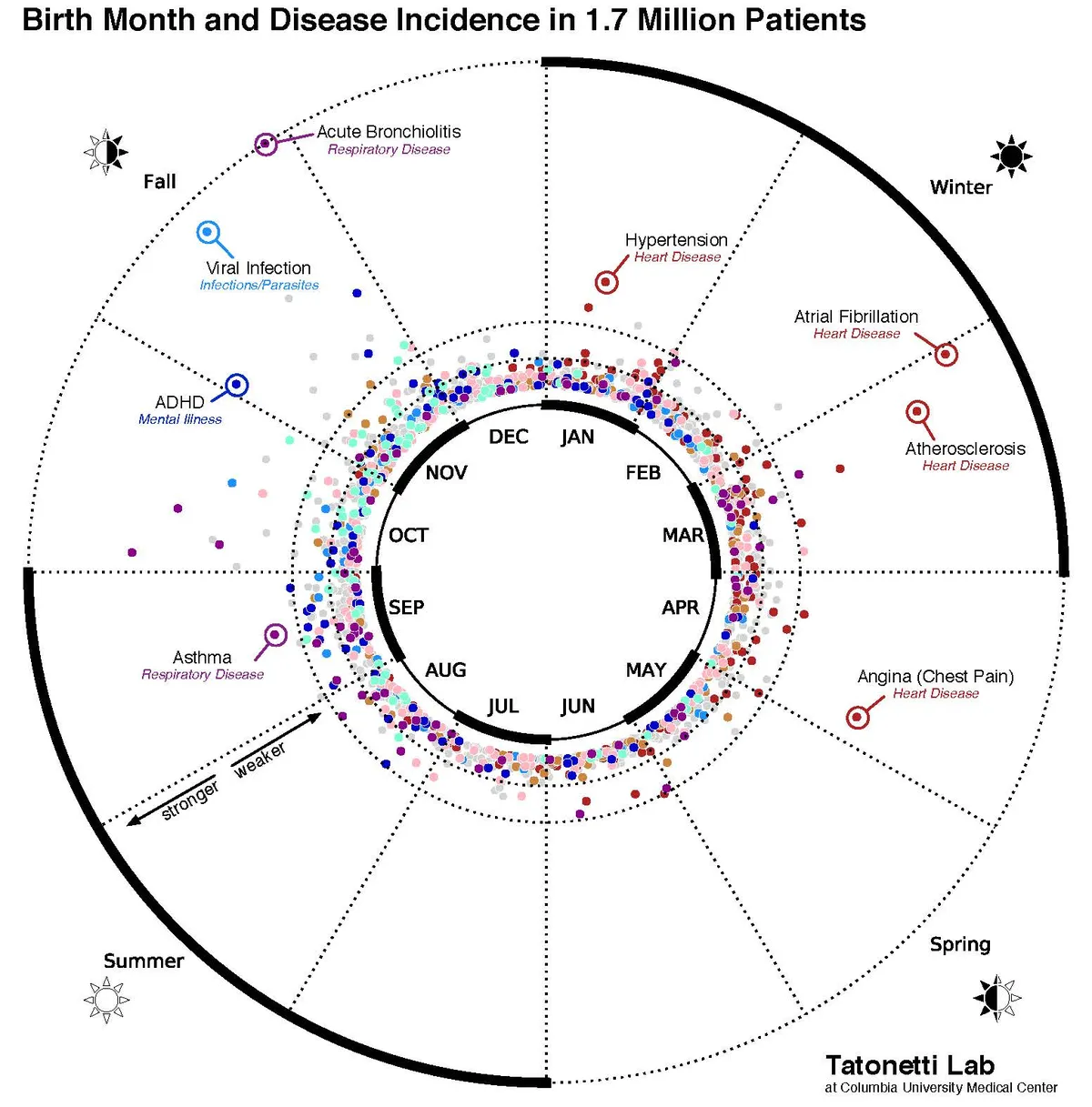
Thus, everything is related to everything. For astrology, for example, there would be a relationship between a person being introverted and the apparent position of the sun, moon, and planets in the sky at the moment that person was born.
Others will uphold that what happens in the world is related to: the lines on our hands, the date (numerology), the alignment of objects with magnetic poles, etc.
In this sense, if we took the phrase "literally", the following occurs:
Let's say that in the world there existed the elements (be they objects or subjects): A, B, C, D, E, F.
A: Juan; B: María; C: Tile; D: Dove; E: Volcano; F: Traffic light
Juan hits María. The tile is loose. A dove flies through the sky. A volcano erupts. A traffic light changes from yellow to green.
If it were true that everything is connected to everything, then all these elements would necessarily be related. Let's say these processes occurred "at the same moment", then there would be a relationship between Juan hitting María and the fact that the tile is loose, as well as the dove flying, the volcano erupting, and the traffic light changing color.
Everything would be related. It would not be a coincidence.
Now, what happens in the world is not five things or processes, but a very large number, not to say, infinite.
As if that weren't enough, these relationships would not be linked only by a synchronous temporal issue, since what happened before is also related to what happens now and what will happen in the future.
Therefore, we thus arrive at a thought of reality by which everything that happens is predetermined, everything, everything, everything that happens in the world should be understood as the successive fall of dominoes.
If this were so, then science is not needed. And not only would it not be needed, since everything would supposedly be explained beforehand, but it would also be impossible to do science or say anything about the world. This theory leads exclusively and necessarily to absolute ignorance.
B-THEORY OF DISCONNECTION
It is difficult to find anyone holding the opposite position, that is, that among the "things of the world" there is no relationship whatsoever. However, let's return to the aforementioned scientific stance, and we will see that EVERYTHING is attempted to be explained by the existence of particles, discarding everything else. It is a reductionism that comes quite close to saying that nothing has to do with anything. In reality, it is postulated that EVERYTHING has to do with particles that organisms exchange, aside from anything else.
Let's look at a simple example where this stance enters into crisis:
Juan hits María on Monday. The next day, Juan hits María. On Wednesday, the same, as well as on Thursday.
On Friday, Juan talks with the parish priest Jorge and realizes it is wrong to hit María. He stops doing it.
If we try to explain that Juan hits María due to certain particles, say, because Juan has an "evil gene," then, how do we explain what happens on Friday? Do evil genes vanish after talking with a priest, is it a sort of exorcism? Did Juan's "particles" change after talking with Jorge?
Neil deGrasse Tyson and many other contemporary scientists want us to believe that everything is explained by particles. And, in part, they are right. But such reductionism leaves out of the analysis the most important thing.
Let's see:
Pablo says:
You play every day with the light of the universe.
Subtle visitor, you arrive in the flower and in the water.
You are more than this white little head I squeeze like a cluster between my hands each day.
Let's do a Tyson-style analysis, considering the previous discourse is oral:
Pablo used air from his lungs to make his vocal cords vibrate, which, by adjusting the space of the glottis, produces a sound that is nothing other than the propagation of elastic waves through the air. These sound waves are longitudinal and as they propagate they generate a variation in air pressure. These variations produce the displacement of the molecules that form the medium. Each molecule transmits the vibration to the others nearby, moving in a chain...
It is a physical analysis. But what Pablo said, what does it mean? It is poetry by Pablo Neruda. It cannot be understood under the laws of physics, chemistry, and biology. It has nothing to do with protons or molecules. Certainly, to speak or to write, we use particles. That poetry is made of particles, yes. But if that is all we consider, then there would be no poetry, only sound waves transmitted through the air. To understand what the words mean we cannot make use of Kepler's Laws or Newton's.
Poetry is "something more" than particles. Which does not suppose any spirit or absolute, perfect, or immutable idea.
So, while stance A1 does not say that nothing has to do with anything, but the opposite, in reality it approaches the former because it excludes from all explanation the non-physical (we could call it the "social").
And "the social" is also susceptible to being considered through sciences: linguistics, semiotics, etc.
I add: Then Pablo says:
I will fight in every street, behind every stone.
Your love also helps me:
it is a closed flower that each time fills me with its aroma and that suddenly opens within me like a great star.
For an analysis of this discourse, grammar and semiotics are also not enough. To whom is Pablo writing? To Matilde or to Delia? Why is he going to fight? Was something happening in the world?
An analysis of that work requires relating the author's life, the world situation, history. If, instead, we reduce it to "particles," it is like saying that everything else has nothing to do with it. Nothing has to do with anything (except for the particles).
C-THE SYNTHESIS: SYMPLOKÉ
I said there were three possibilities. I discarded the first two, the last one remains. Some things are related in the world, in reality.
Thus, not only is science needed to discover such relationships, but such knowledge is possible.
When from a supposed dialectic one attempts to point out the same as in A, then one falls into vulgarity and idealism. It happens that this stance usually arises as opposed to those who deny the relationships between the things of the world (as in biological predeterminism), but one ends up falling into another magical predeterminism.
All this has already been said. We will find it in The Sophist or On Being, by Plato.
Excerpt from the work, from 251d, in the Gredos edition (page 428 of Volume 5 of Diálogos):
The Stranger dialogues with Theaetetus.
STR. - Shall we then cease to relate being to change and to rest, and every thing to every other, as if they existed unmixed and mutual interchange were impossible, and shall we consider them thus in our reasonings? Or shall we gather all things into one, as if it were possible for them to communicate reciprocally? Or shall we relate some yes, and others no? Which of these possibilities would we say they choose, Theaetetus?
THEAET. - I can answer nothing for them.
STR. - Why not examine the consequences of each question, to respond to each of them?
THEAET. - Well said.
----
That is, the Stranger raises whether everything is related or nothing is related or whether some things are related. And they will examine it.
----
STR. - Suppose, for example, that they say, first of all, that nothing has the power to communicate with anything. Change and rest, then, will they, in some way, partake of being?
THEAET. - No, certainly not.
STR. - And what? Could either of the two exist, if it does not communicate with being?
THEAET. - It will not exist.
STR. - This admission, it seems, quickly brings ruin to all, both to those who maintain that everything changes, and to the partisans of unalterable unity, and to those who affirm that being resides in forms that remain always identical and immutable. For all these put being into communication, both those who say that it really changes, and those who maintain that it really is at rest.
THEAET. - Completely.
STR. - And, if there is no kind of mixture, nothing could be said by those who maintain that everything is united, nor by those who divide everything, whether they bring infinite things towards the one, or make them come out of the one, whether they divide into determinate elements, both if they maintain that this occurs alternately, and if they say that this occurs always.
THEAET. - Correct.
---
That is: if nothing has to do with anything, then change and rest have nothing to do with being. But if they have nothing to do with being, then they do not exist. Therefore, they must have something to do with being. Otherwise one cannot affirm that everything changes and also not that everything is at rest. If nothing has to do with anything, those who affirm the first (that everything changes) and those who affirm the second (that everything is at rest) are left in ruins.
Now they will evaluate the other option: that everything has to do with everything.
---
(...) 252d
STR. - But, what will happen if we allow everything to have the power of intercommunication?
THEAET. - Even I am capable of solving that.
STR. - How?
THEAET. Change itself would be completely at rest, and rest itself, in turn, would change, if they could be added to each other reciprocally.
STR. - But is it not totally and absolutely impossible for change to be at rest, and for rest to change?
THEAET. - How could it not be?
STR. - Only the third possibility remains, then.
THEAET. - Yes.
STR. - For it is necessary, one of these things: that everything can mix, that nothing can, or that some things can and others cannot.
THEAET. - And how could it not be?
STR. - And it was discovered that the first two possibilities were impossible.
THEAET. - Yes.
STR. - Then, everyone who wishes to answer correctly will hold the remaining one of the three.
THEAET. - Exactly.
---
As will be seen, it is very similar to what was expressed before, in my way. But immediately after, they use grammar and music, to account for the fact that to determine which things relate to others requires knowledge:
----
STR. - As some things consent to do it and others do not, the same will occur here as with letters; for also some of these harmonize with others, while others are discordant.
THEAET. - How could it not?
STR. - The vowels, unlike the others, are a bond that extends through all, in such a way that without one of them it is impossible for the others to combine with each other.
THEAET. - Indeed.
STR. - And does everyone know which are capable of communicating with the others, or whoever wishes to proceed efficiently will need a technique?
THEAET. - He will need a technique.
STR. - Which one?
THEAET. - Grammar.
STR. - And what? Does not the same occur in the case of sounds, with the high-pitched and the low-pitched? He is a musician who possesses the technique that allows him to know which combine and which do not, and he is not a musician who does not know it.
THEAET. - So it is.
STR. - And we will find something similar in the case of the other techniques, as well as in the absence of techniques.
----------
But not only that technical knowledge is needed, but also...
---
STR. - To divide by kinds and not to consider that a same Form is different, nor that a different one is the same. Do we not say that this corresponds to dialectical science?
THEAET. - Yes, we do say so.
STR. - He who is capable of doing this: to distinguish [A] a single Form that extends completely through many, which are, each of them, separate; and [B] many, distinct from each other, surrounded from outside by a single one; and [C] a single one, but now constituted as a unity from several sets; and [D] many differentiated, completely separate; he who is capable of this, I repeat, knows how to distinguish regarding the kinds, how some are capable of communicating with others, and how they are not.
THEAET. - Completely.
STR. - But, I believe, you will not grant the technique of dialectic except to him who philosophizes purely and justly.
THEAET. - How could anyone grant it to another?
---
There are those who will say that it is true that everything has to do with everything because of another phrase by Sagan: To make an apple pie, you first need a universe.
True, but to explain why one apple pie turned out well and another turned out badly, you do not need to understand galactic structures. You do need to understand other things.
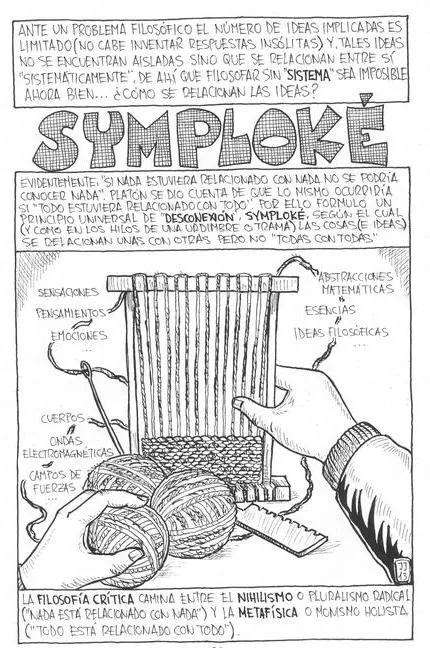
Nowadays we will find that the Spanish philosopher Gustavo Bueno has taken the term Symploké from this text by Plato to account for an imbricated reality, a warp, a plot.
In my view, this perspective allows for a philosophy in contact with reality, not abstract, but which at the same time has a broader and more "totalizing" vision than that which arises from the modern positive sciences, since in each discipline reality is split, studied in parts, as if they were disconnected. Reality is a warp in change and transformation. But let this not confuse us with the magical ones nor envelop us in a sort of scientific "spirituality" like the one deGrasse Tyson seeks.
What unites us, what interconnects us, is also what separates us: it is not a supernatural force, nor is it elementary particles, but the history of social organizations. The ways in which we relate socially. That is what we have in common and it is also what differentiates us.
Neil deGrasse Tyson finds a "spiritual" delight in the fact that everything is made of particles, be it stars, black holes, hares, rocks, or human beings. It is the delight of finding a union. He seems to forget, to set aside, to split from reality, not to see it because he doesn't like it, that in the real world there are wars, billions of people hungry, a few super-duper hyper-millionaires who, however, are generous and use a tiny part of their money to create astronomical observatories. How to explain that through the proton-proton process?
Neil cannot, nor does he want to. He wants to see the beautiful side of the world, the marvelous. He looks with one eye, as we often do when looking through a telescope.
But reality is not far away and long ago. Society is not observed with telescopes. Unless we are very, very nearsighted. Almost as much as astrologers. Or blind, like those who never understood what an elephant is, because each from their unitary perspective, without connection, reached different conclusions. It is the lack of a more comprehensive vision that allows relating the experiences of each one. Therefore, to understand the world, astronomy, physics and chemistry, biology are needed, but also history, sociology, psychology, anthropology. But also philosophy. A critical philosophy.
Sources and related links
- Symploké on Sebastián Molina's Blog
- Symploké on Filosofia.org (video by Gustavo Bueno)
- The Symploké Project in El Catobleplas No. 23, January 2004.
- Symploké in Dictionary of Contemporary Philosophy (directed by Miguel A. Quintanilla), Ediciones Sígueme, Salamanca 1976, pages 466-468
- Armesilla Conde, Santiago Javier On the principle of Symploké in Plato's Sophist and the conjugated concepts of rest and motion.
http://www.armesilla.org/2013/03/sobre-el-principio-de-symploke.html - When not everything is related to everything
About the images
- Images from Symploké, philosophical encyclopedia.
- Materialist Pamphlet. Philosophy
Juan José Méndez Iglesias
https://es.scribd.com/doc/234010174/Panfleto-Materialista-La-filosofia