On Sunday, September 27, a lunar eclipse will occur that can be observed with the naked eye. In Buenos Aires, the Asociación Amigos de la Astronomía and the Planetario will set up their telescopes to share the experience.
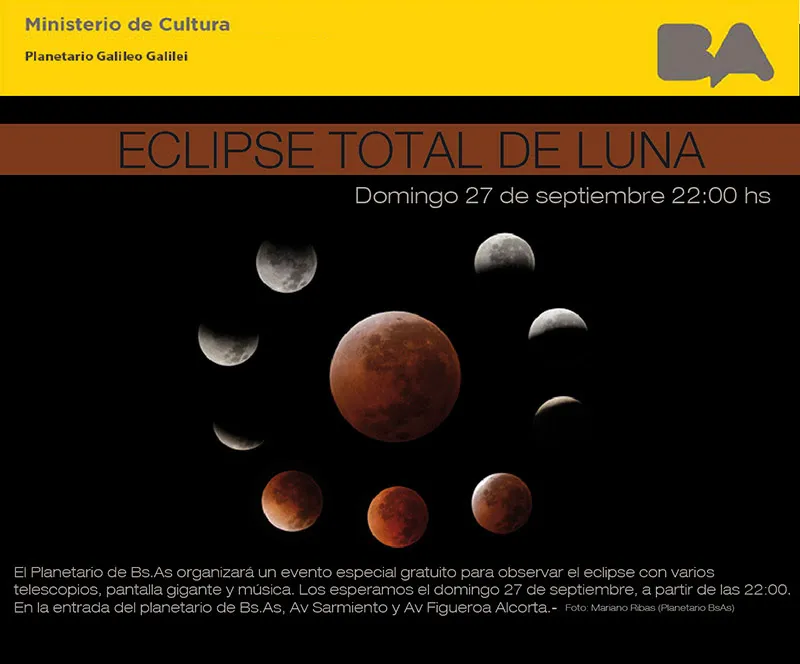
During the night of Sunday, September 27, our satellite will plunge for a few hours into Earth's enormous shadow cone. And far from disappearing, it will be bathed in an ethereal reddish-orange color. It will be a total lunar eclipse, one of nature's greatest spectacles. The phenomenon will be observed, with the naked eye, in Argentina, and throughout the Americas.
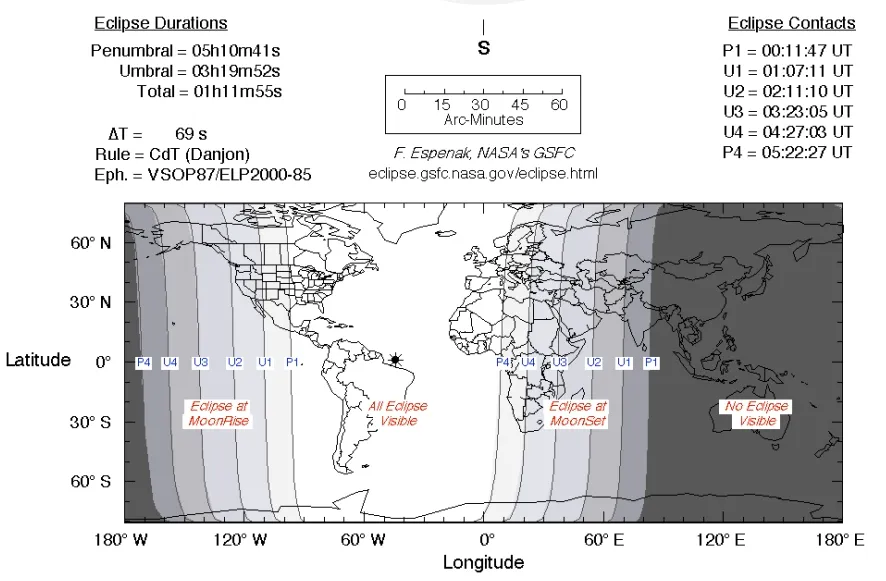
Sunday, September 27, starting at 22:00 h
Observation with several telescopes, giant screen and music, from the access esplanade of the Planetario (Av. Sarmiento and Av. Figueroa Alcorta).
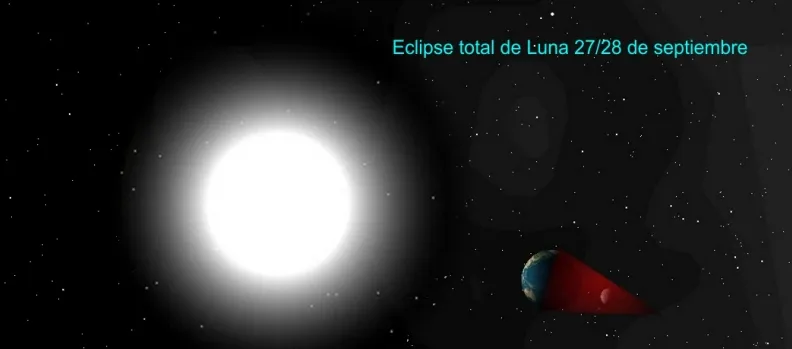
The phenomenon occurs because the angular distance between the Sun and the Moon will be 180º (as always happens when there is a FULL MOON), but also the star, the satellite and our planet will be aligned so that the Sun's light generates a shadow of Earth that will "hide" the Moon:
“Totality”: the Reddish Moon
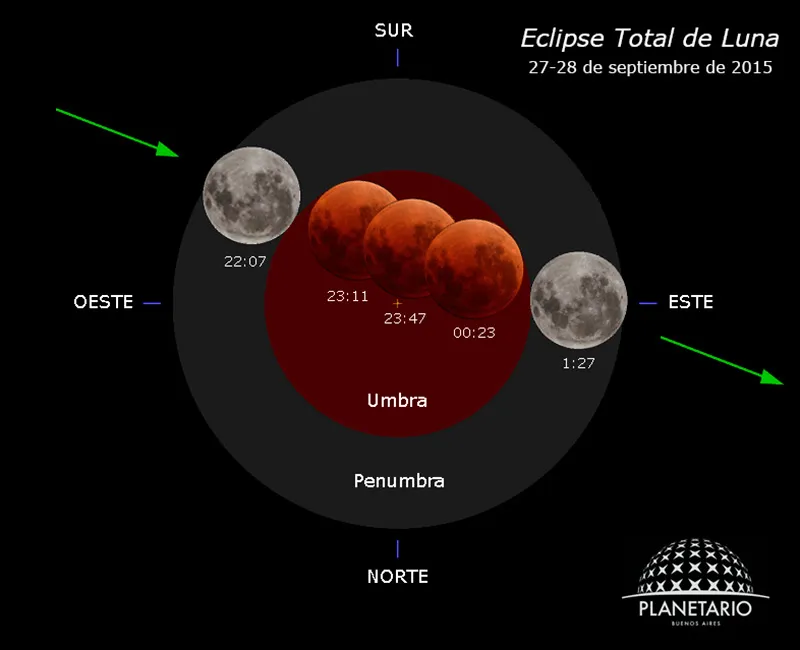
At 23:11 h, the Moon (already located at almost 50º above the northeast horizon) will be completely submerged in Earth's umbra: it will be the beginning of the “Totality” of the eclipse. Its central and most spectacular phase, which will reach its maximum depth around 23:47 h. During the entire “Totality”, our satellite will be weakly illuminated with a soft reddish-orange color… why? It turns out that during a lunar eclipse, Earth's atmosphere (and fundamentally its lowest and densest layer, the troposphere) refracts some sunlight into the interior of the shadow cone. And it is precisely that faint light that saves the Moon from what, otherwise, would be absolute darkness. Since most of that refracted light corresponds to the red and orange wavelengths, during “Totality”, the Moon is “tinged” with beautiful reddish and orange hues.
End of the eclipse
On this occasion, the “Totality” of the lunar eclipse will be especially long: it will last 1 hour and 12 minutes, ending past midnight, at 00:23 h on Monday the 28th. At that moment, seen from Buenos Aires and surroundings, our satellite will still be at 53º altitude above the northern horizon.
The rest of the eclipse will be like watching the movie in reverse: minute by minute, the white and intense direct sunlight will gradually regain the lunar disk. The Moon will leave the “umbra” at 1:27 h in the early morning of Monday. It will be the end of the true eclipse (only a little more than an hour of the final penumbral stage will remain, which is practically irrelevant). From start to finish, the most interesting part of the phenomenon will have lasted more than 3 hours.
And well, here we are, about to witness a wonderful astronomical spectacle. A total eclipse that, moreover, will have our satellite at its minimum distance from Earth. One more example of the impeccable functioning of the precise celestial gears, governed by the laws and mechanisms of gravity. Science in its purest and most palpable state. The same science that allows us to know, with total certainty, that the next total lunar eclipse visible from Argentina will be, only, on July 27, 2018.
And at the Asociación Amigos de la Astronomía
There they also await us, if the sky is clear, starting at 22 h.
The social headquarters and observatory is Av. Patricias Argentinas 550 (C1405BWS) Ciudad Autónoma de Buenos Aires.
The Friends of the Association tell us what will happen with the size of the so-called "Supermoon":
The apparent size of the Moon
A curiosity of this particular eclipse lies in the fact that it occurs with the Moon at a very short distance from Earth. Surely many will highlight this singular circumstance in their publications but, in truth, one thing is the apparent size of an object and another is the value judgment we make about the size of an object.
The apparent size is the angle under which we see an object, therefore, it depends on its real size and the distance from which we are viewing it.
For the Moon this angle has an average value of 0º.5, that is about 1800" of arc. Remember that there are 60 minutes in a degree and 60 seconds in a minute, therefore there are 1800 seconds in half a degree!
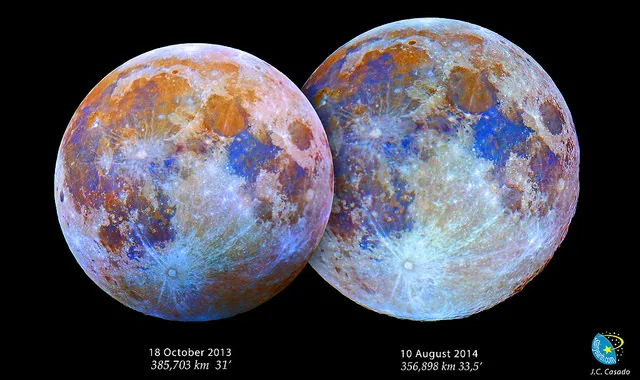
Now, if we compare the apparent size of the Moon at its minimum distance to Earth with the one it has when it moves away to the maximum distance, as can be seen in the following image, we will see that the difference is quite small to be detected with the naked eye.
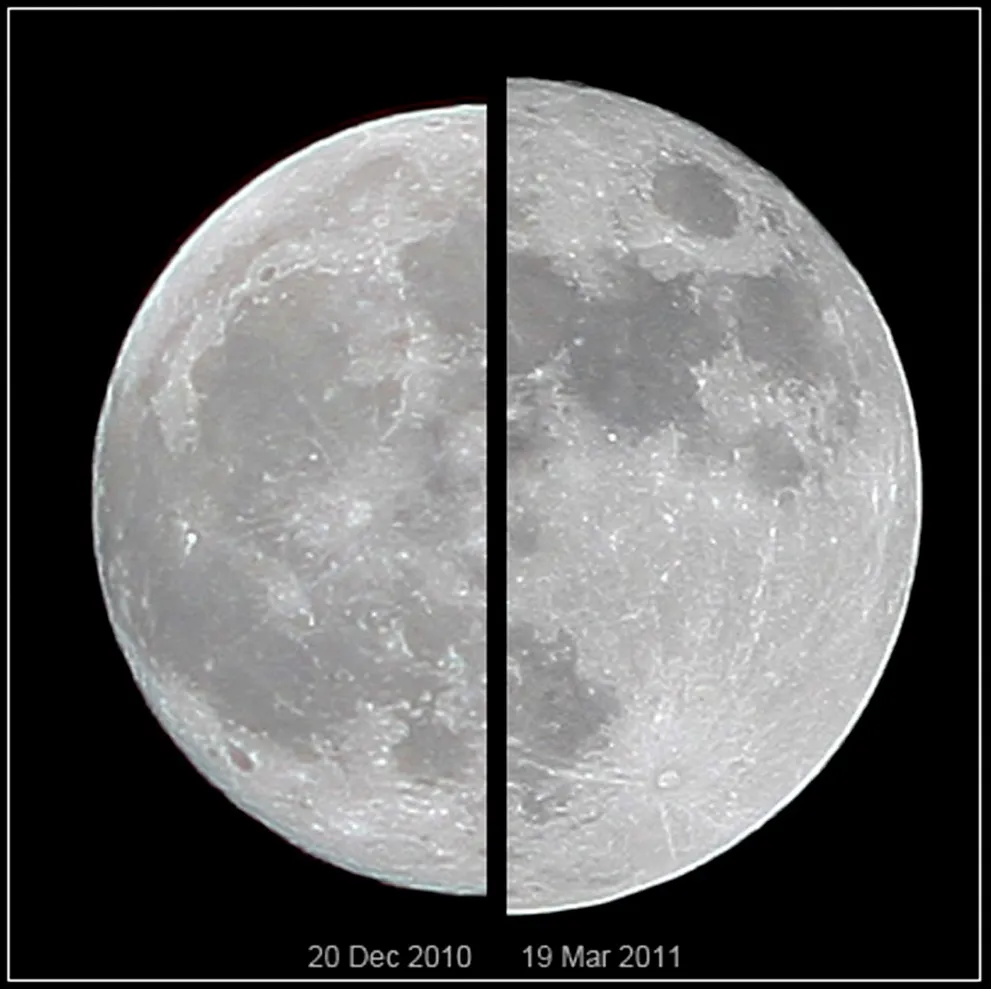
On the other hand, there is a paradox! Since when it seems to us that the Moon is larger, that is when we see it rising or setting on the horizon, it is actually when it will have the smallest apparent size!! The differences between the smallest apparent size and the largest, from moonrise to its culmination, when the Moon is exactly in the North direction, are even smaller and more undetectable to the naked eye.
If we take photographs from moonrise until it seems to us with the naked eye that it has considerably reduced its size, we can verify that in the photographic images the sensible size of our satellite has not varied! If you have any doubt left, think about this: When we see the Moon rise is when it is at its greatest distance from the observer, the Earth's radius moves us away from it; on the other hand, as the Moon gains height relative to the horizon, we will be approaching it until the moment of its culmination.
Apparent sizes of the Moon at its rise, culmination, and during the circumstances of the total eclipse.
At moonrise: 2009",00
1st Contact: 2032",04
2nd Contact: 2036",08
3rd Contact: 2037",51
Culmination: 2038",34
4th Contact: 2038",26
5th Contact: 2037",87
May the psychological effects not deceive us.
And on the web
From the site http://sky-live.tv/ there will be an internet broadcast of the Total SuperMoon Eclipse from the Canary Islands: more info at:
http://www.sky-live.tv/leclipse2015/leclipse2015.html
Sources and related links
- Planetario Galileo Galilei: Eclipse de luna 2015
http://www.planetario.gob.ar/eclipse_luna_2015.html - Asociación Argentina Amigos de la Astronomía
http://www.aaaa.org.ar/ - NASA Eclipse: Eclipse de luna 2015
http://eclipse.gsfc.nasa.gov/OH/OH2015.html - CIEMAT: Eclipse total de superluna
http://www.ciemat.es/portal.do?IDM=61&NM=2&identificador=895
About the images
- Images from Planetario Galileo Galilei, Asaramas, CIEMAT, and F. Espenak (NASA).