If you are looking for a formula for happiness, but are worried about those wretched asteroids that could destroy everything, please read this.
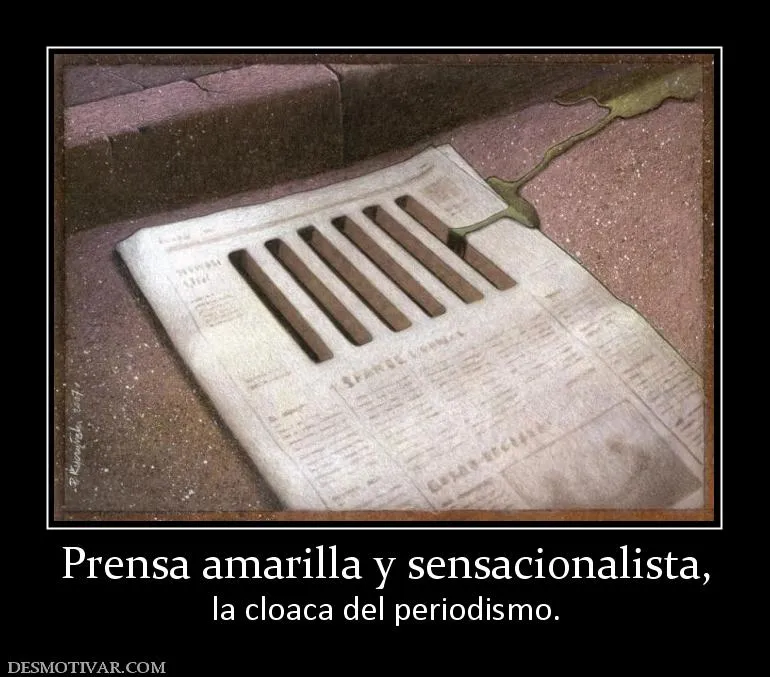
I read that a Facebook user points out the danger of an astronomer talking to the yellow, sensationalist press (gutter press), since the aforementioned -Robert Walsh- gave an interview to The Mirror and that from that publication and others that circulate, the gutter press extracts what suits it to alarm and sell.(1)
I would like to make some reflections on this:
I maintain that in modernity there are three types of discourses. Of course, within each category there are subsets.
A first group will be "The Moderns". Faced with the question in the title they would surely answer:
We must prevent total devastation: stop the wave of immigrants to Europe; prevent strikes: regulate the regulations of States; intervene in the judiciary; hand out favors in the legislature; be generous with the media (by buying them).
A second group will be the "Postmoderns": They will say that the debacle will come from destroying nature since it will punish us, therefore, we must stop eating meat, we must walk barefoot, not use any kind of fabric. We must stop industry and return to non-rationalist, pre-logical, pre-modern times. That was really living better! But we must do it through an app for smartphones, since now things are smart, not the subjects. The commitment of postmoderns lasts thirty seconds, lest they join a cause understood as a "grand narrative".
A third group are the "Critical Moderns": The problem is not industry, technology, science, rationality, but how, who, and for what purpose they make use of such human progress. The problem is not in the killer asteroids, nor in the immigrants. I adhere to this group.
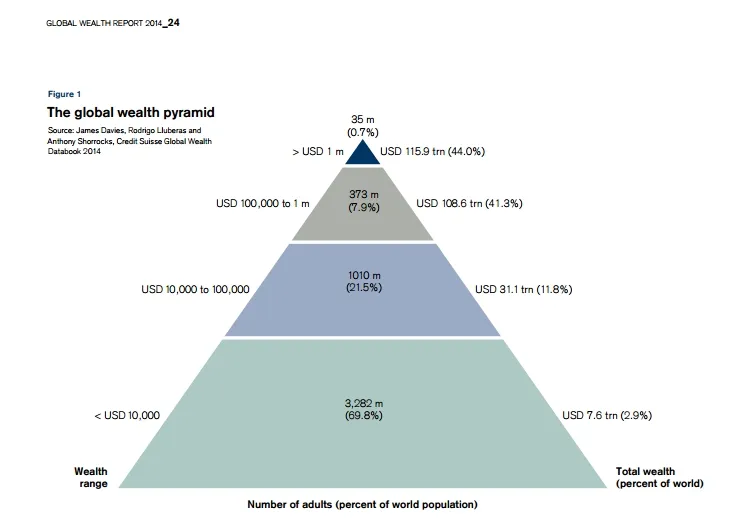
According to Credit Suisse, 0.7% of the world's adult population owns assets of more than USD 1 million each, that's 35 million individuals with total assets of USD 115 trillion, 44% of global wealth.
If we take the first two "steps" of this pyramid, less than 9% of people own more than 80% of the world's wealth. (2)
It is not something potential, that could happen, like asteroids or natural cataclysms, but something that is happening now, that has been happening and that will continue to happen. It is here and now, not later, who knows when. The future arrived... a while ago.
According to the World Food Programme:
Around 805 million people in the world do not have enough food to lead a healthy and active life. That is about one in nine people on earth.
The vast majority of people who suffer from hunger in the world live in developing countries, where 13.5% of the population is undernourished. (3)
In Argentina alone, according to INDEC, informal employment reaches more than 4 million people. (4) Extrapolating to the rest of the world is impossible, so let's go to the ILO report titled "World Employment and Social Outlook 2015". From there I extract some data (5):
Figure 1.3 of that report shows that in the period 2014-2019 (therefore including a projection) unemployment affects more than 210 million people. The map is based on percentages, from the lowest (yellow) to the highest (orange-red). However, it can be somewhat misleading, since the consideration of employment, in many countries, includes what we can consider precarious employment.
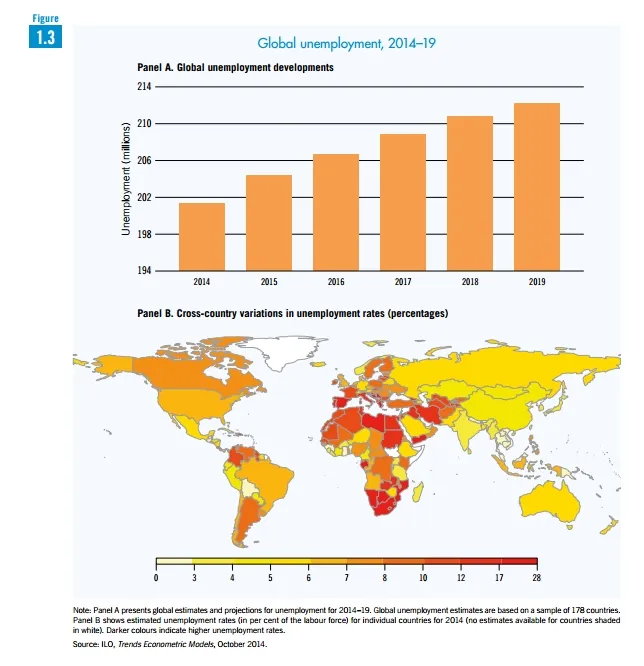
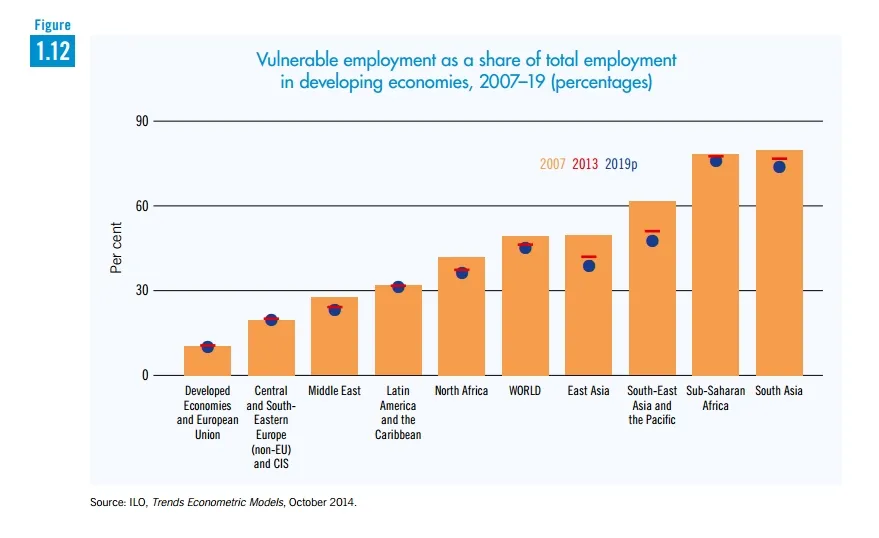
Figure 1.12 shows vulnerable employment as a percentage of total employment in developing economies (2007-2019). As can be seen, in South Asia vulnerable employment is over 75%. In developed economies and Europe, less than 15%. Let's think about this last data for a second: at the highest level of development, in the 21st century, it seems impossible to reduce the level of precarious employment to zero...
Let's add to this picture figures of deaths in wars, epidemics, crimes.
The solution is difficult, but possible
To conclude and paint a realistic scene, let's say that at the same time that this is happening, solutions appear at hand: enormous food production (which occurs at the same time as famine); great scientific-health development (which occurs at the same time as epidemics); great industrial development (which occurs at the same time as unemployment and precarious work).
It is clear that something is not working. Here and now. For a long time. While the moderns justify it, the postmoderns live on the Moon. The critics, we know there will be a lunar eclipse that follows a partial solar eclipse. But we also know that the problems are not in the cosmos, but here on Earth. They are tangible, patent, concrete and social (the cultural is also natural).
While the moderns care about science and development for some, the postmoderns worry about not being able to access Wikipedia when they feel like it (even if they have never collaborated with such a collective publication), or they worry about not accessing a torrent or a movie on Netflix (even if they have never shared content), and they worry about killer asteroids, energy vampires, the apparent location of Saturn in the sky and coffee grounds.
Those of us interested in science and astronomy in particular, which discursive group do we belong to? Do we REALLY have critical thinking? If we only criticize pseudosciences, but agree with the state of the world, we will be moderns, but not critical.
Critics are concerned with the truth. We are concerned with the concealment of truth.
Critics do not want to go die on Mars in the name of who knows what, but we want to take the sky by storm.
Critics do not worry about a fantasy future, nor about the remotely possible. The total debacle will not come from heaven or hell, but is here, in this world, in this society of which we are a part. The problem is not technological nor natural, but political. The first step to avoid the end of society is to make a realistic, rational diagnosis.
But critics are few -although increasing- as shown by executive elections in various countries.
Join our ranks: There are no magic solutions, there is no eternal happiness, we do not guarantee "a happy world". Luckily.
Sir Martin Rees: Can we avoid the end of the world?
https://www.ted.com/talks/martin_rees_can_we_prevent_the_end_of_the_world?language=es
And if we talk about modernity and criticism and it may seem that the astronomical has nothing to do with the political and the economic, then it's better to think about what modernity is. Perhaps in this short video that served as an introduction in a course, we can understand it. In homage to Pablo Rieznik.
Pablo Rieznik - An Introduction to Political Economy - 1. Economy, Science and Sociology
Sources and related links
- (1) Dan Fischer's post on Facebook
https://www.facebook.com/dan.fischer.393/posts/10205871349877822 - (2) Global Wealth Report 2014 at Credit Suisse
https://www.credit-suisse.com/cl/en/about-us/research/research-institute/publications.html - (3) World Food Programme
https://es.wfp.org/hambre/datos-del-hambre - (4) http://www.laizquierdadiario.com/Aumenta-el-empleo-en-negro-y-alcanza-a-mas-de-4-millones-de-personas
- (5) ILO: http://www.ilo.org/global/research/global-reports/weso/2015/WCMS_337069/lang--es/index.htm
About the images
- Initial image from Desmotivar.com
http://www.desmotivar.com/desmotivaciones/1715_prensa_amarilla_y_sensacionalista by artist Pawel Kuczynski (http://pawelkuczynski.com/Strona-g-owna/Home/index.php)