On Saturday the 27th, at dusk, the most impressive astronomical conjunction in decades will be seen: Venus and Jupiter, "stuck together" in the sky. Also, Mars and Saturn near Antares. To note: a talk about the Big Bang.
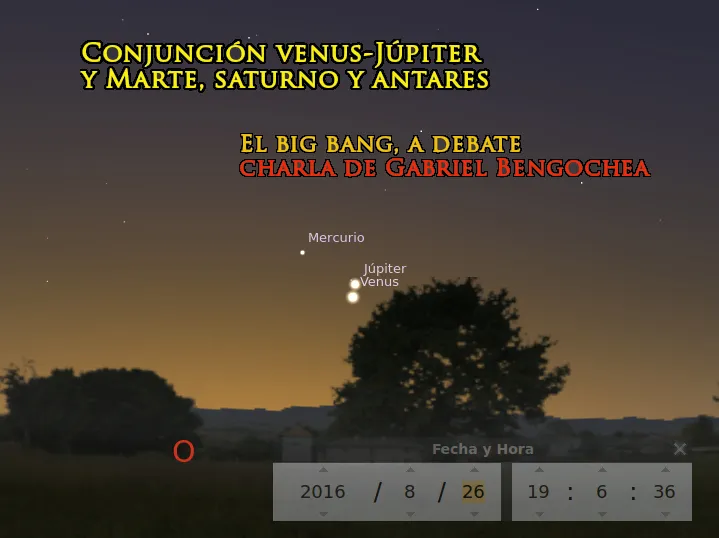
Venus-Jupiter conjunction
The Planetarium of the City of Buenos Aires invites us to observe the Venus-Jupiter conjunction with several telescopes, and with the naked eye, from the esplanade of our institution. The observations will be accompanied by explanations from our specialists. We await you this Saturday starting at 18:30 h.
Public and free activity / Maximum capacity: 500 people.
Important: if it rains or is very cloudy on Saturday, we will carry out the observations on Sunday, at the same time. Although on that day the phenomenon will no longer be the same, something very interesting will still be seen.
It will be on Saturday at dusk. And it will be truly extraordinary: Venus and Jupiter (the two brightest celestial bodies in the sky, after the Sun and the Moon) will star in the best planetary conjunction in decades. With the naked eye, they will be seen literally "stuck together" in the sky, forming a striking "double star." The rare phenomenon will be observed throughout Argentina (provided, of course, it is not cloudy). As if that were not enough, a few degrees from the tight and very bright duo, we will be able to observe another planet...
More information at...
http://www.planetario.gob.ar/venusyjupiter.html
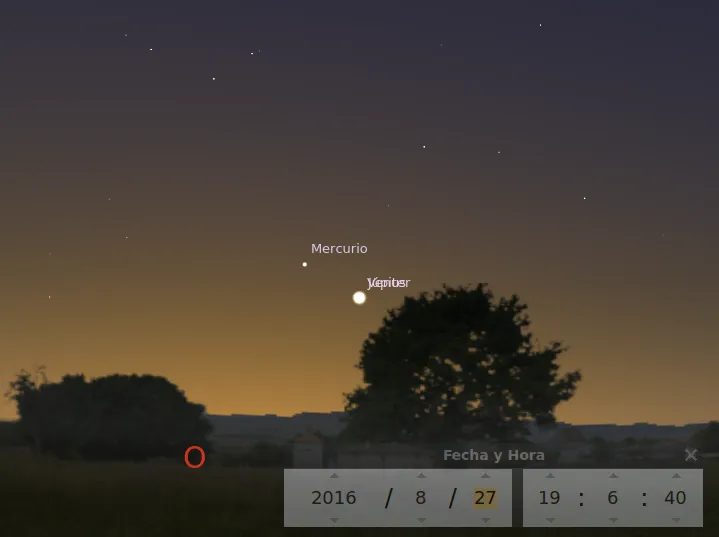
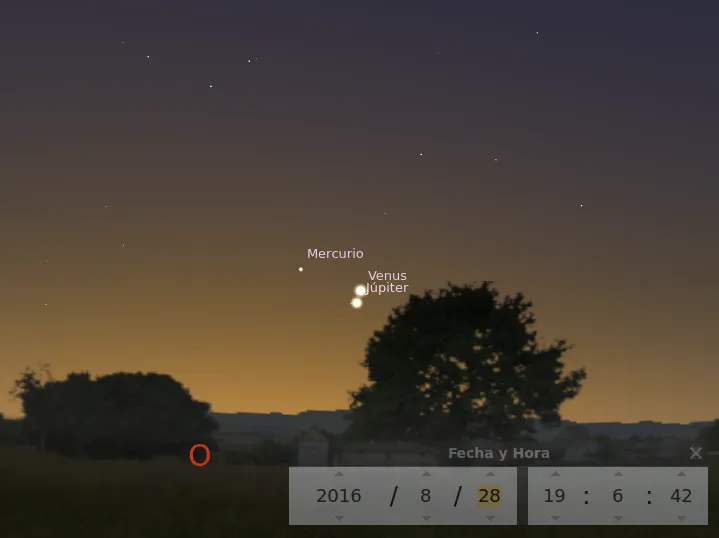
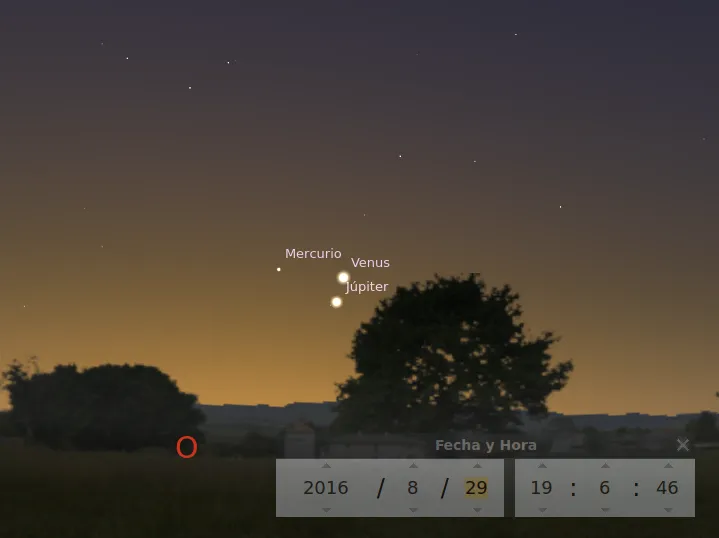
The images below, generated with the Sterllarium program, are simulated illustrations of the positions of certain objects in the sky of Buenos Aires between the 27th and 29th of this month (the image from today, the 26th, is the one that starts the post). Venus and Jupiter have been apparently approaching each other in the sky and will remain very close, but moving apart in the following days. In the image from the 27th, it will be noted that Venus and Jupiter are almost indistinguishable due to the "planetary billiards."
NOTE: That the planets are "aligned" has NO "special" significance, that is, their apparent position does not influence human life in any way, therefore it is not a sign of any prosperity or any misfortune "caused" by astronomical objects. In any case, they can be considered less frequent events than others, "rare" although normal, beautiful to observe (if the clouds let us!).
To take advantage of: Mars, Saturn and Antares
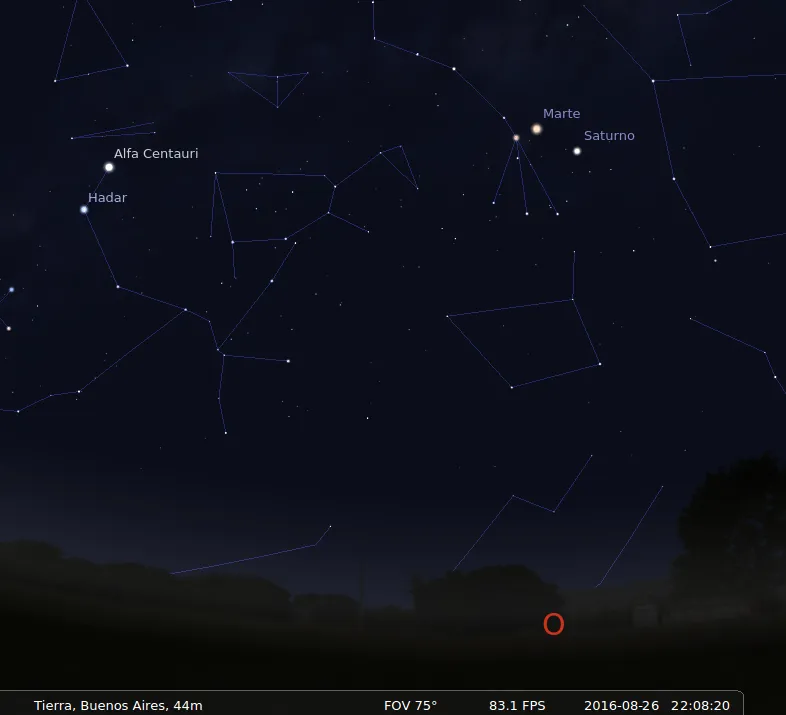
Those who go out to observe will also have noticed the apparent closeness between the red planet, the ringed giant and the brightest star of Scorpius. Not far away in the sky, Alpha Centauri. If we have a telescope, even a medium one, the region is very useful for deep space objects such as M4, M6, M7, M8, M20 and M21.
To note
Los Amigos de la Astronomía invite to a debate talk, titled "THE BIG BANG, DEBATE" with Dr. Gabriel Bengochea (IAFE-CONICET-UBA). It will take place on Saturday, September 3rd, at 18:00 hours, at the social headquarters at Av. Patricias Argentinas 550 - CABA -
Admission is free and open to the public.
Synopsis of the talk:
Over the years, thanks to the innovative ideas of many scientists, and also thanks to the technological development of large astronomical observatories, we have been building an image of the world around us.
The Big Bang model brings together a large part of the ideas about how we think the Universe works.
In the first part of this meeting, I will comment on some of the observational and theoretical foundations of the Big Bang model. Then, in the second part, we will open the debate.
We will try to answer questions such as: is the Universe really expanding?, how do we know the age of the Universe?, how were the seeds of the structures we see today in the sky formed?, how do we model the initial conditions of the Universe?, does the Multiverse exist?, what is the cosmic microwave background?, what do we cosmologists do in Argentina?
Gabriel Bengochea.
Note: It is striking and to be celebrated that a professional publicly asks himself these questions, particularly the first and the last. A talk not to be missed and thus expand our knowledge.
Sources and related links
- Planetario Galileo Galilei
http://www.planetario.gob.ar/ - Asociación Argentina Amigos de la Astronomía
http://amigosdelaastronomia.org/
About the images
Screenshots taken with Stellarium http://www.stellarium.org/es/