On Monday, the transit of Mercury across the Sun will be visible. The Planetariums of Buenos Aires and La Plata will have special telescopes available for observing a phenomenon visible in almost the entire world.
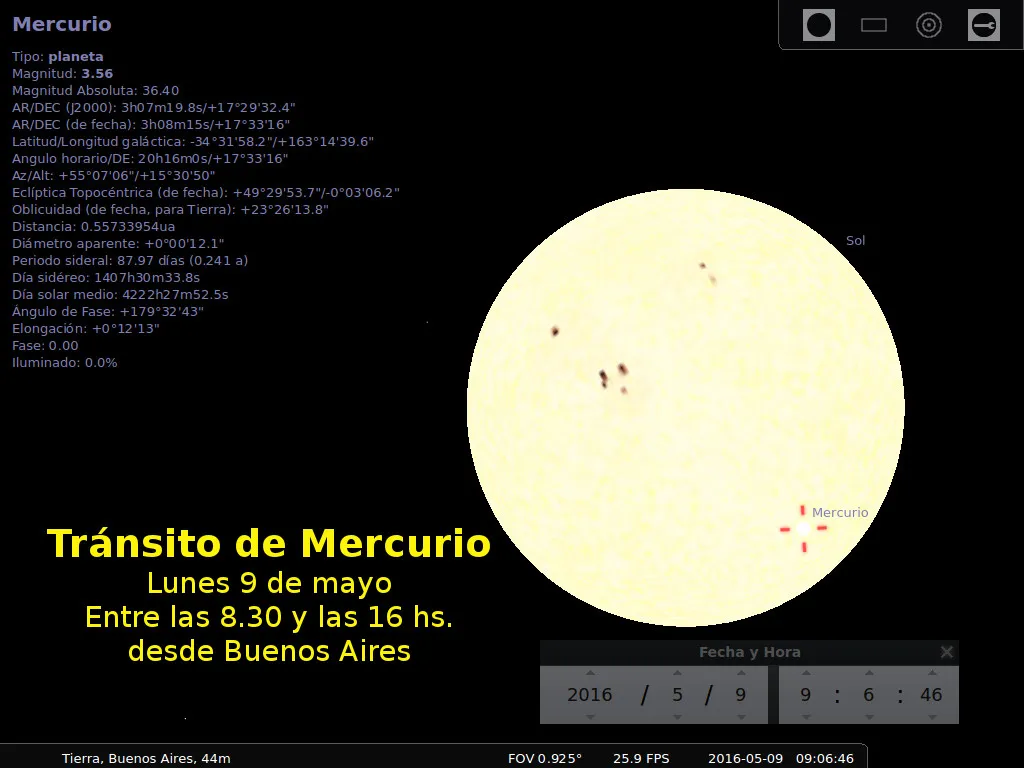
Currently, the transits of Mercury, its apparent passage in front of the Sun from our point of view, do not seem to have major scientific interest, but they have had it in the recent past, particularly for measuring the Earth-Sun distance.
The phenomenon has therefore occurred many other times, but it is more infrequent than others. They usually occur in May or November only 13-14 times every 100 years.
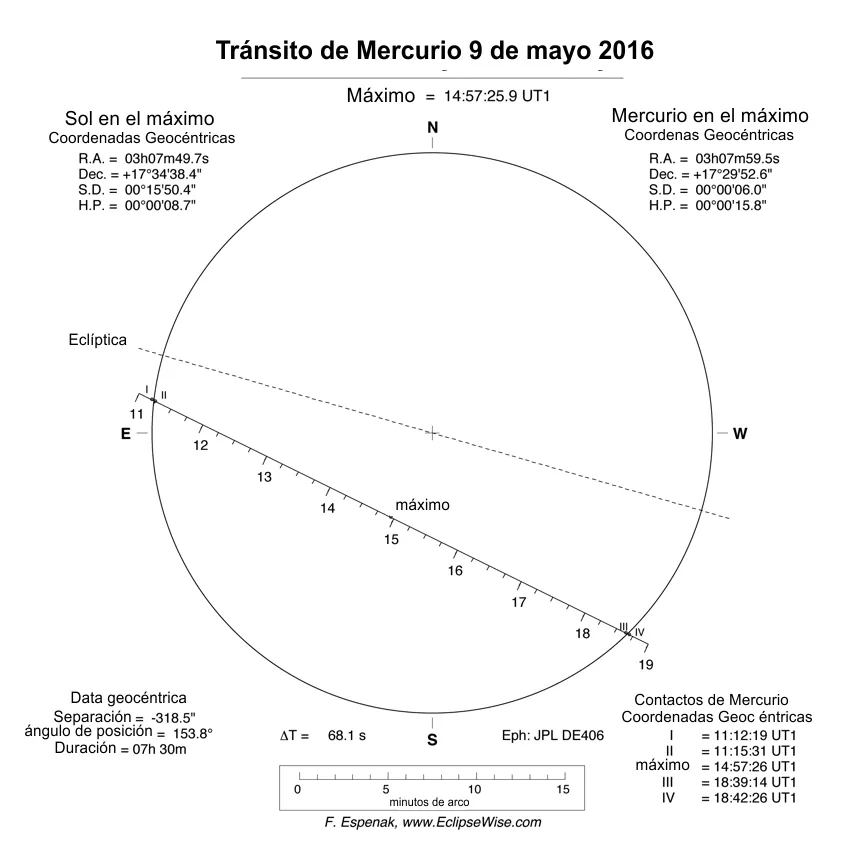
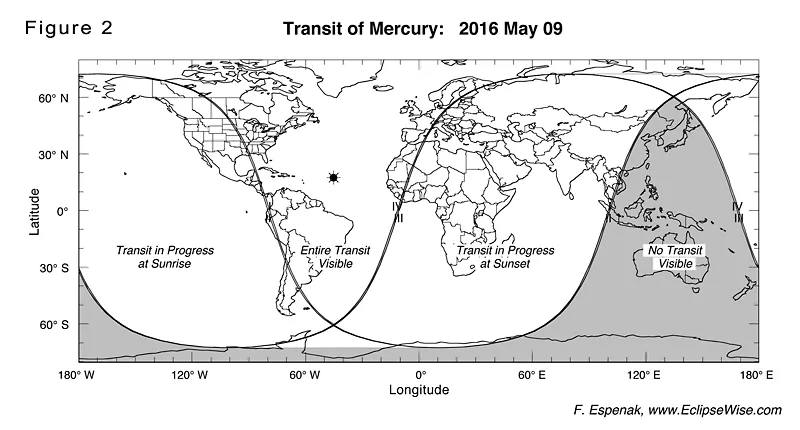
In Argentina, the event will be observable shortly after sunrise, around 8 o'clock, and will last until past 15 o'clock, about 7 hours in duration.
It will be perceived as a small spot that will move across the surface of the Sun.
Observation requires care
As it is often said: the Sun can be looked at directly only twice in a lifetime. Once with the right eye and once with the left!
Looking at the Sun directly damages eyesight, so to observe these phenomena, special telescopes or normal ones with the use of filters are used.
Interesting data
Times of the contacts for Buenos Aires
I 08:13:37
II 08:16:42
Max. 11:58:00
III 15:39:11
IV 15:42:21
Curiosities
Alejandro Blain, from the Asociación Argentina Amigos de la Astronomía, provided us with these curious facts:
1) The relationship between the real sizes of the Sun and Mercury is 1/285, but at the moment of the transit, the Earth will be 151 million kilometers from the Sun, which will then appear to us with an apparent size of 1900".8 (arcseconds). Mercury passing in front of the Sun at 83 million km from Earth will only reach 12" in apparent diameter, so the relationship of apparent sizes between the two will be on the order of 1/158.
2) It is very interesting to realize that both images, that of the Sun and that of Mercury, we will not see them where they actually are located because the light from the Sun will take about 08m23s to arrive and that from Mercury will take 04m38s.
3) About thirteen transits of Mercury occur per century; on November 11, 2019, another transit occurs, even more favorable than this one on May 9. Then we will have to wait until the year 2078 to be able to see another complete transit from Buenos Aires.
4) There will be transits within the present century in the years 2019, 2032, 2039, 2049, 2052, 2062, 2065, 2078, 2085, 2095 and 2098.
5) The Gautier telescope of our observatory arrived in Argentina in the year 1882. It was built to take data of the transit of the planet Venus that occurred on December 6, 1882. We hope that on Monday, May 9, it can also take images of the transit of Mercury about 134 years after its initial work.
To observe from the Planetarium
The Galileo Galilei Planetarium of Buenos Aires will have special telescopes or with filters for observing the phenomenon starting at 8:30 hours. From there they inform us:
It's been almost a decade since we've seen something like this: on Monday, May 9, we will be direct witnesses of a new "transit" of Mercury, one of the most curious and interesting astronomical phenomena. For more than 7 hours, the little planet will "parade" in front of the Sun. And it will be seen as a tiny black spot. The phenomenon will NOT be visible to the naked eye, but with the help of telescopes, filters, and special techniques (like those the Planetarium will use during the special event for the public). The "transit" will be visible in Argentina and in most of the world (in total or partially), except in Oceania and the far east of Asia. Our country (and South America in general) has an unbeatable "front-row seat" to see it.
The Planetarium of La Plata is also organizing an observation event, as indicated on its Facebook page.
With confidence that it will be clear (or semi-clear), we wish everyone good and cautious observations.
Sources and related links
- Planetario Galileo Galilei
http://www.planetario.gob.ar/n_transito.html - Asociación Argentina Amigos de la Astronomía
http://amigosdelaastronomia.org/
About the images
Credits: initial image: Simulation with Stellarium.
Fig. 1 and 2: F. Ezpenak http://eclipsewise.com/oh/tm2016.html