Astronomers discover unique structures detected around a nearby star.
Using images from ESO's Very Large Telescope and the NASA/ESA Hubble Space Telescope, astronomers have discovered never-before-seen structures in a dust disk around a nearby star. The fast, wave-like shapes detected in the disk of the star AU Microscopii do not resemble anything that has been seen, or even predicted, before. The origin and nature of this phenomenon present a new mystery for astronomers to solve. The results are published in the journal Nature on October 8, 2015.
AU Microscopii, or AU Mic for short, is a young nearby star -32 light-years away- surrounded by a large dust disk. Studying these debris disks can provide valuable clues about how planets are created, since they form in these disks.
Astronomers have been searching for anything that suggested the presence of lumpy or warped zones in AU Mic's disk, as such signs can tell us the location of possible planets. And in 2014, thanks to the capabilities of ESO's new instrument SPHERE (installed on the Very Large Telescope), with great capacity for high-contrast imaging, they discovered something unusual.
"Our observations have shown something unexpected," explains Anthony Boccaletti of the Observatoire de Paris (France), lead author of the scientific paper. "The SPHERE images show a set of unexplained features in the disk that have an arc- or wave-like structure, something completely different from anything that had been observed before".
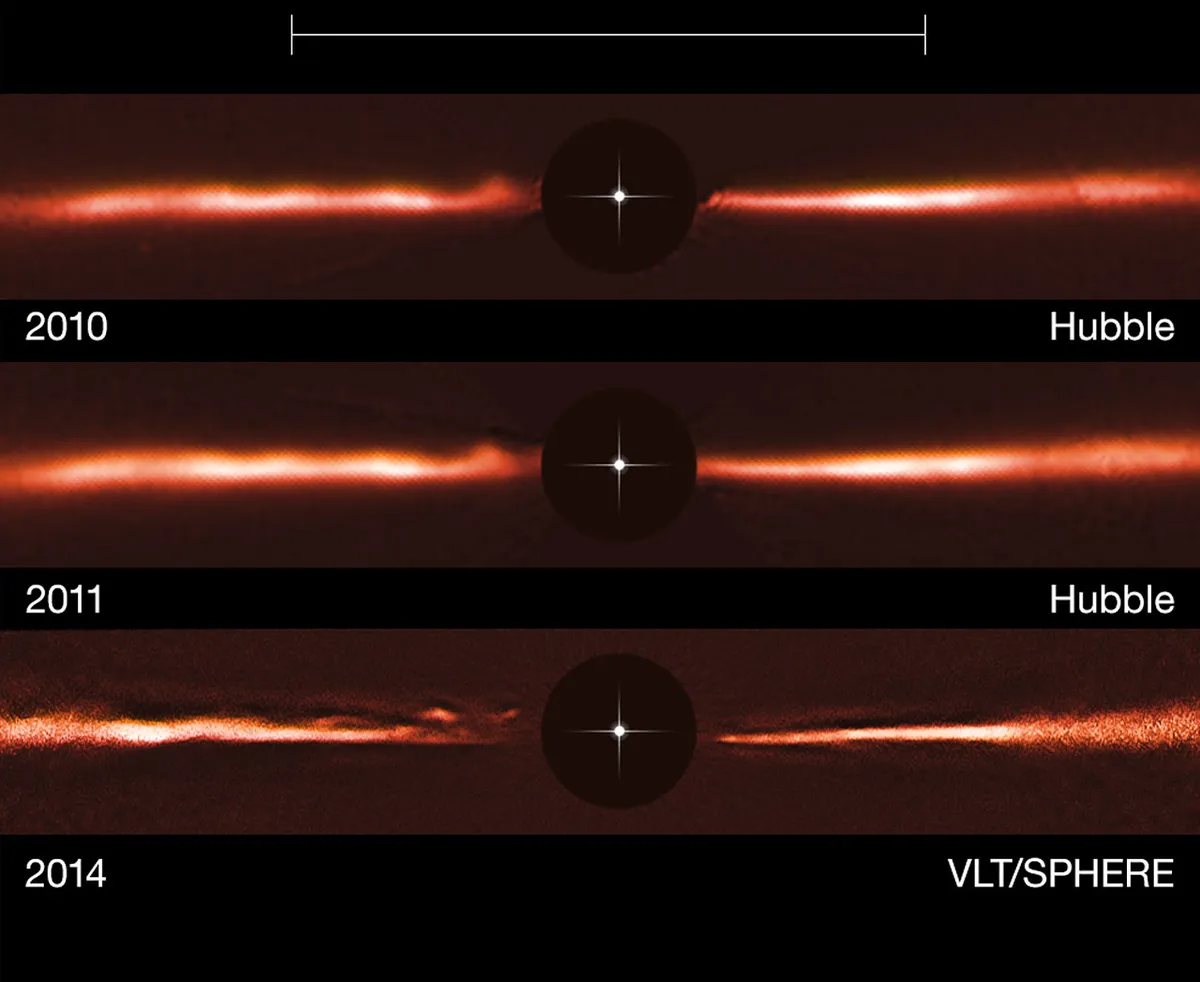
The new images show five wave-like arcs at different distances from the star, reminiscent of waves in water. After detecting this phenomenon in the SPHERE data, the team turned to previous images of the disk taken in 2010 and 2011 by the NASA/ESA Hubble Space Telescope, to see if it was also visible in them. They were not only able to identify the waves in the earlier Hubble images, but they also discovered that they had changed over time. It turns out these waves are moving, and very fast!
"We reprocessed images from the Hubble data and finally obtained enough information to track the movement of this strange phenomenon over a period of four years," explains team member Christian Thalmann (ETH Zurich, Switzerland). "By doing this, we discovered that the arcs are moving away from the star at speeds of up to 40,000 kilometers per hour!"
The waves farthest from the star seem to be moving faster than those closer in. At least three of the arc shapes are moving so fast that they could well be escaping the star's gravitational pull. Such high speeds rule out the possibility that it is a phenomenon characteristic of a conventional disk caused by objects -such as planets- disturbing the disk material as they orbit the star. There must have been something else involved to generate that speed in the waves and make them move so quickly, which means they are a sign of something truly unusual.
"Everything about this discovery is quite surprising," comments co-author Carol Grady, of Eureka Scientific (USA). "And since none of this has been observed or predicted theoretically before, we can only hypothesize about what it is, what we are seeing, and how it arose".
The team cannot say for certain what caused these mysterious waves around the star. But they have considered and ruled out a number of phenomena to explain it, including the collision of two rare and massive asteroid-like objects releasing large amounts of dust and spiral waves triggered by instabilities in the system's gravity.
But there are other ideas they have considered that seem more promising.
"One explanation for the strange structure links it to the star's flares. AU Mic is a star with high flare activity — it often releases huge, sudden bursts of energy from or near its surface", explains author Glenn Schneider, of Steward Observatory (USA). "One of those flares may have triggered something on one of the planets — if there are planets —, like a violent extraction of material that might now be propagating through the disk, propelled by the force of the flare".
The team plans to continue observing the AU Mic system with SPHERE and other facilities, including ALMA, to try to understand what is happening. But, for now, these curious waves remain an unsolved mystery.
This research work is presented in the scientific paper titled "Fast-Moving Structures in the Debris Disk Around AU Microscopii", which appears in the journal Nature on October 8, 2015.
Sources and related links
- -Mysterious waves racing in a planet-forming disk
https://www.eso.org/public/spain/news/eso1538/ - -Hubble Observations Provide Insight into Planet Birth
http://hubblesite.org/newscenter/archive/releases/2007/02/
About the images
The top row shows an image of the AU Mic disk obtained by Hubble in 2010; the middle row shows a Hubble image from 2011; and the bottom row shows VLT/SPHERE data from 2014. The central black circles show where the bright light of the central star has been blocked to see the much fainter disk, and the position of the star is indicated schematically.
Credit:
ESO, NASA & ESA