On the bias of some horoscopes in favor of a political candidate and the myopia of the foolish militant.
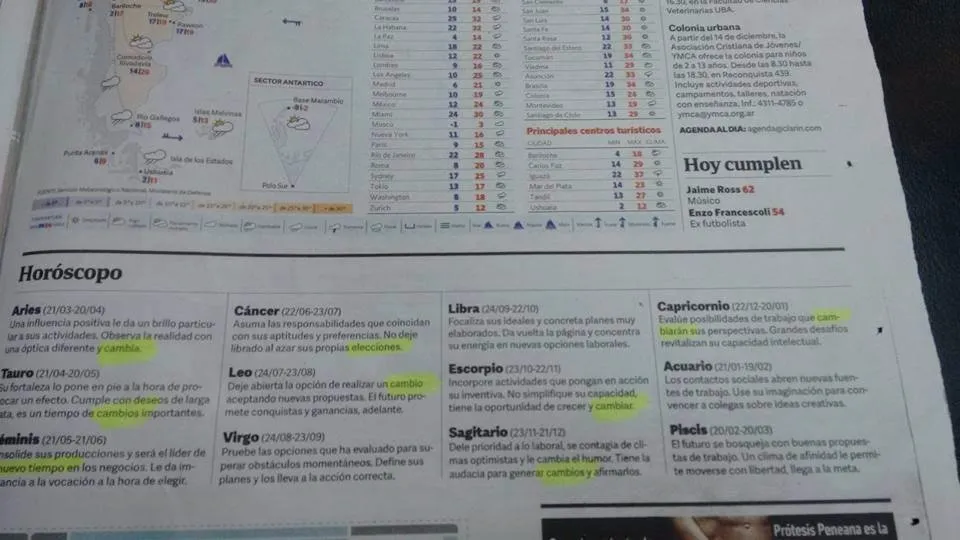
I read in Perfil.com about the Twitter comments of some K militants regarding a partisan bias in the horoscope of the newspaper Clarín. [1]
It reports on a tweet from Professor Romero who wondered if such a bias existed in the following way:
Is it just me or does #Clarín want to shove #Cambiemos down our throats even in the horoscopes?
And he showed two images, one of the newspaper's horoscope for 11-12 and another from the magazine Viva for 11-15, in both cases highlighting in yellow the word change and the conjugations of the verb, repeatedly used.
This was echoed by Camilo García and Luis D'Elía, among others, on that social network.
The myopia is atrocious for several reasons:
1-Horoscopes, whether published in Clarín or Tiempo Argentino, in the Washington Post or El País, have no truth to offer. They are nothing more than a discourse with mythological roots and no connection to scientific knowledge. It is utterly false, always, in any medium, whatever it says. It is not false or biased only when it apparently supports a particular political group. If the Clarín horoscope spoke of "continuity" it would be equally false, although I suppose the fools would consider it "a lesser evil".
2-Not only Clarín publishes horoscopes. So do Tiempo Argentino and Télam, Crónica and Diario Popular. And they are all lies, always.
3-Theodor Adorno analyzed the discourse of the horoscope. He did so in a text titled "Bajo el signo de los astros" [2].
Below, an excerpt from the conclusions of that analysis:
(...) Obviously, the first concept that comes to mind in this context is that of social and psychological dependence. Our analysis of the Los Angeles Times column has pointed out in detail how the audience's needs for dependence are presupposed, fostered, and continuously exploited. However, in terms of the specificity of contemporary astrology, the concept of dependence as such seems, in a way, too abstract to take us very far. Throughout all of history, in organized society, most people were in some way dependent, and in some phases probably even more so than today. This, however, must be qualified somewhat. It does not matter if the individual is 'freer' today in many aspects than they used to be in past times; the socialization of life, the 'confiscation' of the individual by innumerable channels of organization has undoubtedly increased. Suffice it to mention as an illustration that the traditional dichotomy between work and leisure tends to be increasingly reduced and that socially controlled 'leisure activities' absorb more and more of the individual's free time. Although the basic dependence of the individual on the social body has always prevailed, and in a highly irrational way, this dependence was at least 'veiled' for many people during the classical era of liberalism, when the person came to think of themselves as a self-sufficient monad. This veil has now been pulled aside and people begin to face their own dependence much more than they used to eighty years ago; and this is largely due to the fact that the processes of social control are no longer those of an anonymous market that decides the individual's economic destiny in terms of supply and demand. The processes of mediation between social control and the individual tend to fade away, and the individual once again has to obey the direct verdict of the groups that steer society. It may be this growing obviousness of dependence, more than an increase in dependence per se, that is felt as a lack today and prepares people's minds for astrology, as well as for totalitarian creeds. Paradoxically, a greater proportion of intellection could result in a regression towards attitudes that prevailed long before the rise of modern capitalism. For, although people recognize their dependence and quite often dare to conceive of themselves even as a mere pawn, they find it extremely difficult to face this dependence in an unmitigated way. (...) This may be one of the reasons why they so like to project their dependence onto something different, be it a conspiracy of Wall Street bankers or the constellation of the stars. What throws people into the arms of various species of 'prophets of deceit' (...) is their desire to reinforce their own dependence, to not have to take care of matters oneself.
(...) In other words, astrology cannot be interpreted merely as an expression of dependence, but must also be considered as an ideology for dependence, as an attempt to reinforce and in a way justify painful circumstances, which seem more tolerable if an affirmative attitude is adopted towards them. (...)"
I translate this in my own words: astrology is an ideology of NO social CHANGE, of acceptance of the status quo, of leaving things as they are, that is, it is NOT revolutionary. The "changes" suggested by horoscopes are personal, individual, small, insignificant for society. Astrology has been an instrument of social control of the Ancien Régime. But the French (Bourgeois) Revolution did not put an end to such barbarism because it is also functional for the new ruling class.
We could say the same about other practices like meditation, feng-shui, Bach flowers. They are supposed "magical" remedies for human problems that, beyond whether they really, objectively, produce an improvement or are a subjective placebo, are a way of dealing "better" with anguish and everyday problems. However, many of those who carry out these practices do not ask about the CAUSES of such anguish, they only want to deal with them by mitigating them, they are an anesthesia.
The personal causes we cannot know, they will be different in each case, but they have common elements: most people work many hours for a miserable salary. And of that we do know the causes: surplus value.
But instead of getting to the root of the matter, which would imply a major social change in which we should be protagonists, it is preferable to blame our problems on evil spirits, bad vibes, hatred, the vibe, biocosmic energy, or the apparent position of the planets in the sky. They are all ways of justifying the state of affairs without us having anything to do with it. It is a justification for injustices and inequalities.
Do Camilo García, Luis D'Elía and Romero perhaps hope to find some truth in the horoscope? Do they not see that it is an instrument of social control, whether published in Clarín or in Télam?
Surely not. Just as they also do not consider the Church to be an instrument of social control.
MODERN ASTROLOGY
One of the characteristics of capitalist modernity is automation and standardization, contrary to the artisanal nature of feudalism.
On November 16, the following horoscope was published in the newspaper Tiempo Argentino:
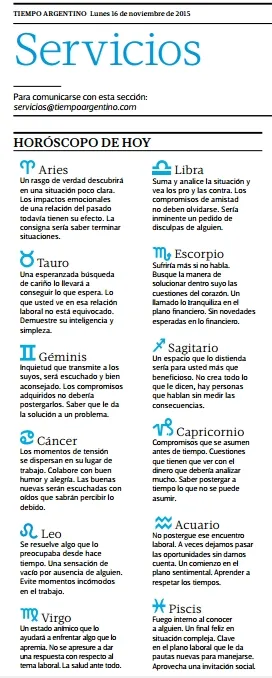
In the first paragraphs it says:
Aries
A trait of truth will be discovered in an unclear situation. The emotional impacts of a past relationship still have their effect. The motto would be to know how to end situations.
Taurus
A hopeful search for affection will lead you to get what you expect. What you see in that work relationship is not wrong. Show your intelligence and simplicity.
I invite the reader to select this text and search the web. You will find, for example, that on the site Elcomercioonline.com.ar [3] the Horoscope for Friday, August 14, 2015 was published and that the text is identical to the one published in Tiempo Argentino three months later.
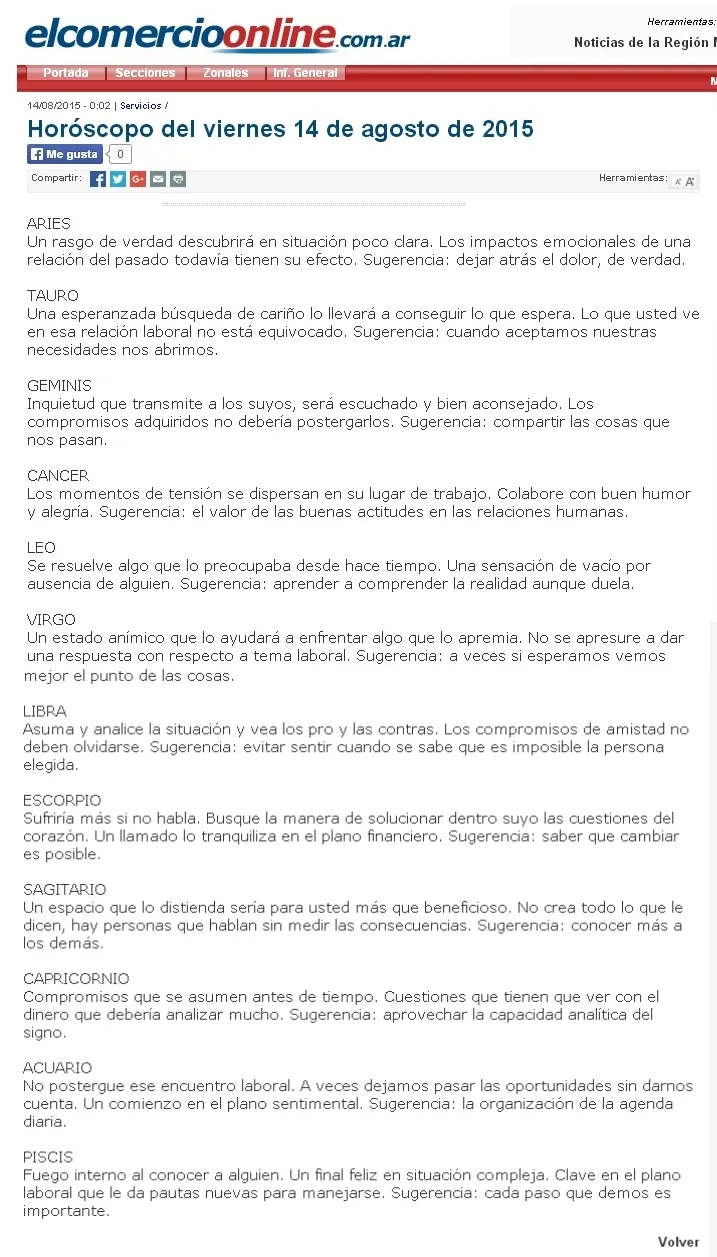
I cannot know for certain how these two nearly identical texts were produced. But it is possible to infer that a software that spits out horoscopes -in a pseudo-random fashion- from previously written texts is at work here. I had already detected this both in Tiempo Argentino and in several provincial newspapers.
The same is not true for the horoscope published by the newspaper Clarín on the second-to-last page.
Therefore, we could infer that certain horoscopes are not written personally by astrologers for each newspaper, but are produced by software or else that the same text produced by one person is distributed (i.e., sold) to several media outlets at different times (which would be almost a "fraud"); while in other cases they are indeed written specifically for one outlet and in some the signature or pseudonym of the supposed author is indicated.
Perhaps that is why more specific content with a partisan bias can "filter" into the Clarín horoscope, as opposed to those impersonal ones published in other media, perhaps in an automated fashion.
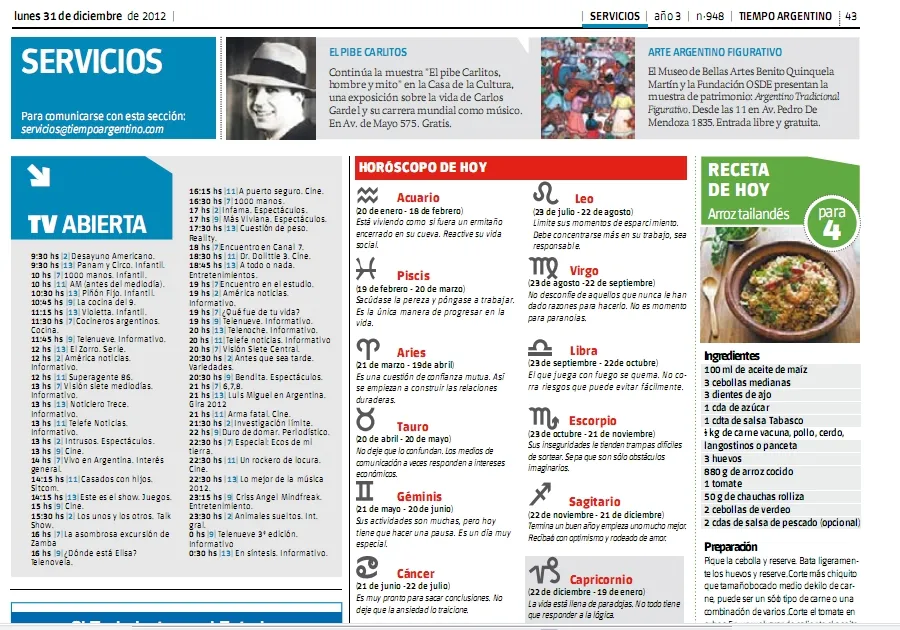
However, on December 31, 2012, the newspaper Tiempo Argentino published the following horoscope. The reading of the comment for Taurus could also be interpreted as the infiltration of a political message, due to the supposed fight between Clarín and the National Government. Let's say, in passing, that the inclusion of the horoscope in Tiempo Argentino, as well as its structure and supplements, could well be thought of as an attempt to copy the Clarín format, a "Clarín K". They are not so different...
On December 3, 2012, in the horoscope published on the lanacion.com site, the following comment is noted:
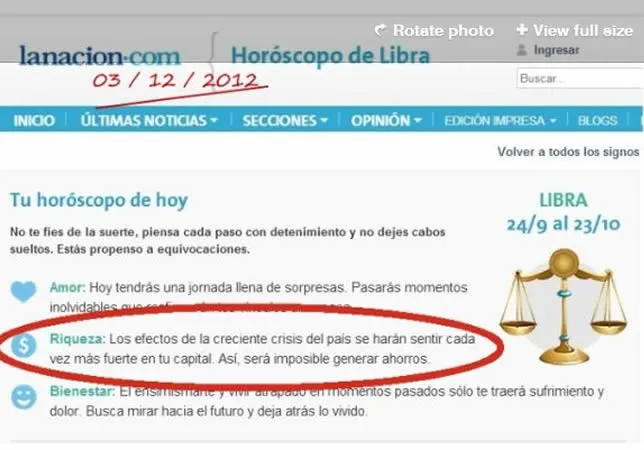
In all three cases we could establish some relation to the current situation. They are, however, exceptions. What is NOT exceptional is that in all cases, in any newspaper or website, the horoscope is a conformist discourse. And furthermore, discriminatory, because in all of them a false relationship of dependence is established between people, their destiny, and the position of the planets in the sky. Even for the one who says they read the horoscope as mere entertainment, they "know" what their zodiac sign is, what characteristics it has, and that it is different from 11 others. Which, of course, is a prejudice (and a detriment). And this is so because horoscopes are not just the text, but also the name (sign-constellation), the date range, and the icon, which allow distinguishing one supposed sign from another. Adorno did not take this analysis into account. The horoscope is the massive and simplifying discourse of another more complex but equally false one: astrology. And they reach us through newspapers, which supposedly reflect reality...
Social change only occurs through the action of people in a society. But neither Clarín, nor Tiempo Argentino, nor Télam like to give that message: social revolution is not encouraged because it would threaten their political and economic interests. The differences between sectors of the ruling class cannot conceal the fact that such distinct groups possess common interests that are not ours.
The media and the political class strive for reforms, which they call changes and continuities. Those who do not "behave well" are subjected to "zero tolerance," from one side and the other. Even a supposed almost divine being who recently called to "make a mess" now does not want secret documents to be leaked, lest we still find out the truth...
Modernity is not so modern if slavery persists through other "means."
Sources and related links
[1] Perfil.com: K militants complain about the use of the word "Cambiemos" in Clarín's horoscope http://www.perfil.com/politica/Militantes-K-se-quejan-del-uso-de-la-palabra-Cambiemos-en-el-horoscopo-de-Clarin-20151117-0064.html
[2] Theodor W. Adorno; Escritos sociológicos II, 2; Ediciones AKAL, Spain, 2011, pp 112-115.
[3] elcomercioonline.com.ar: Horoscope for Friday, August 14, 2015 http://www.elcomercioonline.com.ar/articulos/50069460-Horoscopo-del-viernes-14-de-agosto-de-2015.html