The largest comparative study advances on the mystery of the missing water.
Astronomers have used the Hubble and Spitzer space telescopes to study in detail the atmospheres of ten hot Jupiter-sized planets. The team discovered why some of these worlds seem to have less water than expected. The results were published in Nature.
To date, astronomers have discovered nearly 2000 planets in orbit around other stars. Some of these planets are classified as hot Jupiters: they are gas giants with characteristics similar to the Great Red Spot that orbit very close to their stars, making their surface hot, and are difficult to study in detail because the light from the nearby star hinders investigations.
Due to this difficulty, only a handful of such exoplanets have been explored with Hubble, through a limited range of wavelengths. These initial studies found several planets with less water than expected [1].
Now, an international team of astronomers tackled the problem with a larger comparative study to understand their atmospheres. Only three such atmospheres had been previously studied in detail, so this new sample forms the largest spectroscopic catalog of exoplanet atmospheres.
The team used multiple observations from Hubble and Spitzer to analyze the atmospheres of a series of planets with varied characteristics across a greater range of wavelengths. For once, let's use proper names and numbers: the sample included two planets previously studied in detail, namely: HD 209458b, HD 189733b, and they used Hubble to observe eight others: WASP-6b, WASP-12b, WASP-17b, WASP-19b, WASP-31b, WASP-39b, HAT-P-1b, HAT-P-12b.
The observations extended from the ultraviolet (0.3 μm) to the mid-infrared (4.5 μm).
"I'm really excited to finally 'see' this wide group of planets together, as it's the first time we had enough wavelength coverage to be able to compare multiple features from one planet to another", said David Sing, from the University of Exeter, UK, lead author of the new paper. "We found that planetary atmospheres are much more diverse than expected".
From less to more cloudy
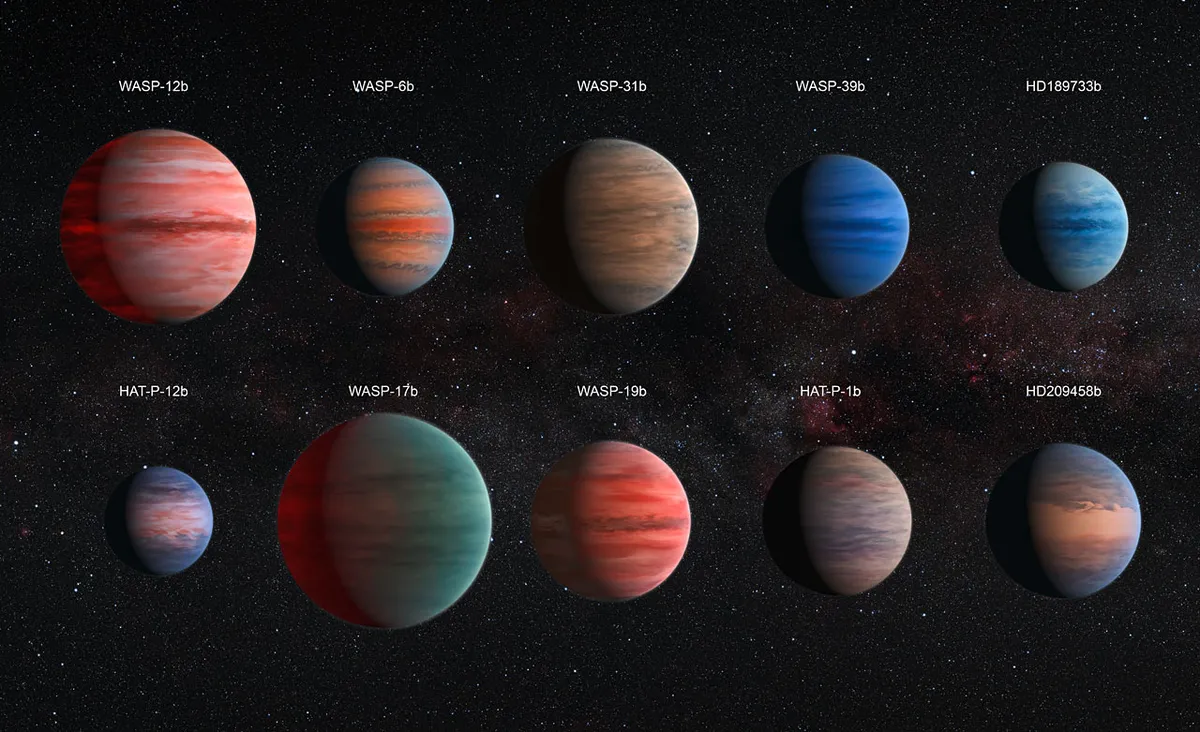
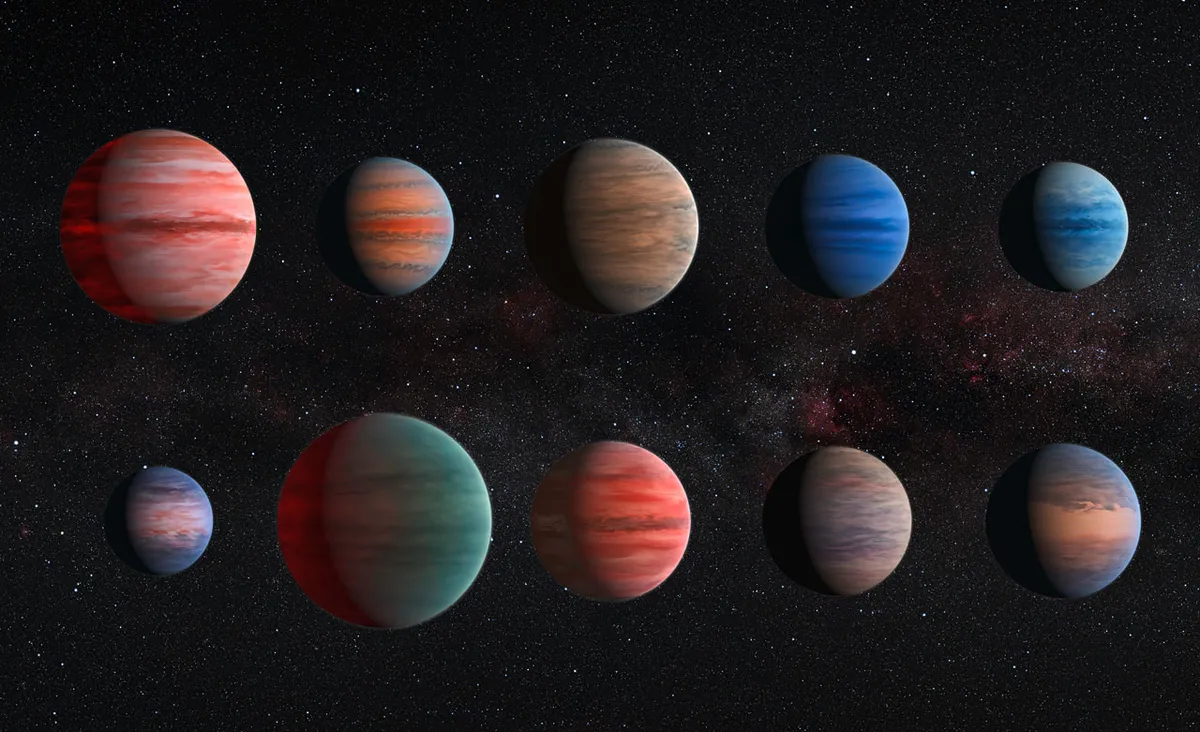
The images are to scale relative to each other. HAT-P-12b, the smallest of them, is approximately the size of Jupiter, while WASP-17b, the largest in the sample, is almost twice the size. The hottest planets in the sample are portrayed with a bright night side. That effect is greatest in WASP-12b, the hottest of all, but also visible in WASP-19b and WASP-17b. Many planets are known to exhibit Rayleigh scattering. That effect causes the sky to look blue by day and reddish at sunset on Earth. It is also visible as a blue edge on the planets WASP-6b, HD 189733b, HAT-P-12b, and HD 209458b.
The wind patterns shown on these ten planets, which resemble structures visible on Jupiter, are based on theoretical models.
All the planets have a favorable orbit that places them between their star and Earth. When the exoplanet passes in front of its star, as seen from our world, some of the starlight travels through the planet's outer atmosphere. "The atmosphere leaves its particular fingerprint on the starlight, which we can study when the light reaches us", explained co-author Hannah Wakeford, from the Goddard Space Flight Center.
These fingerprints allowed the team to extract the "signatures" of various elements and molecules, including water, and to distinguish between exoplanets with and without cloudiness, a property that could explain the mystery of the missing water.
The model developed by the team reveals that while the cloudless exoplanets showed strong signs of water, the atmospheres of those hot Jupiters with weaker water signals also contain clouds and haze, which in both cases are known to hide the presence of water. Mystery solved?
"The alternative is that planets form in an environment deprived of water, but that would require completely rethinking our current theories of how planets form", noted Jonathan Fortney, from the University of California. So the mystery would have been solved simply by postulating that clouds hide the presence of water from prying astronomical eyes. However, in science it's not so easy to claim victory. In fact, exoplanet atmosphere research is in its infancy to consider that a mystery has been solved. In any case, the veil on the matter has been lifted a little, since regarding the existence of water on exoplanets, astronomers were as lost as a Turk in the fog.[2].
The work to be published on 12-14-2015 in Nature is titled “A continuum from clear to cloudy hot-Jupiter exoplanets”
Sources and related links
- SpaceTelescope: Hubble reveals diversity of exoplanet atmospheres
https://www.spacetelescope.org/news/heic1524/ - [1] See Hubble traces faint signatures of water in exoplanet atmospheres
https://www.spacetelescope.org/images/opo1354a/ - [2] Where does the saying come from: “Lost as a Turk in the fog”?
http://mira.ellitoral.com/2014/07/de-donde-proviene-el-dicho-perdido-como-turco-en-la-neblina/
About the images
Credits: ESA/Hubble & NASA