With a mass similar to that of our planet, it would be in the habitable zone of the star system closest to Earth. Is it possible that there is life?
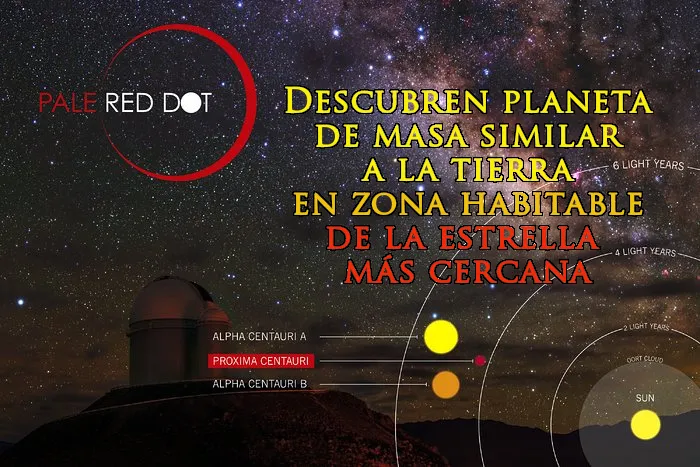
Using telescopes from ESO and other facilities, a team of astronomers has found clear evidence of a planet orbiting the closest star to Earth, Proxima Centauri. This long-sought world, dubbed Proxima b, orbits its cool red host star every 11 days and has a temperature that would allow liquid water to exist on its surface. This rocky world is a little more massive than Earth and is the closest exoplanet to us—and it may also be the closest planet that could harbor life outside the Solar System. A paper describing this milestone discovery will be published in the journal Nature on August 25, 2016.
Just over four light-years from the Solar System lies a red dwarf star that has been named Proxima Centauri, since it is the closest star to Earth apart from the Sun. This cool star in the constellation of Centaurus is too faint to be seen with the naked eye and is located near a much brighter pair of stars known as Alpha Centauri AB.
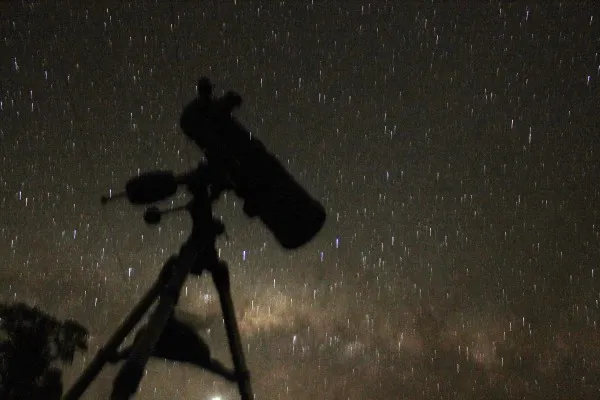
During the first half of 2016, Proxima Centauri was regularly observed with the HARPS spectrograph, installed on the 3.6-meter ESO telescope at La Silla (Chile) and monitored simultaneously with other telescopes around the world [1]. This was part of the Pale Red Dot campaign, in which a team of astronomers, led by Guillem Anglada-Escudé (from Queen Mary University of London), searched for the tiny wobble that the gravitational pull of an orbiting planet would cause on the star [2].
Since it was a matter of great public interest, the progress of the Pale Red Dot campaign obtained between mid-January and April 2016 was shared publicly on the website and through social media. The reports were accompanied by numerous outreach articles written by specialists from around the world.
Guillem Anglada-Escudé explains the background of this unique search: "The first hints of a possible planet were seen in 2013, but the detection was not convincing. Since then, we have worked hard to get more observations with the help of ESO and other institutions. The recent Pale Red Dot campaign has been almost two years in the planning".
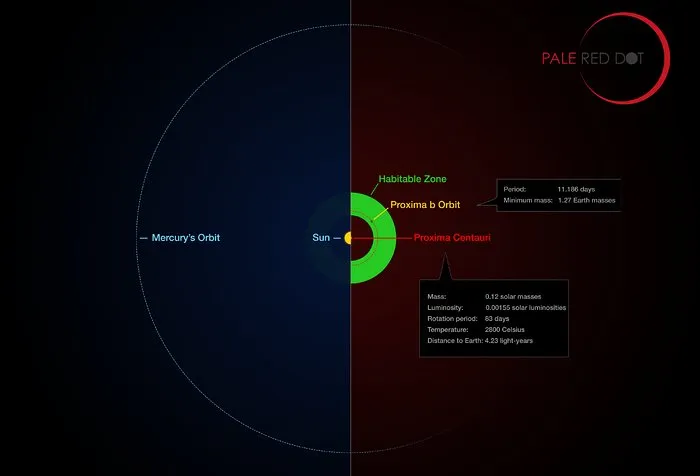
By combining the Pale Red Dot data with previous observations carried out at ESO observatories and elsewhere, a truly exciting result has clearly been obtained. At times, Proxima Centauri approaches Earth at about 5 kilometers per hour—the pace of a normal human walk—and at other times, it recedes at the same speed. This regular pattern of changing radial velocities repeats with a period of 11.2 days. Careful analysis of the tiny changes in the Doppler effect indicated the presence of a planet with a mass at least 1.3 times that of Earth, orbiting about 7 million kilometers from Proxima Centauri—only 5% of the Sun-Earth distance [3].
Guillem Anglada-Escudé talks about the excitement of the last few months: "I kept checking the consistency of the signal every day during the 60 nights of the Pale Red Dot campaign. The first 10 were promising, the first 20 were consistent with expectations, and at 30 days the result was pretty definitive, so we started drafting the paper!".
Red dwarfs like Proxima Centauri are active stars and can vary, generating effects similar to those caused by the presence of a planet. To rule out this possibility, during the campaign the team also carefully monitored the changing brightness of the star using the ASH2 telescope, installed at the San Pedro de Atacama Celestial Explorations Observatory (Chile) and the Las Cumbres Observatory telescope network. Radial velocity data taken when the star was flaring were excluded from the final analysis.
Although Proxima b orbits much closer to its star than Mercury does to the Sun in our Solar System, its star is much fainter than the Sun. As a result, Proxima b lies within the habitable zone around the star and has an estimated surface temperature that would allow the presence of liquid water.
Despite Proxima b's temperate orbit, conditions on the surface could be strongly affected by X-ray and ultraviolet radiation flares from the star, which are much more intense than those experienced by Earth from the Sun.
This discovery will be the start of more extensive observations, both with current instruments and with the next generation of giant telescopes like the E-ELT (European Extremely Large Telescope). Proxima b will be a perfect target for the search for evidence of life elsewhere in the universe. In fact, the Alpha Centauri system is also the target of humanity's first attempt to travel to another star system, the StarShot project.
Guillem Anglada-Escudé concludes: "Many exoplanets have been found and many more will be discovered, but searching for the closest potential Earth analog and succeeding has been the experience of a lifetime for all of us. The stories and efforts of many people converge in this discovery. The result is also a tribute to all of them. The next step is the search for life on Proxima b...".
Could this planet have life?
First, we would have to define "life." The existence of microbial life is not the same as "intelligent" life, but in any case, if microbial life were discovered on an exoplanet, it would be one of the greatest discoveries in human history. Therefore, we must be cautious, particularly because to say something more concrete we would have to consider whether Proxima b has an atmosphere.
Whether a planet of this type has the capacity to host water and life similar to Earth's is an intense topic of debate, largely theoretical. The main aspects that would work against the presence of life are related to the star's proximity. For example, it is very likely that gravitational forces cause the same side of the planet to remain exposed to daylight, while the other side is in perpetual night. The planet's atmosphere could also be slowly evaporating, or have a more complex chemistry than Earth's due to strong ultraviolet radiation and X-rays, especially during the star's first few billion years of life. However, none of these arguments have been conclusively proven and cannot be taken as fact without direct observational evidence that allows, among other things, the characterization of the planet's atmosphere. Similar factors apply to the planets recently found around TRAPPIST-1.
Some methods for studying a planet's atmosphere depend on its passage in front of its star and, therefore, on the star's light that, in turn, passes through the exoplanet's atmosphere on its way to Earth. Currently, there is no evidence that Proxima b transits across the disk of its star, and it seems there is little chance of this happening, but other observations are being carried out to check this possibility.
What remains to be known and the importance of the discovery
During a press conference held this morning in Germany (8:00 a.m. in Argentina) which I attended via the internet, the scientists highlighted what cannot be said with the current observations:
-It is not known whether the planet has an atmosphere or not.
-It is not known if it possesses liquid water. It is presumed, based on the type of star and the planet's proximity, that it could have.
-Therefore, it is not known if there is any form of life.
-It is presumed, based on the estimated mass, that the planet would be rocky, as in most cases found around red dwarfs.
-The title of the paper says "candidate" not because they doubt there really is a planet there (the doubts are almost nil), but because there is greater uncertainty about the mass and therefore the composition of the planet.
Exoplanets have been discovered for two decades. In this case, it would not only be of a mass similar to our world, but it would be very close, which would open the possibility of sending some unmanned probe.
During the conference, people from Starshot spoke, which aims to develop micro-ships propelled by laser. However, that technology would not be available for another two to three decades. They hope to achieve accelerations of up to 20% of the speed of light. Traveling 4 light-years at one-fifth the speed of light would imply a journey of about 20 years.
The astronomical community seems very excited to consider that results like this indicate we are getting closer and closer to finding the needle in the haystack.
A pale red and close dot
"Pale Red Dot" is an international search to find Earth-like exoplanets around the closest star to us, Proxima Centauri. It will use the HARPS instrument, installed on ESO's 3.6-meter telescope at La Silla Observatory, as well as the LCOGT (Las Cumbres Observatory Global Telescope Network) and BOOTES (Burst Optical Observer and Transient Exploring System) telescope networks.
It will be one of the few outreach campaigns that will allow the general public to witness the scientific process of data acquisition at modern observatories. The public will see how teams of astronomers from different specialties work together to obtain, analyze, and interpret the data, which may, or may not, confirm the presence of an Earth-like planet orbiting our closest stellar neighbor. The outreach campaign is composed of several blogs and media outlets, updated on the "Pale Red Dot" twitter account, with the hashtag #PaleRedDot. For more information visit the website http://www.palereddot.org
Sources and related links
[1] In addition to the data from the recent Pale Red Dot campaign, the article incorporates contributions from scientists who have been observing Proxima Centauri for many years. This includes members of the original UVES/ESO M-dwarf program (Martin Kürster and Michael Endl) and pioneers in the search for exoplanets like R. Paul Butler. Public observations from the Geneva HARPS team obtained over many years were also included.
[2] The name Pale Red Dot refers to Carl Sagan's famous phrase describing Earth as a pale blue dot. Since Proxima Centauri is a red dwarf star, it would bathe its orbiting planet in a pale red glow.
[3] Over the last ten years, it has already been technically possible to obtain detections like the one we are announcing today. In fact, signals with smaller amplitudes have been detected previously. However, stars are not smooth balls of gas and Proxima Centauri is an active star. The confirmed detection of Proxima b has only been possible after achieving a detailed understanding of how the star changes on timescales from minutes to a decade, and after monitoring its brightness with photometric telescopes.
This research work has been presented in the scientific paper titled “A terrestrial planet candidate in a temperate orbit around Proxima Centauri”, by G. Anglada-Escudé et al., and appears in the journal Nature on August 25, 2016.
A planet is discovered in the habitable zone around the closest star http://www.eso.org/public/spain/news/eso1629/?lang
About the images
Image 1: ESO/Pale Red Dot
Image 2: Credit: ESO
Image 3: Credit: ESO/M. Kornmesser/G. Coleman