A lecture on gravitational waves will be given by Dr. Ernesto F. Eiroa; Institute (IAFE, CONICET-UBA), an astrophotography exhibition and a special planetarium show for the blind will be held at the Galileo Galilei.
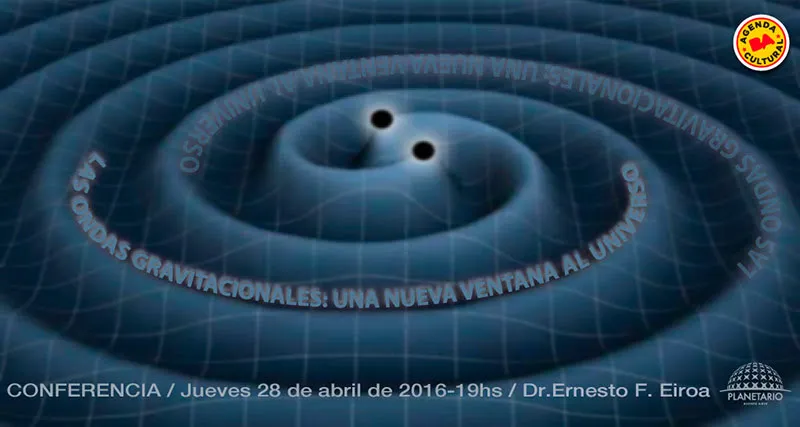
LECTURE: GRAVITATIONAL WAVES: A NEW WINDOW TO THE UNIVERSE
Thursday, April 28 at 19 h. Free activities / Room capacity 250 attendees / Admission in order of arrival
The theory of General Relativity predicts the existence of gravitational waves, a theoretical finding due to Einstein himself in 1916. They correspond to vibrations of space-time, which carry energy that propagates at the speed of light and reach our planet as a result of some distant event. Since the late 1970s there has been strong indirect observational evidence for the existence of these waves, but there had been no direct detection until their recent discovery by the LIGO observatory. From the analysis of the signal characteristics, scientists concluded that the gravitational waves detected by the instruments were produced during the final instant of the merger of two black holes. With the observation of gravitational waves, a new window to the Universe opens, which will allow us to obtain information about its origins, its evolution, about the presence of compact objects and regarding the nature of gravity, among other topics of physical and astronomical interest.
This presentation shows different theoretical and observational aspects of gravitational waves, paying special attention to the discovery announced on February 11 of this year by the LIGO-Virgo collaboration.
Exhibition
Prior to the lecture we will inaugurate an exhibition of fabulous images captured by astrophotographers and then we will present "Tonight's Sky", a live narration that describes the sky of Buenos Aires in the different months of the year: Myths and legends of the most representative constellations of the southern hemisphere, the position of the Moon and the planets, and other celestial objects only visible with telescopes, such as bright stars, nebulae, clusters and distant galaxies.
Planetarium for the blind
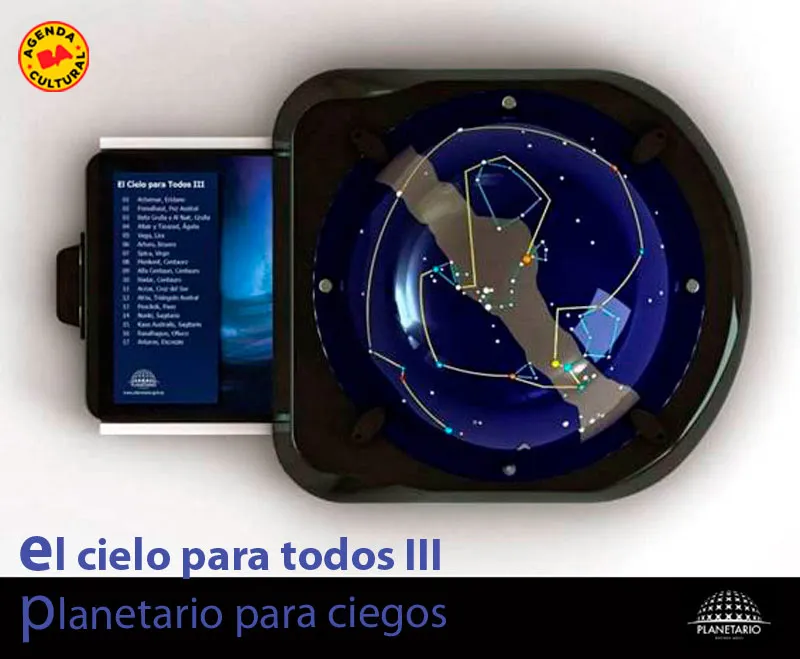
The Planetarium of the City of Buenos Aires invites you to a special show
Friday, April 29, 17:30 h.
Limited capacity, register at [email protected]
PLEASE ATTEND ONLY WITH CONFIRMATION FROM THE PLANETARIUM
The Galileo Galilei Planetarium invites those with total blindness or visual impairment to this special presentation, designed especially for people attending individually, who can come with their families and/or a companion, to share an interesting, enjoyable and inclusive activity.
"The Sky for All III" is a science outreach show, aimed primarily at blind or low-vision people.
Essentially, it is a tactile and auditory planetarium, with a recorded narration, music and soundscape. And its goal is to bring the non-sighted public closer to the knowledge of the sky, the stars, and astronomy in general. A goal centered on the premise that knowledge is a right, and as such, must be accessible to all.
During the presentation, which lasts a little over half an hour, the audience "travels" through the sky, identifying stars, constellations, and the outline of the Milky Way, and at the same time, accesses different astronomical notions (especially those related to stars).
Evolving project
Since its birth in 2001, "The Sky for All" from the Planetarium of the City of Buenos Aires has been evolving. And to a large extent it was due to the enriching experiences gathered at the end of each presentation, where attendees have shared and commented on their impressions with us. Experiences that were materialized in constant improvements that have been incorporated over the years. In its third version, the show has incorporated profound modifications and improvements over the two previous versions (launched in 2001 and 2004 respectively). On the one hand, the new script is more agile and compact, has two levels of narration, and features carefully treated complementary sounds. On the other hand, the tactile celestial map is far superior to previous versions: the relief stars now have different sizes, are accompanied by Braille indications, and the tracing of the "guide thread" and the constellations is more easily identifiable by touch. In addition, careful work has been done with the colors of the represented stars, considering that the show is also aimed at people with low vision. After 12 years of presentations and enriching experiences presented to groups and contingents convened through different institutions, on April 29, our program "The Sky for All" will be presented to an audience attending individually accompanied by their relatives and/or friends to further broaden the outreach.
Since capacity is limited, please register by email at [email protected].
Sources and related links
Galileo Galilei Planetarium http://www.planetario.gob.ar/