Can galaxy clusters be considered as Russian dolls of cosmological research? Perhaps they are "cosmic buoys floating in the sea of the Universe"? On astronomy, scarecrows, and poetry.
Throughout the decade I have been running this small blog, I have learned something thanks to criticism. Jaime García, a prominent amateur astronomer dedicated to variable stars, once taught me, through a critique, that the concept of "galactic clusters" cannot refer to clusters of galaxies. The former refers to star clusters, like globular clusters which, although not part of the galaxy, are strongly related to it, for example, the Milky Way, orbiting its nucleus. It is called the "galactic" nucleus precisely because that word suggests "belonging to the galaxy". Therefore, if we want to refer to groupings of galaxies, the term is cluster of galaxies and not galactic cluster. I have learned that lesson and I thank him publicly.
A press release from the Chandra X-ray Observatory 1 reports that astronomers have used data obtained with that instrument, as well as from Planck and a long list of optical telescopes to develop a powerful new method for investigating dark energy, that mysterious energy postulated to be what would explain the acceleration of the universal expansion.
The technique is based on the observation that the outer boundaries of galaxy clusters - the largest structures in the universe, bound by gravity - show similarity in their X-ray emission profiles and sizes. The most massive clusters are simply scaled versions of the less massive ones, explains the release. It should be added that there are also other structures called superclusters, groupings of galaxy clusters.
Andrea Morandi, from the University of Alabama in Huntsville, explains almost poetically:
"In this sense, galaxy clusters are like Russian dolls, with the small ones similar in shape to the larger ones. Knowing this allows us to compare and determine their distances across billions of light-years more accurately".
By using these clusters as distance markers, astronomers can measure how fast the universe was expanding at different times since the Big Bang. According to the general theory of relativity, the expansion rate is determined by the properties of dark energy plus the amount of matter in the universe, where the latter is mostly composed of invisible, but detectable, material commonly referred to as dark matter.
If the assumed cosmological parameters (for example the properties of dark energy or dark matter) were incorrect, then the distant clusters would not be similar, that is, their sizes would be larger or smaller than expected. The cosmological parameters are then adjusted for all clusters, so that with different masses and distances, they appear similar. The process is similar to determining the unknown weight of an object by adding or subtracting known weights from a two-sided scale until they balance.
These results, published in a paper by Morandi and a colleague 2, confirm previous studies on the properties of dark energy that would not have changed over billions of years. They also support the idea that dark energy is best explained by the "cosmological constant", which Einstein proposed and which is equivalent to the energy of empty space.
In a simple historical review, after the General Theory was published, some physicists noted that such a theory would imply that space would not be static. If the force of gravity were dominant and there were a certain amount of matter, the universe would contract. When Einstein realized this and because everyone considered (until the mid-1920s) that the universe was static, he made a modification to his theory by adding a repulsive variable to balance gravity and thus make the universe apparently static. Shortly after, Hubble's findings showed that the universe was not as supposed and Einstein considered that variable, called the Cosmological Constant, one of his biggest mistakes.
The twists of scientific discovery never cease to amaze, as since the late 1990s astronomers have pointed out that the expansion of the universe has accelerated, by studying type Ia supernovae. Since then, it has been considered that that "mistake" by the German might not be one, in a sense. There must be a "force" to explain that acceleration and since then Einstein's idea has been recovered in some form.
"Although we have strongly sought other explanations, it still seems that dark energy behaves like Einstein's cosmological constant", said Ming Sun, co-author of the paper in question.
The researchers studied 320 galaxy clusters with distances from 760 million light-years to 8.7 billion light-years. This encompasses the era when dark energy caused the then-expanding universe to accelerate.
To determine the results more precisely, astronomers used combined data from optical supernova observatories and the work done with the Planck satellite on the cosmic microwave background.
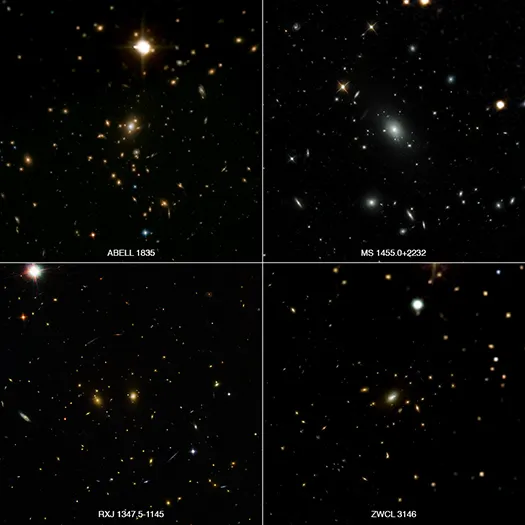
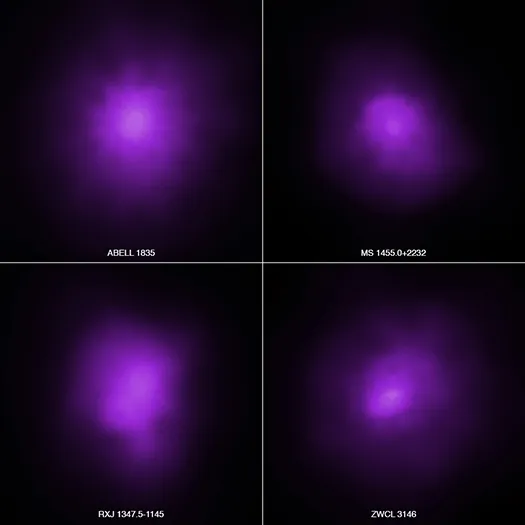
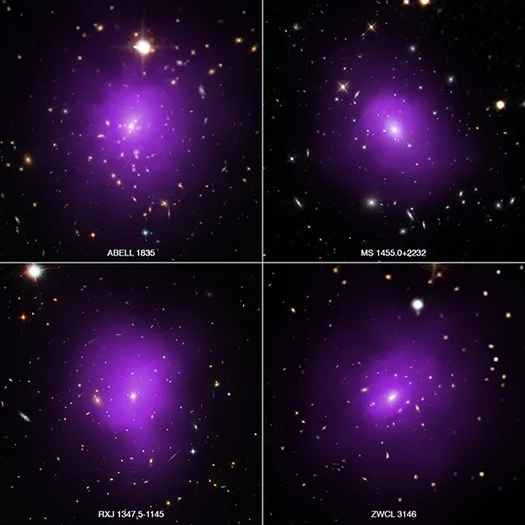
The four are: Abell 1835, MS 1455.0+2232, RXJ 1347.5-1145, ZWCL 3146. The first at an approximate distance of 3 billion light-years (z=0.253). The others: 3.1; 4.7 and 3.3 (in billions of light-years distance, approximate) respectively. We see these four clusters in three sets of images: In the first (initial image of the post) are combined data. In these here we see optical data and X-ray data.
"The nature of dark energy is one of the greatest mysteries in physics, so it is crucial to invent new tools to study its properties, since different methods can have very different assumptions, strengths, and weaknesses", explained Morandi and added: "We think this new technique has the ability to provide a great leap in the understanding of dark energy".
The cosmological poetics: buoys and matryoshkas
The Russian doll metaphor arises from the following reasoning: The amount of matter in the universe (dominated by dark matter) and the properties of dark energy (which astronomers call cosmological parameters) affect the expansion rate of the universe and, therefore, how distant objects change over time. If the cosmological parameters used are incorrect and a cluster is inferred to be moving away faster than the correct value, then the cluster will appear larger and fainter due to this 'Russian doll' property.
As the astronomers explain in the paper, these galaxy clusters are considered similar not in their entirety, but particularly in their outer parts.
The X-ray emission from those parts is what is compared and summed, excluding the central parts because there are large differences between the properties of different clusters caused by outbursts from supermassive black holes and star formation.
On the Chandra Observatory site, Dr. Andrea Morandi (of Italian origin, of course) shares his personal scientific perspective on this work 3.
He notes that in the summer of 2015, upon seeing a graph in a paper, galaxy clusters were defined as 'cosmic lighthouses'. However, he thought, if they were, they would not 'feel' the underlying physical properties of the universe. Instead, he thought of another metaphor: clusters would be like 'cosmic buoys floating in the sea of the universe'.
Continuing with the metaphor, he explains on the Chandra blog, we can tell if that 'sea' is rough or calm (or how fast the universe is expanding due to dark energy) by observing the buoys. With data from 320 clusters, he explains, scientists can measure the expansion rate of the universe by studying how dark energy pushes away the clusters that act as cosmic buoys. A true poetic legacy for cosmological science.
Morandi and poetry
On a personal page, Morandi says he is a lover of poetry 4 and quotes lines from the film 'Dead Poets Society', for example. Both on that site and on the Chandra blog, a personal photo of the astronomer next to a scarecrow is published. Perhaps the Italian is not familiar with Girondo. I don't know. But knowledge is about that. About knowing that we don't know.
It's impossible not to relate it to Girondo's famous calligram in Espantapájaros (al alcance de todos) from 1932 5. I invite you to watch the video and read the entry indicated here.

Sources and related links
- 1 'Russian Doll' Galaxy Clusters Reveal Information About Dark Energy
http://chandra.si.edu/press/16_releases/press_042816.html - 2 Andrea Morandi and Ming Sun
Probing dark energy via galaxy cluster outskirts
MNRAS 2016 457: 3266-3284.
DOI: 10.1093/mnras/stw143 - arXiv:1601.03741 [astro-ph.CO]
http://arxiv.org/abs/1601.03741 - 3 Chandra Blog: 'Russian Doll' Galaxy Clusters Reveal Information About Dark Energy
http://chandra.si.edu/blog/node/595 - 4 Personal site of Dr. Andrea Morandi
https://sites.google.com/a/uah.edu/andrea-morandi/Personal - 5 Blog La biblioteca de Jules: The friendship of word and image
https://labibliotecadejules.wordpress.com/tag/caligrama/
About the images
Credits: X-ray: NASA/CXC/Univ. of Alabama/A. Morandi et al; Optical: SDSS, NASA/STScI