It won't be made by film directors, but by astronomers. And its stars will be... stars!
Hollywood is buzzing. George Lucas or Steven Spielberg must be thinking "Why didn't I think of that?". The first movie of our Universe will be produced by astronomers. It will have dangerous protagonists (asteroids) and mysteries like dark matter and dark energy.
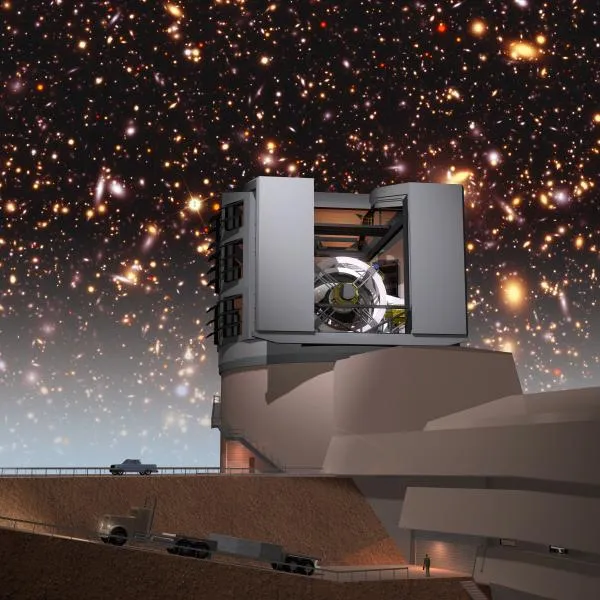
The thing is, when completed, the Large Synoptic Survey Telescope (LSST) will be capable of taking images of the sky covering 40 times the area of the full moon 1, thus creating a survey of the entire visible sky in just three nights. That means billions of galaxies, stars, solar systems that will be seen for the first time and monitored over a decade.
LSST will create a very detailed map of galaxies with their approximate distances from each other, from which we can learn about the mysterious nature of dark energy that seems to be accelerating the expansion of the Universe. But it will also detect changes in the sky night after night: objects with high relative motion like asteroids and new objects or those whose brightness varies, like supernovae. Covering every part of the sky about 800 times during its decade of operations, the professionals in charge of the instrument will create the first movie of the Universe.
When it begins operations, it will generate one of the largest scientific databases in the world. LSST will conduct a "synoptic" survey because it will form a general view of the cosmos: billions of objects portrayed in six colors, spanning a volume of space-time larger than any previously explored.
Steven Kahn, Director of LSST, said: "LSST will be one of the premier astronomy projects in the coming decades" and added that "The telescope is being built in the Andes of Chile, on Cerro Pachón. The weather conditions there are the driest on Earth, ideal for astronomical observation".
"What makes LSST unique is that each of its images covers an area of the sky to a depth that captures faint objects and does so very quickly. That combination of area, depth, and speed means we can do many scientific studies with the same dataset", explained Sarah Bridle, from the University of Manchester. The United Kingdom will participate in the survey which was originally American and is becoming international (with participation from Brazil), thanks to funds supplied by that country's Science and Technology Facilities Council, the STFC.
First light for the instrument is expected in 2020 and its main survey will begin in 2022. Like the great movie sagas, the story of LSST will be told in stages, from a preview in 2023 to the finale in 2033.
Name and numbers
LSST is a "synoptic" telescope since the word, which derives from "synopsis" meaning according to the DRAE:
1. f. Graphic arrangement that shows or represents related things, facilitating their joint vision.
2. f. General exposition of a subject or matter, presented in its essential lines.
The instrument will produce a 6-band survey (0.3-1.1 microns) of more than 20,000 square degrees of the southern sky using an 8.4m primary mirror with an effective aperture of 6.7m. f-ratio = f/1.234.
Each part of the sky will be visited about 1000 times in ten years. It has a 3200 megapixel camera, a field of view of 9.6 square degrees, and a data handling system to manipulate 30 TB of information every night!
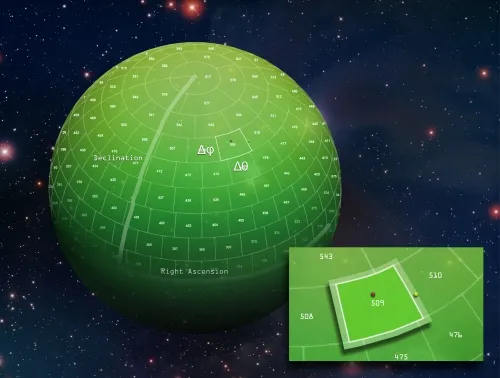
Here I stop to mention that they have designed a special system to host and search the data. The LSST database team developed an innovative overlapping partitioning method to store huge amounts of information for fast access. By overlapping equally sized packets of information on the partitioned sphere, searching for the nearest neighboring sources is fast and efficient. The improved algorithms resulting from this innovation architecture will be available as open source software.
It has a camera that measures 1.65x 3 METERS and 3.2 gigapixels.
Final database size (for data release 11, DR11) = 15 PB
Final disk storage = 0.4 Exabytes
1The angular diameter of the Moon as seen from Earth is about 30-34 minutes, that is, half a degree. This implies that the Moon is 0.5 degrees in diameter (half would be the radius) and therefore, 0.2 square degrees. It is calculated as π(0.5/2)2.
Just as degrees are used to measure circles, square degrees are used to measure spheres. If LSST covers 9.62 square degrees, then 9.62/0.2=48.
Sources and related links
- Billions of galaxies set to star in the ‘greatest movie ever made’
http://www.manchester.ac.uk/discover/news/billions-of-galaxies-set-to-star-in-the-greatest-movie-ever-made - LSST
http://www.lsst.org/ - LSST Science Book, Version 2.0
arXiv:0912.0201 [astro-ph.IM]
http://arxiv.org/abs/0912.0201 - LSST: from Science Drivers to Reference Design and Anticipated Data Products
http://arxiv.org/abs/0805.2366
About the images
Initial illustration: Todd Mason, Mason Productions Inc. / LSST Corporation
Data Mining Sphere: LSST