How to take advantage of music in science education.
In the journal International Journal of Science Education, researchers Gregory Crowther and others [1] publish a paper on how video songs can be used to teach science. The paper can be read (in English) in full on the Taylor & Francis website (see link below).
Their work focuses on what is known in English as STEM, an acronym that refers to Science, Technology, Engineering, and Mathematics and is used in educational contexts. There are specific concerns in developed countries about generating greater youth engagement in careers linked to STEM knowledge, largely because they are needed in industries.
Another concept the researchers use is K-12 science, which refers to educational systems like the American and European ones and encompasses what in other latitudes we call early childhood education (k is for kindergarten), primary, and secondary school, up to "12th grade" which includes students up to 19 years old.
In the introduction, the authors of the paper point out different approaches and strategies on how to improve science education, but will focus here on the role of music.
They indicate that music plays a role in youth in relation to their sense of identity and belonging; different musical genres are associated with styles of dress, ways of speaking, as indicators of belonging to groups. Furthermore, youth, they indicate, use music to explore their internal values and feelings.
Music, therefore, could be a form of entry (making it a strategy we could call "entryism") into scientific discourses.
To know to what extent this is true, in addition to extensive bibliography on the subject, experiments are conducted. We will see which ones these researchers have done.
Study A
The question that guided this first study is: To what extent does watching music videos rich in content increase the understanding of science concepts?
Therefore, music in this study is intricately associated with videos and thus is an exploration of audiovisual discourses.
The videos used were chosen with the following criteria: they are interesting from a musical point of view; they include valid STEM content for a multiple-choice type test; and they were accessible on YouTube.
A majority of such videos were created by professional educators or by professional musicians.
This study was one of the components of five science outreach events organized by others in Washington.
Protocol
The researchers set up a stand or table at these events. The public was informed of the experiment's objective, which consisted of using a laptop with headphones to access the www.singaboutscience.org site to the Quizzes section. From there they chose a video according to their age and interest. Clicking the video title opened a preview of the video in a new window with a test of five questions, plus questions about the participants' age, sex, and other characteristics. Then, upon clicking CONTINUE, they watched the video. At the end, they had to answer the same questions as before watching the video and were then shown the correct answers to each question.
A total of 568 data sets were completed from a total of 550 people (a few watched more than one video). The total number of males and females was similar (278-260 respectively). 6% were under 8; 54% between 8-12; 24% between 13-17 years old; 4% between 18-22 and 12% over 22.
They used a classification of the tests based on Bloom's Taxonomy [2].
It should be noted that among the five questions of each test, one question was included that had nothing to do with the video's content. We will see next the reason for that inclusion.
Results
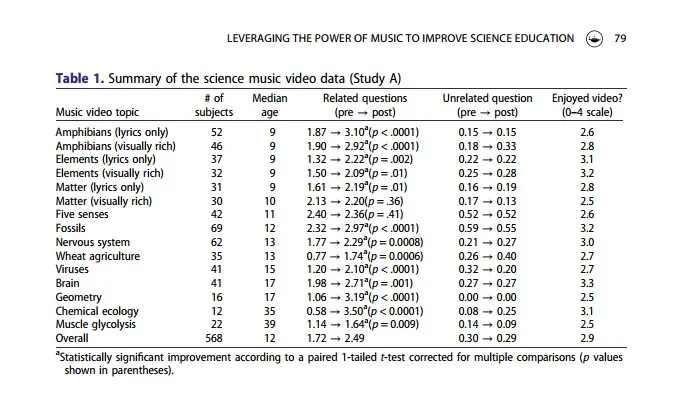
The data suggest that the subjects' performance improved after watching the videos, except on the "bonus" questions, meaning that a correlation between content-form could be established.
Table 1 summarizes the results. I will set aside a detailed (statistical) explanation of this table. It is enough to note that the first column indicates the number of participants, the second their average age, the third indicates three values. The pre-video, the post-video, and in parentheses what is known as the p-value. The next column shows the pre and post of the unrelated question and finally the subjects' indication of whether they enjoyed the video on a scale from 0 to 4.
According to the researchers, the post-video improvement reflects genuine comprehension.
Study B
In a second study, they sought to compare music videos and non-music videos.
The result is somewhat striking: they did not find substantive differences between music videos and non-music videos, except that the subjects said they enjoyed the former more. This allows the conclusion that music improves the enjoyment of science lessons without that necessarily improving understanding.
Study C
This study delves deeper into the previous one and attempts to identify if the effect is only short-term or also long-term. The video "Fossil Rock Anthem" was used for this test, which is a parody of "Party Rock Anthem" by LMFAO, a song chosen for its popularity among the target audience.
Two versions of the video were made, one with music and another with "just facts," which is therefore called Facts.
The test was conducted in each case twice, with a difference of 28 days.
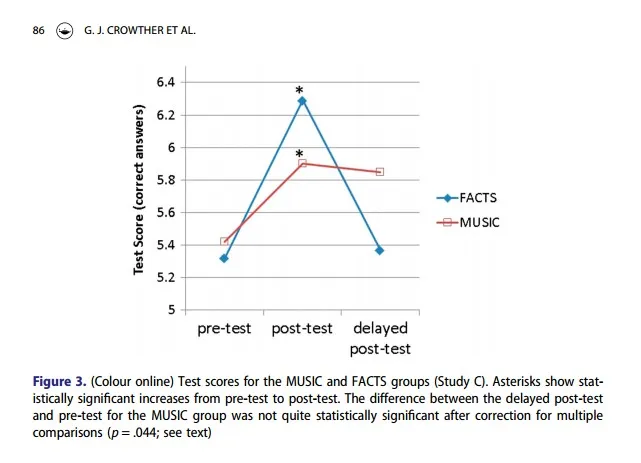
Both groups improved between pre and post, although the FACTS group was a bit better. But 28 days later the improvement of the FACTS group regressed and the improvement of the MUSIC group remained, as seen in Figure 3 of the paper.
The authors are aware of the limitations, but also of some strengths of these studies, which, of course, must be conducted in greater numbers and with greater considerations.
REDUCTIONIST INTERPRETATIONS
It is worth drawing our reflection to the problems and solutions of education. Recently in Argentina, the "failing grade" was re-imposed in the educational system, having been removed in the past. In both cases, although the direction was opposite, the diagnosis seems the same: it would be the failing grade that limits students and therefore that would be the problem of education or, conversely, the problem is the lack of a failing grade. Although the direction is opposite, the sense is the same: the problem of comprehension in science is reduced to a single variable.
Interpreting the present work in the same way would be deplorable. Music and videos can be a tool. But let's not ignore the existence of many other variables that make up education and let's not overvalue the use of technology as a "savior" mechanism for problems, which are more complex. On the other hand, a blackboard and chalk are also "technologies".
ON THE AUDIOVISUAL
The word "text" is often associated with linguistic discourses, that is, with words and particularly written ones. It is possible, however, to consider a video as a text that does not possess only linguistic signs, but also other types of signs.
However, when we learn to read and write we do so with a grammar (there are, however, different grammatical approaches or theories), but what grammar does a video or a film have?
Actually, an audiovisual production possesses many "grammars" which, however, are not necessarily taught as is the case with THE grammar.
Therefore, if difficulties in the comprehension of a WRITTEN text have been documented, how many more difficulties will we have in making a comprehension of an audiovisual text!
Therefore, using videos intensively in classes of different sciences (and there is another point I will indicate below) without those teachers and students having a more thorough knowledge of "audiovisual grammars" that allows identifying the sign elements of those materials, may not be a good approach.
STEM and positivism
Words admit multiple meanings and the word "positivism" does not escape this rule.
I will say that in at least one sense, the concept refers to:
1-A mechanistic-Newtonian perspective
2-A "de-ideologized" perspective under the assumption that studying natural phenomena and objects does not include any "subjectivity"
3-And, as a result of the two previous ideas, the concept of "science" is associated with the natural and exact sciences and NOT with the social sciences, which are diminished to a sub-scientific subcategory for being considered "subjective" or "ideological".
Positivism, however, can be understood as a necessary overcoming in the face of the magical thinking of the Ancien Régime. This does not preclude it from being criticized at the same time. It is an overcoming that must be overcome. The social sciences are as "scientific" as the natural sciences and the latter are not "neutral", but are in themselves social practices.
The STEM approach seems to be, in this sense, positivist. Note that the S of the acronym refers to "Science", but when its content is detailed we notice that it refers to natural and exact sciences. The three studies indicated above were conducted, as explained, with videos. Let's look at the list of videos used (below) and we will notice that, indeed, their "content" is about natural sciences and not about social sciences. Is it not possible to study history or economics scientifically?
Aside from whether it is possible, could it be that there is no "demand" for this social knowledge from industry as there is for STEM knowledge?
Should the development of scientific thought be tied exclusively to industrial development?
Is not such development also economic?
It happens that economics is a science, but a social science. As can be seen, it is not true that everything is related to everything, but it is true that in reality things and sciences are intertwined. Objectively it is so, although this may not "sound" good to some.
The videos used in these studies
From the supplementary materials I extracted the list of videos used. Note that in some cases the music appears not at the beginning, but at the minute, in some cases there are two versions, one with the song lyrics and in one of the tests "distractor" videos were used.
I have compiled these videos in a YouTube playlist (except for the distractor videos) which can be viewed here:
https://www.youtube.com/playlist?list=PLZGPCBUBDuiG2vvOotQfF0dqmCs4VOt-Q
“The Double Life of Amphibians” by Two Of A Kind (recommended for grades 3-6)
http://www.youtube.com/watch?v=Oan3TX_eMr8 (visually rich)
http://www.youtube.com/embed/E52Oy0ITojM (lyrics only)
“Five Senses” by Thomas H. Culhane (recommended for grades 3-7)
http://www.youtube.com/watch?v=pYL6QYkhQ_M
“Meet the Elements” by They Might Be Giants (recommended for grades 3-6)
http://www.youtube.com/watch?v=Uy0m7jnyv6U (visually rich)
http://www.youtube.com/watch?v=q6yv4IbRWII (lyrics only)
“Shake” [states of matter] by Lodge McCammon (recommended for grades 4-6)
http://www.youtube.com/watch?v=ulxV-LIir1Q (visually rich)
http://www.youtube.com/watch?v=x91sRYKO3hE (lyrics only)
“Ain’t It Beautiful?” [wheat agriculture] by Monty Harper (recommended for grades 5-9)
http://www.youtube.com/watch?v=rMUNbi-oIII
“Fossil Rock Anthem” by Tom McFadden (recommended for grades 5-9)
http://www.youtube.com/watch?v=ClJ5lwl_wM0
“Nervous System” by Mr. Parr (recommended for grades 5-8)
http://www.youtube.com/watch?v=YRwPMICvbT4
“I’m a Virus!” by Glenn Wolkenfeld (recommended for grades 9-12)
http://www.youtube.com/watch?v=kYf_Sl8W3qY
“Ode to the Brain” by Symphony of Science (recommended for grades 8-12)
http://www.youtube.com/watch?v=JB7jSFeVz1U
“Tau” [geometry] by Marc Gutman (recommended for grades 9-12)
http://www.youtube.com/watch?v=uAFU-K4M9Ck
“Necessary But Not Sufficient” [muscle glycolysis] by Science Groove (“super-advanced”)
http://www.youtube.com/watch?v=8HX34kHHDow
“Sagebrush” [chemical ecology] by Students of Jeremy Long (“Super-Advanced”)
http://www.youtube.com/watch?v=LzQadI_yUTg
“Simple Machines” by David Newman https://www.youtube.com/watch?v=IFRSqvPdjSQ (musical version; 2:32)
https://www.youtube.com/watch?v=O-Xy7Rbwnzs (non-musical version; 2:59)
https://www.youtube.com/watch?v=l0GCJPFbUI0 (distractor video)
“Cell Theory” by Jeramey Tamez https://www.youtube.com/watch?v=ovjfNBSlOc4 (musical version; 1:05)
https://www.youtube.com/watch?v=F6eI_WVZKiM (non-musical version; 0:54)
https://www.youtube.com/watch?v=V96_PjlrVQc (distractor video)
“You Start at the Anode” by Mark Rosengarten https://www.youtube.com/watch?v=gixnW8OdH3E (musical version; 1:37)
https://www.youtube.com/watch?v=jglGY5-cl4k (non-musical version; 1:37)
https://www.youtube.com/watch?VZ5bPYNvvKs (distractor video)
“Myofibrils” by Science Groove https://www.youtube.com/watch?v=f9PMRUL6XB8 (musical version; 1:47)
https://www.youtube.com/watch?v=WIqGxoZarH8 (non-musical version; 1:26)
https://www.youtube.com/watch?v=vgs1pcb1xDk (distractor video)
“Fossil Rock Anthem” by Tom McFadden http://www.youtube.com/watch?v=ClJ5lwl_wM0 (song; 3:16)
http://www.youtube.com/watch?v=ydNmAavzwDc (just-the-facts version; 2:52)
Sources and related links
- [1] INTERNATIONAL JOURNAL OF SCIENCE EDUCATION, 2016
published by Taylor & Francis
VOL. 38, NO. 1, 73–95
Leveraging the power of music to improve science education
Gregory Crowther, Tom McFadden, Jean Fleming and Katie Davis
DOI: 10.1080/09500693.2015.1126001 - [2] Taxonomy of educational objectives
https://es.wikipedia.org/wiki/Taxonom%C3%ADa_de_objetivos_de_la_educaci%C3%B3n - SingAboutScience.org
http://singaboutscience.org/wp/homepage/
About the images
Initial image: Logo of the site SingAboutScience.org
Table 1 and Figure 3 from the paper Gregory Crowther et al (2016)