Is it true that human beings are made of the same materials as stars, plants, animals, machines, furniture, and everything known?
The reader Octavio, from Colombia, writes to ask me what I meant at the end of a recent interview when they pointed out the equality in the composition of stars and people and I indicated that was false. The interview in question was conducted by Fernando Freixas for the program "Pueblo Chico" on Radio Uno (103.1 FM) and can be heard here:
http://radiocut.fm/audiocut/entrevista-a-gerardo-blanco/
The process of knowledge can be thought of as pendular, in a cycle that renews itself and has two positions (of progress and of regression).
Since antiquity, it was easy to notice, even with less information than today, the existing differences between stars, planets, plants, animals, and human beings. These differences—which were noticed for being remarkable—however lacked good definitions because there was less knowledge available.
Over millennia, we have advanced somewhat. Modern science, relating discoveries in chemistry and astronomy, tells us that everything known is made of the same materials. That is, the discourse of popularization, in this case, focuses on the common denominators more than on the differences.
This procedure is very interesting: to show, to make evident something that exists, that is real, but that most of society does not perceive, even though what is shown is only ONE PART of the totality. This procedure is valid, as long as one does not fall (pendularly) into thinking the opposite of before when reality is NOT like that.
THE THESIS "EVERYTHING IS CONNECTED TO EVERYTHING" or "LEGO PHILOSOPHY"
Paradoxically, the popularization discourse in contemporary sciences resembles ancient thought in that for millennia it has been postulated that everything that exists possesses a divine spark and, therefore, everything is connected to everything.
Science, currently, seems to uphold the same thing, in a different way: what exists in everything would not be a divine spark, but the chemical "elements," basic building blocks of EVERYTHING known.
Is this true? Next, I am going to cast doubt on this idea and I will do it in two ways. To be more specific, I am going to divide my arguments into two parts, based on two statements.
Statement 1: human beings are like the stars because we are composed of the same chemical elements formed in celestial bodies.
Statement 2: human beings are composed of the same materials as everything that exists (stars, galaxies, dogs, houses, cars, etc.).
It is easier to cast doubt on the second statement based on the dark matter hypothesis. A few decades ago, based on the discoveries of astronomers (particularly the astronomer Vera Rubin), researchers point out that most of the matter in the Universe would be a form of matter DISTINCT from EVERYTHING KNOWN until now. That is, a form of matter DIFFERENT from that which composes stars, dogs, cats, furniture, and everything else (although it would be indispensable for the formation of galaxies, perhaps also of stars).
However, dark matter remains a hypothesis, despite the fact that successive investigations have narrowed the possibilities and therefore it is possible to expect soon some resolution to the enigma that, it seems to me, the astronomical community hopes will be a confirmation of the hypothesis.
If the hypothesis is not confirmed, we would have a nice problem.
But if, as seems to be the current scientific consensus, the existence of dark matter is confirmed, then, the thesis of "everything is connected to everything" that has been upheld from Carl Sagan to the present in popularization would enter into crisis.
It is more difficult to cast doubt on statement 1. What follows is an argument that is more philosophical than scientific, even though it includes modern scientific notions.
The idea that we are made of stellar material arises from the knowledge of stellar nucleosynthesis, which can be told simply as follows:
Primitive stars, the first generations, formed from clouds of matter that were almost exclusively hydrogen. Let's imagine hydrogen atoms as Lego-type building blocks.
If we use that analogy, those blocks would all be the same, say yellow blocks.
But in the recipe to make a star, another ingredient is needed: gravity. Gravity is energy and, since energy and matter are two sides of the same coin, then it is another ingredient of matter. However, in this recipe the ingredients can be differentiated: yellow blocks (hydrogen atoms) and white blocks (gravity). These blocks are similar to each other, though differentiable.
As gravity compresses matter, the temperature increases, in a process similar to what happens when we put water in a pot over a fire: the fire is energy that passes to the H2O molecules, which therefore move faster. The average speed of the molecules is what we know as temperature. Since energy is permanently input into the system, the molecules quantitatively increase their speed and therefore, the temperature quantitatively increases. Until a critical point is reached (boiling) where a qualitative change occurs: the water goes from a liquid to a gaseous state.
In an analogous way, gravity, by compressing matter (hydrogen atoms) quantitatively increases the temperature of the system. And at a critical point, a qualitative change occurs and the atoms can fuse. So this thermonuclear fusion process consists of two compressed white blocks, at a critical moment, being able to fuse and create a new form of matter: orange blocks (helium atoms).
These new building blocks can be distinguished from those that gave rise to them, but they are very similar. In successive processes, the basic elements will fuse in stars to create heavier elements. In the end, the primitive stars expelled their outer layers into space. From that material, the second generation of stars would later form, no longer from a cloud of white blocks, but from material that included white, orange, and green blocks. And once again, the same mechanism was resumed to produce enriched elements that were also expelled into space and led to the later formation of third-generation stars.
In this way, the elements we know from the periodic table were produced, except for hydrogen, a small amount of helium and lithium (which would have formed as a consequence of the big bang) and those other elements that do not form naturally but could be created in laboratories.
This process could be thought of as follows: there are certain basic building blocks (atoms, gravity) that, when related to each other, give rise to different structures: stars, planets, galaxies.
That is, matter is capable of transforming into other forms of matter.
Let's advance a bit further: in some cases, this mechanism achieves something astonishing: the new matter (generated by matter itself) is qualitatively distinct from previous forms: LIFE is formed. Science still has problems defining what life is and how it is produced exactly. In the case of Earth, we can appeal to the concept of "primordial soup" (or "primordial broth") as a set of ingredients (whose key is water) that, through reaction to radiation (another form of matter), would have formed the first unicellular and then multicellular organisms that could replicate (meaning there are "replicants" long before Blade Runner).
And here, then, given the qualitative and substantial difference between forms of matter, a greater distinction would be valid: there is matter that, despite its difference, can be thought of as equal: inert and basic matter (atoms, gravity).
The interaction between those forms of matter gives rise to LIVING matter, more complex, formed not only by basic blocks, but by more complex structures: molecules, proteins...
And in biological evolution, a form of matter then emerged that also requires another classification: CONSCIOUS living matter, which can think and think about itself, communicate and create libraries, cathedrals, universities, wars, bombs, poems.
Living matter, however, deserves subclassifications: a worm is not the same as an octopus: some living forms possess a central nervous system, more or less complex.
THE MATERIAL METAMORPHOSIS
So we have developed a sort of material ontology, therefore monist, but pluralist: matter is NOT all the same. And then, the primitive differences we had noticed can be taken up again, but in another way, without denying the common denominators, but on the contrary, thanks to the fact that they exist.
Matter generates new forms of matter (we can appeal to the concept of "emergentism"), in transformation processes, like larvae that become chrysalises that transform into butterflies.
In this analogy, stars would be a phase prior to larvae, that is, a form of matter created by basic building blocks and resulting in simple matter. I say it is simple not because it is easy to understand the stellar formation process, which is complicated and full of advanced mathematics (what astronomers dedicate themselves to), but because it is a form of matter MUCH LESS COMPLEX than others like those that have life and those that have conscious life.
Therefore, saying that human beings are like stars or furniture is seeing only part of the issue. It is true that in all those cases (except for potential dark matter) the basic building blocks are the same. But it is false that we are only basic building blocks. Not even stars are only that.
And even less so people. We are NOT objects, we are complex beings, enriched not only by a long natural and biological process, but also by more complicated social processes. We have developed languages and societies that would be impossible to think of without socialization processes.
So when we hear or read that we are like stars, we can think that whoever says that is telling us only part of the issue, based on a Lego/Minecraft-type interpretation of reality. That is not a completely false story and is valid insofar as it is not easy, without knowledge, to notice the common denominators among the matter known so far.
But immediately after, it is necessary to tell the rest of the story. That is why human beings are not objects of exchange (playmobils), but subjects of change, which is quantitatively and qualitatively different from being pieces of rock or groupings of gas or the mere accumulation of basic blocks.
Sources and related links
- Wikipedia: Primordial broth
https://es.wikipedia.org/wiki/Caldo_primigenio - Wikipedia: Emergentism
https://es.wikipedia.org/wiki/Emergencia_(filosof%C3%ADa)
About the images
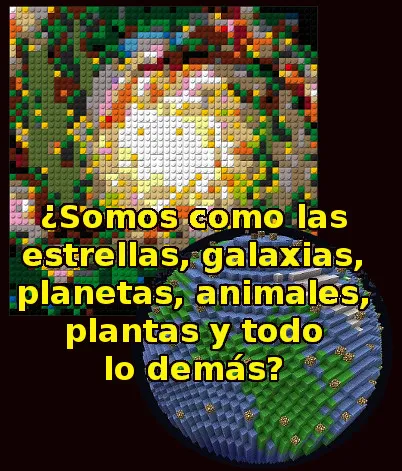
Initial image: I used the Photobrix service to create the image of a "Lego-type" galaxy and an image from Planet Minecraft.
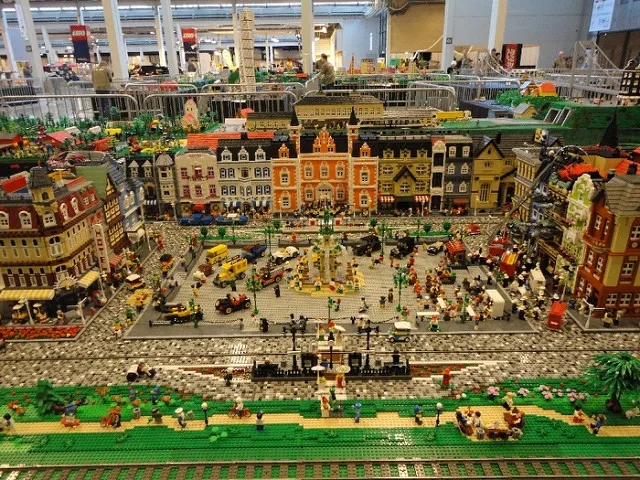
Image 2: Flickr: LEGO World Kobenhavn 2011, by Matija Grguric https://www.flickr.com/photos/matijagrguric/5457215712
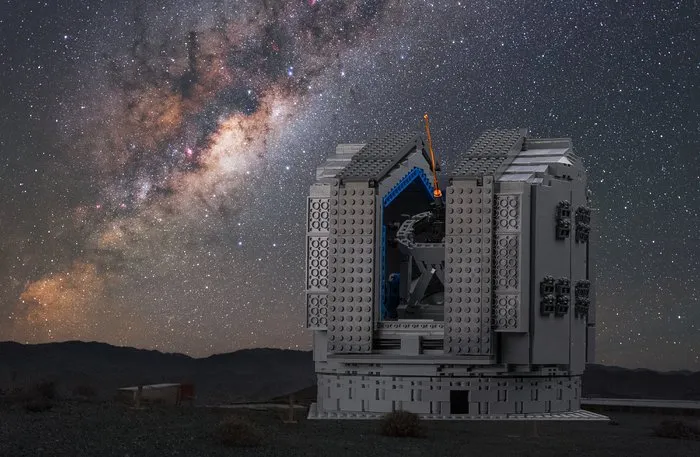
Image 3: LEGO® model of the VLT against the real Milky Way
Model of the VLT by Frans Snik is placed in front of a background photograph, from the telescope's current location in the Atacama Desert in Chile, with the Milky Way rising majestically into the sky.
Credit: Y.Beletsky/ESO/F. Snik/M. Zamani https://www.eso.org/public/spain/images/ann16013b/