A reflection on the possibility of updating the constellations.
I will not be the first one here to reflect on whether the 88 constellations with their corresponding boundaries -established between 1928 and 1930- should be modified. In previous articles I have already addressed the issue, for example, from a "multicultural" point of view, that is, considering that a large part of the "modern" constellations are a legacy of the Greco-Roman and, in general, European tradition.
In this case, my reflection takes another point of view. In a quick review of the official asterisms, it is possible to establish a categorization -not free of conflicts- like the following:
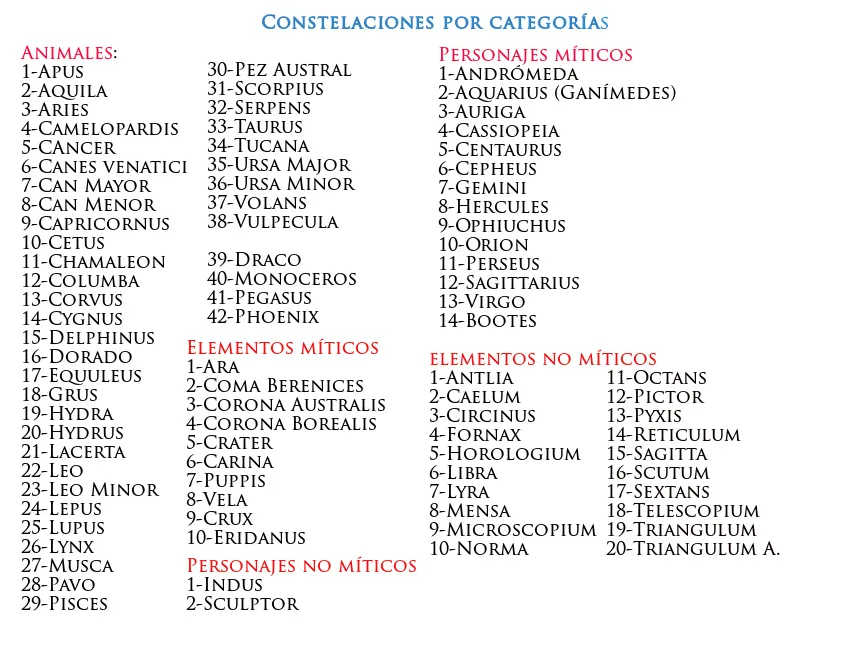
I insist that these labels can well be reviewed. It is remarkable how almost half of the constellations we inherit refer to animals, whether real (though in many cases associated with mythical tales) or imaginary.
Furthermore, I count 14 mythological characters and about ten elements (things) that also refer to myths.
In the Non-mythical Characters category I included "the Indian" who, however, was thought of by the conquerors as a kind of "animal"; and the Sculptor, which does not have a mythical story as a basis and whose profession is still current.
Finally we have 20 constellations that refer directly or indirectly to existing or intelligible things. In this category, the three parts of the former Argo Navis could also be included.
Many of these symbols were proposed by Lacaille in the mid-18th century and are the most "modern" of the imagined constellations.
So I wonder, how many of the constellations reflect modern society?
The question has multiple nuances to consider, but I will address two, namely:
A-What do we call modernity?
B-Is it necessary for constellations to reflect modernity?
A1-MODERNITY
Some authors consider that the process of modernity can be thought of from the 15th century onwards, from which a series of important processes occurred such as the fall of Constantinople, the discovery of America, and the invention of the movable-type printing press. These and other processes (scientific, industrial, French revolutions), migration from the countryside to cities, gave rise to capitalism and industrialization, especially in Europe from the 17th century onwards.
If we take the 15th century as the beginning of modernity, then the Bayer, Plancius, Lacaille, Hevelius, Brahe constellations would be modern.
It is possible, at the same time, to consider that modernity is a process that underwent significant changes so as to subdivide this period into stages. For example: first modernity, high modernity, late modernity (contemporaneity).
But it is also possible to point out that modernity was established in the 15th century and extends until the 18th century.
And that the Contemporary Era began from the 17th century.
However, in art history we will find that the concept of Contemporary Art is strongly associated with the 20th century (from the end of the 19th century).
The most "modern" constellations from those listed above and which are "official" are those proposed by Lacaille at the end of the 18th century. Therefore, among the 88 current ones, there are no constellations proposed during the last two centuries.
A2-THINKING ABOUT CONTEMPORANEITY
Before moving to the next point, what has been said so far is valid for reflection: If we wanted to include constellations that reflect contemporaneity, what signs-symbols would achieve such an objective?
It is possible to think about the question regardless of whether this thought requires modifying, expanding, or removing constellations used until now. It would, therefore, be an abstract reflection, in that sense.
The valuable thing would be: what are we, as a contemporary society? What identifies us, what objects, characters, professions, indicate what we currently are as a global society, regardless of cultural differences?
I will indicate some ideas below, but I believe that at this point the valuable thing would be to know several opinions with their corresponding arguments. In each case, there would be a different interpretation of global reality.
If something has characterized us throughout history, it is that there have been leaders and the led: The monarch, the pharaohs, the emperor, presidents, prime ministers; slaves, workers, artisans, merchants, laborers, employees.
These differences account for power and work. Among the mythological constellations there are indirect references to professions, such as Orion (the hunter) or Bootes, the ox-driver or herdsman. Although as professions these have not disappeared, it would be absurd to consider that such professions account for contemporaneity.
But Lacaille added elements that do come close to our days: Fornax, the furnace, to cite one case.
That example is good for relating objects to professions, although it is also possible to do so with people-characters as symbols of certain jobs, like the Sculptor.
In this sense, if there is an element that characterizes a large part of contemporaneity and jobs, it is the computer (whether desktop, laptop, smartphone, or other electronic devices).
Another element that characterizes modern life is money, coins, or currencies.
Also the educational system, whether through schools, colleges, or universities (which can be thought of as buildings, but also as professions: the teacher, the professor).
Transportation systems, whether cars, trains, subways, airplanes are symbols of current times. Argo Navis, already cited, referred to a sailing vessel associated with certain myths.
The media, from the telephone to newspapers-radio-TV-cinema are not only symbols of contemporary communication but also of professions and art forms (like the sculptor or Lyra).
Undoubtedly, the invention of the internet also marks the times we live in.
If money is also a symbol of the economic system (as banks could also be), politics -which has existed since antiquity- could also be symbolized by a rostrum (which could also serve to refer to media).
The clock as a way of measuring time is not a modern invention if we go back to sundials and other forms. But that it is an element that is also contemporary, there is no doubt. There Horologium has its place.
B1-WOULD IT BE USEFUL AND NECESSARY TO UPDATE THE CONSTELLATIONS?
There are different uses and needs. Is it useful to listen to music? It is possible to answer the question based on certain scientific studies that relate hearing music to the faster recovery of patients with certain ailments (music therapy). But do those of us who do not have such ailments not find music or other art forms useful and necessary?
Theater is useful, although its usefulness is different from that of a hammer. It is a form of communication and expression and, as far as I understand, communicating and expressing oneself is useful and necessary.
Constellations were used in antiquity to tell stories that made it easier to remember the relative positions of stars, which was useful for guidance on land and in navigation.
But the stories associated with the asterisms reflected the way those past inhabitants and societies interpreted reality (their ideology).
Lacaille proposed constellations that referred to processes occurring in his time: the air pump, the telescope, the octant, the microscope...
Several constellations from the 17th century (Bayer) refer to animals recently known in America after the discovery of the "New World" (Tucana and others).
As noted at the beginning, this time I will not refer to asterisms imagined by various cultures, including pre-Columbian ones, but if we also took those into account, is it far-fetched to point out that constellations have been a reflection of what societies thought about reality, about their natural and social environment?
If that were the case, then this mechanism or process of identification seems to have been interrupted in the last two centuries.
B2-NAME CHANGES
On other occasions, different social sectors and for various reasons have proposed changing the names of "things." It is very common for this to happen with street names. Perhaps it is the most economical way to pay tribute. It also happens with cultural institutions (museums, schools) or train stations, subways, etc.
Name changes can occur for different specific reasons, but it is possible to find common denominators: something (a person, a historical period) is not sufficiently reflected in the names used, while others are overrepresented.
A recent case in Buenos Aires: the name of the Avellaneda station on the Roca Railway was changed to "Darío Santillán and Maximiliano Kosteki." While the first name referred to a president (whose surname has been used on multiple occasions for streets, schools, and the municipality that still bears that name), the new names refer to two protesters murdered in 2002 near that station.
What is the use? It arises from the need for memory, to remember not only presidents, to not forget events that are intended to be kept in living memory.
These changes often generate complaints about possible negative consequences, for example, from merchants who have stores on a street and consider that the change would harm them. It should be noted that during a transition period, streets with modified names are referred to using both the new and the old nomenclature. And after a while, we get used to them and the maps are updated.
Recurrent visual observers might complain about any possible contemporary change to the constellations. The harm could be mitigated by maintaining the current boundaries, changing only the name and reference. It must be said that since the establishment of modern boundaries, inconveniences with such a division have been pointed out, for example, because some constellations are too large or have one part in the northern hemisphere and another in the south.
B3-FORGET THE PAST?
It is not about forgetting the past or hiding what we don't like. Besides, if it were, what about the constellations that have been set aside?
In any case, it is possible to maintain traditional constellations but remove some to add others. If the "modern" constellations (which maintained the Roman tradition) are from 1930, we are 14 years away from their centennial. Wouldn't it be possible, within a decade and a half, to review the constellations?
One alternative is to remove "repeated" constellations (the three of Argo Navis, the Triangulum, the dogs, two Leo, etc.). If the previous boundaries were maintained and only the names of, say, a dozen constellations were changed, the "harm" would be minimal. Over time, new books, maps, and software would be updated and for years the two nomenclatures would be used.
In this way, constellations could be updated at least once per century. And the maintenance of asterisms related to myths could be more plural by replacing those linked to Greece and Rome with others from different ancient cultures.
SOME POSSIBILITIES
It occurs to me as a possibility to change the name of certain constellations to general categories, for example, instead of Leo, "The Felines" or more general "The Mammals"; instead of Apus/Cygnus, "The Birds"; instead of Fornax and Antlia, "the machines"; change Sculptor to "The Artists or The Arts"; Telescopium and others to "the sciences or the scientists", Circinus/Mensa to "the instruments". That is, to move from particular symbols to more general ones.
Thus, there would be a greater breadth of designations, which would allow creating new ones: The Merchants, the Workers, the Continents, the Transports, the Arts, the Sciences, the Communications, Liberty, Justice, the Tribune (or Politics or Debates), the Plants, the Fruits, Education, Leisure, etc. In this way, moreover, the previous reflection on the inclusion of computing could be included in "The Instruments," a category sufficiently general to include those that arise in the future.
On genders and language
It has been customary until now for the "official" names of constellations to be in Latin. At the same time, in the process of rethinking asterisms, the issue of masculine/feminine gender bias could arise, for example, in the aforementioned examples, "Los trabajadores" in Spanish would refer to men and not women. Keeping Latin would allow overcoming this bias, as it could be "Laboratur."
Disambiguation regarding astrology
A possible change in the names of constellations, which could imply the "official disappearance" of some of them, modified by others, could allow for a greater separation between astronomy and astrology in conventions. In this way, some of the constellations of the ecliptic could "disappear," as exemplified before: instead of Cancer, "The Arthropods"; Libra could become "Justice" or, if considered as a scale, be included in The Instruments, although I prefer the first option.
Thus, after a transition period, the words Libra or Cancer would be linked to the astrological concept of signs and not to that of constellations. The fact that there are still certain conventions in common, in particular, the names of some constellations, still confuses a certain portion of the population about the relationship between the astronomical science and the pseudoscience of astrology.
CONCLUSION
Thinking about constellations is thinking about the past. The social past and not the past of astronomical objects. Therefore, the official asterisms say something about who we have been over time, albeit in a biased and, moreover, outdated way.
Not updating the constellations would be living in the past. But what would be truly interesting would be the modification process, that is, the debates that would be generated regarding which symbols represent contemporaneity. Constellations function only as references in the concept of the sky, associated with the celestial sphere, and it is useful, especially for amateurs. Such references can be likened to the names of neighborhoods or streets of a city schematized on a map.
At the IAU, one of its working groups could well analyze the topic, convene historians, learn the opinion of the astronomical community and, why not, also of the general public, in a modification process that, if it takes years, could culminate in the centenary of the current scheme.
To think about the sky is to think about society. To update the sky is to debate the present.
Sources and related links
- Constellations at IAU (English)
http://www.iau.org/public/themes/constellations/ - Wikipedia: Constellations by date of creation
https://es.wikipedia.org/wiki/Anexo:Constelaciones_por_fecha_de_creaci%C3%B3n - The Origin of the Constellations
http://www.southastrodel.com/Page20500.htm - Las constelaciones y la Uranometría Argentina
in Historia de la Astronomía, by S. Paolantonio
https://historiadelaastronomia.wordpress.com/2013/03/02/las-constelaciones-y-la-uranometria-argentina/ - Los exoplanetas "mediocres"
http://www.noticiasdelcosmos.com/2009/10/los-exoplanetas-mediocres.html
About the images
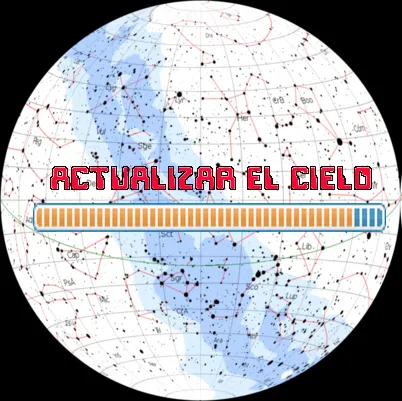
Initial image combined using: By Tfr000 (talk) 18:06, 26 July 2012 (UTC) (This file was derived from MessierStarChart.svg:) [CC BY-SA 3.0 or GFDL], via Wikimedia Commons, and Progress bar (http://todoparaweboblog.es.tl/Barras-alternatibas.htm)