On astronomical alignments and the viralization of nonsense.
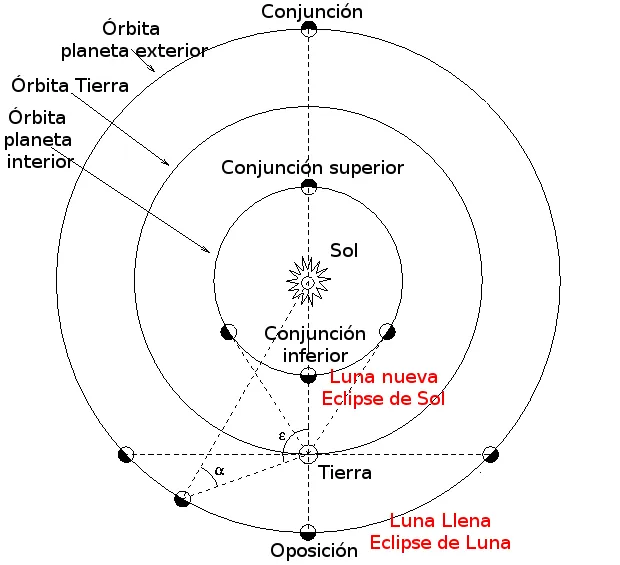
In astronomy, the term "alignment" can refer to a variety of phenomena (conjunction, opposition, eclipse) which we can summarize as follows:
An alignment occurs when two objects are on the same line of sight from a third point of view.
Let's place two fingers in front of our eyes, one from each hand, in such a way that one finger covers or hides the other. If we shift our gaze a little or move our head slightly, the alignment is lost. Because those two fingers are not aligned "in themselves," but rather it is an optical phenomenon perceived from a third point of view, in this case, our eyes.
Two points (or objects) will be aligned relative to a third if it is possible to draw or imagine a straight line connecting them.
SYZYGIES
Do you know what the word "Syzygy" means in astronomy? Have you ever heard or read it? In Spanish it is called sizigia although sometimes it is written sicigia.
It would be good to use it more since it applies to all types of astronomical alignment, be it conjunction, opposition, transit.
The full moon is an opposition, and therefore, a syzygy. The new moon is a conjunction, also a syzygy. Are you getting used to the word? Viralize it.
For oppositions and conjunctions to occur, the three objects must be at the same celestial longitude, although not necessarily at the same latitude. If both aspects coincide, there is an eclipse.
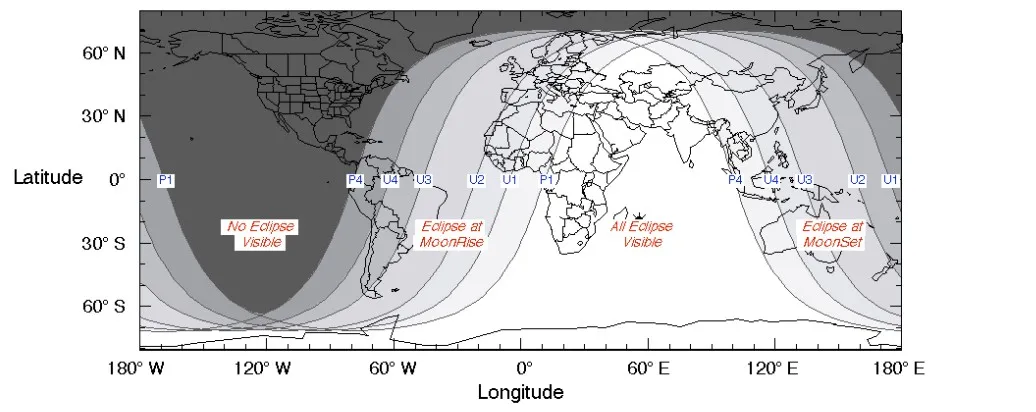
Lunar eclipses can only occur at full moon and solar eclipses at new moon. There is a movie that shows a solar eclipse and immediately after, the full moon (see references). That makes no astronomical sense. When the Moon covers the sun (in a solar eclipse), the face pointing towards Earth is not illuminated.
Syzygies are, therefore, the product of a perspective effect and, for that very reason, have no special meaning, do not occur at "magical" moments, nor do they have major effects on human life, except for some consequences due to the lack of sunlight or the greater tidal effect in solar and lunar eclipses, respectively.
SUPERMOON
It is called a supermoon when the moon is full and at its closest approach to Earth. This closest approach can be considered within the month (since in its orbit around the world, the Moon is not always at the same distance because the orbit is elliptical), within the year, or in recorded history.
If it is closer, then it should appear larger and consequently, brighter. But it depends on the amounts. The law of the transition from quantity to quality applies here. Not every quantity translates into a noticeable effect.
Think (and try) the following. Walk at night in a dark area (take the necessary precautions) with little urban lighting, except for some light in the distance, say 100 m. You can see that light source of a certain size and brightness. Now walk towards that direction 6 m, that is, you will get 6% closer relative to your previous distance. Will you see a larger and brighter light source? Hardly. But don't take my word for it, check it yourself.
Something similar happens with the supermoon. Regarding brightness, it does not increase in the same proportion as the apparent size, but neither is the apparent increase in brightness noticeable. Unless it is recorded in photos, in which case a comparison can indeed be made between a full moon at perigee and a full moon not at perigee. The comparison will show a greater difference depending on what and how it is compared: comparing a monthly full moon at perigee to a moon at average distance will not yield the same result as the difference between a full moon at historical perigee and historical apogee.
For all practical purposes, a supermoon is not a full moon that appears significantly larger and brighter compared to any other full moon of the year.
What meanings are we giving to the term supermoon?
If we have this objective information and use reason, a supermoon adds or subtracts nothing from a full moon.
So, a supermoon occurring during a lunar eclipse, why should that be significant? Perhaps because two phenomena "come together"? But it happens that the lunar eclipse phenomenon, which necessarily occurs at full moon - meaning that by definition a lunar eclipse is the union of two phenomena - and the fact that the moon in some cases is a little closer to Earth adds or subtracts nothing noticeable. It is a curious fact, yes, but unobservable. Or, to put it another way: A lunar eclipse with the moon at perigee (supermoon) will look similar to any other lunar eclipse. In any case, the geographic latitude from which we make the observation can have observable differences, as can whether it is a total or partial eclipse.
It is valid, whether for personal or collective recreation, or for scientific interest, to observe natural eclipse phenomena; there is no need to add "supermoon" to make it interesting, unless you live in the Moon of Valencia...
THE SUPERMOON AND THE ECONOMY
Let's say that in a country, $0.10 (ten cents) is of very little value, not even enough to buy a piece of candy. Now let's say that in that place, the manufacturer of a product offers the following deal:
1 product for $10, 3 products for $29.99. Would that be an interesting offer?
Well, with the offer, we would save $0.01 compared to the expense we would have if we bought three products outside of that promotion. But since $0.01 would be very little, it wouldn't be significant. It wouldn't be an attractive offer.
If someone considered it attractive, why might that be? I'll leave the question unanswered for now. Think about it.

THE BLUE MOON
A blue moon is said to be the second full moon in the same month. It is relatively infrequent, because it is most common to have only one full moon each month. In 2018 there was a blue moon on January 31. There will be another on March 31.
What does it mean? Nothing. It's a full moon. It looks like all other full moons. It's a curious fact resulting from the use of the civil calendar. If we had another type of calendar there would be no blue moon.
It's due to the same type of calendar curiosity that once a month the moon neither rises nor sets (see related article, below). It's a curiosity that adds NOTHING observable compared to any other full moon.
SUPERMOON AND BLUE MOON
The "combination" of these two phenomena does not translate into any appreciable difference compared to other full moons.
If they have tried to "sell" us something spectacular, well, it isn't. And it doesn't depend on someone believing me, it's easy to verify with reality. Furthermore, it's possible to explain it theoretically.
If we have bought that the blue supermoon is something significant, it's like buying the previous offer assuming it would be an unmissable opportunity, when it isn't. Why would we do something like that? I leave the answer pending.
THE RED MOON
It's quite common for the natural satellite to appear with a reddish tint during a total lunar eclipse. It's an atmospheric effect. For the same reason the sky looks blue during the day, but orange at twilight and sunset. Do me a favor. Search the web for images of any other total lunar eclipse and you'll see that on many occasions the Moon also looks orange-reddish.
Even without an eclipse, the full moon can look orange at sunset. It's good then to do this exercise:
At what time does the full moon rise and set?
Well, for there to be a full moon, there must be a 180º difference between the Sun and the Moon.
If we have the full moon right over our heads, then the moon is halfway through its journey. It rises in the east and sets in the west, approximately. If it's between east and west, it's halfway. That's called the meridian. So the full moon is very high in the sky, halfway between east and west. What time is it? Well, if the moon is "over" our heads, and for there to be a full moon the Sun must be at 180º, then the Sun will be "under" our heads. When the Sun is "over" our heads it's noon. When it's "under" our heads, it's midnight.
If the full moon is at the zenith at midnight, and that's the halfway point of the journey, then at what time did it rise?
The moon takes between 10 and 12 hours to travel the east-west sky due to Earth's rotation. Let's say 12. So the full moon rose 6 hours before midnight and will set 6 hours after. That is, it rises at approximately 18 h, reaches the zenith at 24 h, and sets at 6 in the morning. The full moon rises when the sun sets and vice versa, it sets when the Sun rises, a product of Earth's rotation.
Just because of this, there is a high chance that the full moon, when rising and setting, will look with a slight orange tint, because it rises at sunset and sets at twilight, when the sky looks that color tone.
The effect is pronounced when there is a lot of dust in the atmosphere, due to fires or volcanoes, for example.
Do me another favor: search the web for images of the full moon at sunset and you'll see many reddish full moons.
By the way, blood, nothing at all.
THE PROMOTION
Earlier I made an economic analogy with a sales promotion. What is media virality? Isn't it when something is "promoted" massively? It's also a promotion. Sometimes, things are promoted as "fabulous offers" that aren't. And unnecessarily.
Lunar and solar eclipses, total or partial, are natural phenomena, of perspective. They are beautiful and can also be instructive, either to obtain new data or to explain the movement of objects like Earth, Moon, and Sun.
Everything else is unnecessary additions, even counterproductive. If someone gets the idea that "supermoon" means the Moon will look much bigger than usual, it's false. You won't see that, objectively speaking, although we humans have the ability to see things that don't exist, like someone finding human faces in a damp stain.
CONCLUSION
Why do we fall for these "spells"? Why do we buy those promotions?
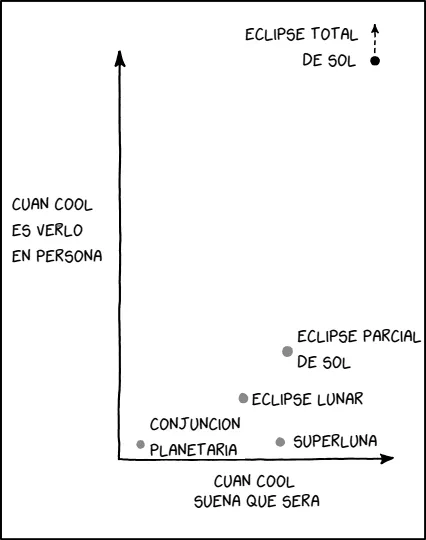
In some cases, we pay more for what is worth less. The brilliant Randall Munroe, author of the comic strip XKCD, said it in his own terms in the image that starts the post (image translated by me, see references).
The term that could apply is alienation, when we stop thinking for ourselves, when we are carried away by the crowd. Has it never happened to you that in a group you behave differently, that you do things you wouldn't do on other occasions?
Celestial phenomena (not heavenly, as a newspaper published) can be beautiful to observe. If we exaggerate them in mass discourse, it's possible that this only generates disappointment, but in any case, it's a fraud. Social communicators also get carried away by the "trend" and repeat something they don't even understand. But worse, some obscure charlatan who dresses as an expert, in charge of a planetarium, says what is not. "Phenomena that hadn't occurred together in 150 years"...
It's like saying: "Look, how incredible, a person with a red shirt stopped in front of a red traffic light. And more, now a second person, who is also 1 centimeter closer to the traffic light. And also the person's last name is Red. It's something that hasn't happened in 150 years!" It's the Nobel Prize of stupidity.
There are those who consider that scientific discourse takes away the romance from the cosmos. From that point of view, it would be more romantic to say and think that stars are "jewels embedded in the black universal velvet". Very nice and cliché. But knowing that stars are not jewels but suns, enormous masses of plasma, some a hundred times larger than our Sun, and that they can be seen but as points because they are unreachable, at literally sidereal distances, doesn't take anything away, but adds a lot. The awe and curiosity are greater knowing that, than believing they are costume jewelry.
Similarly, eclipses, planetary conjunctions and transits, that is, syzygies, do not require any marketing, but they do require explanations. Facilitating observation is a matter of scientific dissemination and outreach, but there is no need to lie or exaggerate, unless the intentions are otherwise.
Sources and related links
- Want to know when the Moon's perigees and apogees will occur? You can check on this website:
http://fourmilab.ch/earthview/pacalc.html - Inconstant Moon
(The moon at perigee and apogee, in English)
http://fourmilab.ch/earthview/moon_ap_per.html - An impossible full moon (about the film Apocalypto, Mel Gibson, 2006)
http://laseccionnueve.blogspot.com.ar/2013/07/una-luna-llena-imposible.html - The frequency of the unrepeatable in astronomy
http://www.noticiasdelcosmos.com/2016/06/la-frecuencia-de-lo-irrepetible-en.html - When the moon does not rise
http://www.noticiasdelcosmos.com/2012/05/cuando-la-luna-no-sale.html
About the images
Fig. 1: Translation of the original
XKCD: Eclipse Review https://xkcd.com/1880/
with typography from https://github.com/ipython/xkcd-font
Fig. 2 I used as a base the image from Wikimedia https://commons.wikimedia.org/wiki/File:Positional_astronomy.png?uselang=es
Fig. 3 Image from
Qué: Deceptive offers in the supermarket, are you fed up?
http://www.que.es/ultimas-noticias/curiosas/201312200800-ofertas-enganosas-supermercado-estas-harto.html