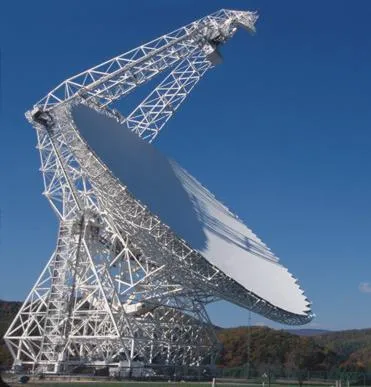
A team of astronomers studied NGC 4945 with the ALMA radio telescope.
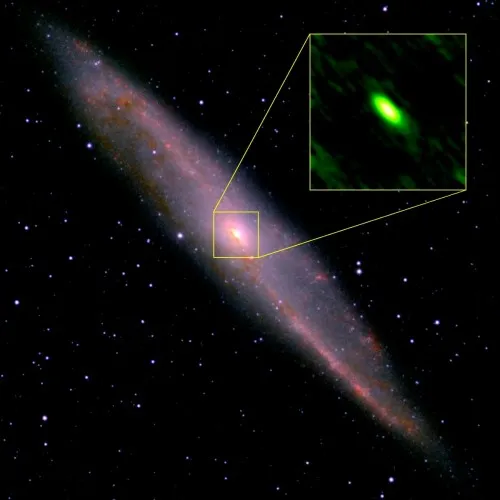
A team of astronomers from the University of Manchester, the Max Planck Institute and the University of Bonn discovered a star-forming region in a nearby spiral galaxy. The results show that the star formation rate in the center of the galaxy could be higher than previously thought.
The team managed to penetrate the thick dust around the center of the galaxy NGC 4945 using ALMA, the 66-antenna radio telescope installed in Chile.
Astronomers use short wavelengths like ultraviolet and infrared light to study the hottest and brightest objects. The sites where stars are forged are often surrounded by dust that absorbs the ultraviolet and visible light from young, hot, blue stars, making them difficult to detect. However, when heated, the dust produces infrared radiation.
NGC 4945 is unusual because the interstellar dust is so dense that it absorbs that infrared radiation, so scientists cannot obtain data on what is happening there. But thanks to the innovative ALMA instrument, which is capable of penetrating those dust layers, they have managed to study the region.
"When we looked at the galaxy with ALMA, its center was ten times brighter than we would have anticipated from mid-infrared images", said Dr. George J. Bendo, lead author of the paper accepted by MNRAS.
"Although it looks very dusty and bright in the infrared compared to the Milky Way or other nearby spiral galaxies, it is very similar to other infrared-bright galaxies that are more common in the more distant universe", adds the scientist.
The Atacama Large Millimeter/submillimeter Array (ALMA) radio telescope is capable of detecting two different forms of emission from ionized gas in star-forming regions in other galaxies. First, it can measure continuum emission at 85-100 GHz where the spectral energy distributions (SEDs) of galaxies are dominated by so-called free-free or "Bremsstrahlung" emission (emission from ionized hydrogen clouds -HII regions- produced by free electrons scattering off ions without being captured).
And second, ALMA is sensitive enough to detect the recombination line emission (H42-alpha) at millimeter and submillimeter wavelengths.
In this work, the detection of 85.69 GHz and H42α line emission from the center of NGC 4945, a galaxy located at a distance of 3.8 Mpc (approximately 12 million light-years), is reported. The obtained star formation rate (SFR) was 4.35 ± 0.25 M⊙ yr−1, ten times higher than that recorded in Spitzer 24 µm and WISE 22 µm (micron) surveys.
Sources and related links
- Astronomers Uncover Hidden Stellar Birthplace
http://www.manchester.ac.uk/discover/news/astronomers-uncover-hidden-stellar-birthplace/ - Free-free and H42α emission from the dusty starburst within NGC 4945 as observed by ALMA
G.J.Bendo et al.
MNRAS (2016)
DOI: 10.1093/mnras/stw1659 - arXiv:1607.02304 [astro-ph.GA]
https://arxiv.org/abs/1607.02304 - Bremsstrahlung radiation on Wikipedia
https://es.wikipedia.org/wiki/Radiaci%C3%B3n_de_frenado
About the images
Image by George J. Bendo
J-band (1.25 micron) image from the Visible and Infrared Survey Telescope for Astronomy
Ks-band (2.15 micron) image from the Visible and Infrared Survey Telescope for Astronomy
Red: 3.6 micron - image from Spitzer Space Telescope