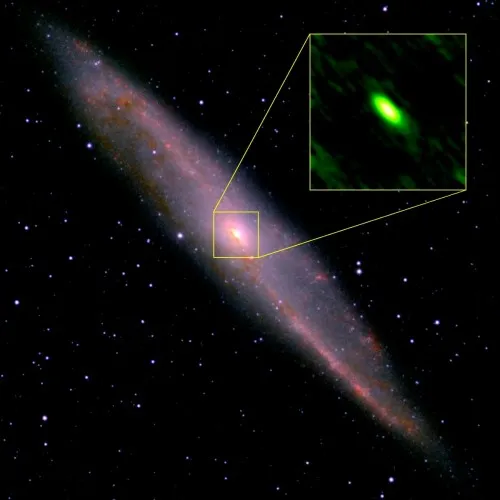
Using a powerful radio telescope to spy on the early universe, a team of astronomers obtained the first direct measurement of the magnetic field of a galaxy in its birth as it was 6,500 million years ago.
Astronomers believe that the magnetic fields in our own Milky Way and other nearby galaxies -which control the star formation rate and the dynamics of interstellar gas- arise from a slow "dynamo effect". In this process, slowly rotating galaxies are thought to have generated magnetic fields that grew very gradually as they evolved over 5 billion to 10 billion years to their current levels.
But in the October 2 issue of Nature, astronomers report that the magnetic field they measured in this distant proto-galaxy is at least 10 times larger than the average value in the Milky Way.
"This was a complete surprise," says Arthur Wolfe, a physics professor at the University of California who led the team. "The magnetic field we measured is at least an order of magnitude greater than the average value of the magnetic field detected in our own galaxy".
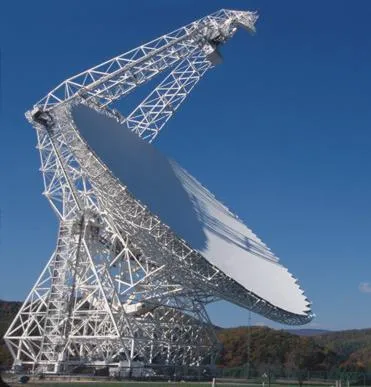
The astronomers used the Robert C. Byrd radio telescope at Green Bank operated by NRAO to observe the young protogalaxy called DLA-3C286.
Until recently, astronomers knew very little about magnetic fields outside our galaxy, having directly measured the magnetic field in only one nearby galaxy. "And that field was not as strong as the field we saw [now]," says Wolfe.
To make their measurements, the scientists studied the radio waves emitted by an even more distant object, the quasar 3C 286, behind the protogalaxy. As these electromagnetic waves passed through the young galaxy, some were absorbed by the hydrogen atoms in the protogalaxy. Normally, atoms would absorb only a specific frequency. However, as the atoms were affected by the galaxy's magnetic field, they absorbed at two nearby frequencies. This phenomenon, called the Zeeman effect, allows scientists to measure the strength of the magnetic field affecting the hydrogen gas through which the waves passed. These observations were the first measurements of this effect in a celestial object at such a distance.
But a team of Swiss and North American astronomers reported in the July 17 issue of Nature that an indirect measurement of the magnetic fields of 20 distant galaxies, using the light from bright quasars, suggests that the fields of young galaxies were as strong when the universe was a third of its current age as they are in mature galaxies today.
According to Wolfe, those indirect measurements and the direct measurements of his team "do not necessarily call into question the theory of the generation of magnetic fields, the dynamo model, which predicts that the strength of magnetic fields should be much lower in galaxies of the cosmological past".
"Our result presents a challenge to the dynamo model, but does not rule it out," he added. "The powerful magnetic field we detected is in a gas with very little star formation, and an interesting implication is that the presence of magnetic fields is a major reason why star formation is very weak in that type of protogalaxies".
Wolfe also indicated that his team has two other plausible explanations for what was observed. "We speculate that we are seeing a field towards the central regions of a massive galaxy, since magnetic fields are usually greater towards the center of nearby galaxies. It is also possible that the field we detected has been amplified by a shock wave generated by the collision between two galaxies".
"In any case, our detection indicates that magnetic fields could be important factors in the evolution of galaxies and in particular could be responsible for the low star formation rate detected in the progenitor gases of young galaxies in the early universe".
The challenge now, according to Xavier Prochaska, another team member, is to make observations like these in galaxies across the universe.
Sources and related links
- First detection of magnetic field in distant galaxy produces a surprise
- EurekAlert:Young galaxy's magnetism surprises astronomers
- An 84-muG magnetic field in a galaxy at redshift z = 0.692
Arthur M. Wolfe et al.
Nature 455, 638-640 (2 October 2008)
DOI:10.1038/nature07264 - NRAO:Young Galaxy's Magnetism Surprises Astronomers
About the images
Credit:NRAO/AUI/NSF