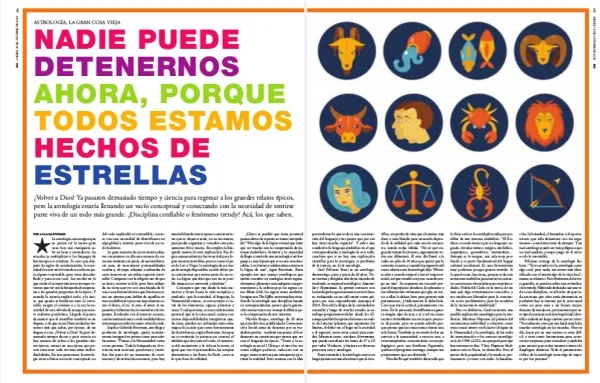
A full-page article in the Sunday newspaper with a pre-Socratic view.
I know it may be redundant, repetitive, insistent, to go back to the topic, but I consider it necessary. Many of those who are against astrology consider, however, that it is an ancient way of thinking that no longer has an impact on society, that only a small minority is guided by that pseudoscience. For that reason, it would not be important to insist on the topic.
But if that were so, why does the opposite seem true when examining social discourse?
Most newspapers publish the horoscope which is, of course, a reference to astrology, a reference to the supposed existence of 12 different kinds of people not due to the socialization process, not due to historical development, but due to the apparent position in the sky of some objects.
But also, articles are published with certain forms that could be interpreted as "scientific," giving a nuance of "seriousness" to a sum of discriminatory prejudices. And it is done in the newspapers.
So it is necessary to show that this happens, even if some do not want to see it.
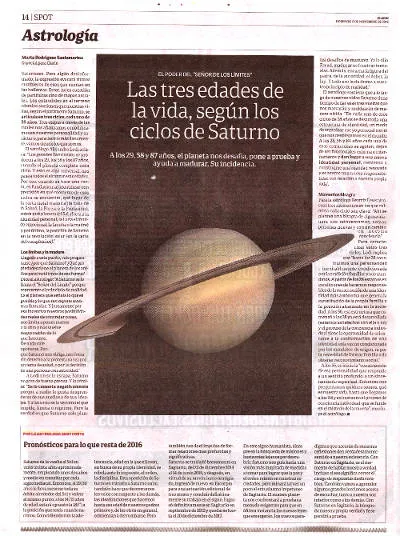
In this case, the newspaper Clarín in its Sunday edition publishes a full-page article in the Spot supplement, page 14 [1]. The article is signed by Marta Rodríguez Santamaría and contains statements from a couple of astrologers. Next to the article there is also a box with "predictions."
The main article is based on the supposed existence of cycles in people's lives caused by the transit of Saturn. The planet or the god?
Well, the writer asks a good question that she does NOT answer, let's see:
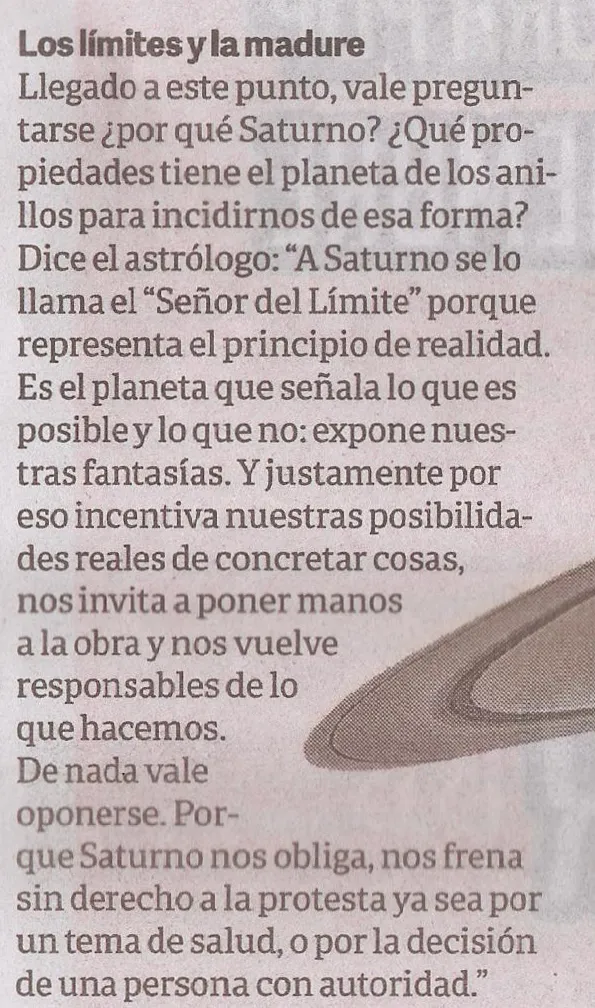
Limits and maturity (sic)
At this point, it is worth asking: Why Saturn? What properties does the ringed planet have to affect us in that way? Says the astrologer [Alejandro Lodi]: "Saturn is called the 'Lord of the Limit' because it represents the principle of reality. It is the planet that indicates what is possible and what is not: it exposes our fantasies. And precisely for that reason it encourages our real possibilities of achieving things, invites us to get to work and makes us responsible for what we do. It is useless to oppose it. Because Saturn forces us, stops us without the right to protest, whether due to a health issue or the decision of a person in authority."
The bold is mine. Surely the political class (for example in Jujuy) will have taken note of how to justify the criminalization of protest with a false astrological argument...
As can be seen, the "properties" of Saturn are not physical, it is not indicated that they are magnetic, electrical, gravitational, that is, variables studied by astrophysicists. Instead, they are "spiritual." It's like saying that the printer or the wardrobe affect our lives "spiritually." Or, it does not refer to the planet Saturn but to the god Saturn.
In Roman mythology, Saturn (associated with the Greek god Cronos, time) ruled thanks to a pact with his brother Titan by which Saturn would have no children. But he had them and because of that pact, he ate them. His wife, however, hid three children, among them Jupiter, who later defeated his uncle Titan and returned the throne of the sky to Saturn. Then father and son clashed and it was Jupiter who took possession of the sky.
Therefore, Greco-Roman mythology is based on the tense relationship between father and son and on how Jupiter's maturity was strongly linked to his relationship with his father. We still use mythology, knowing that they are stories, because it is useful to illustrate something about reality, in a metaphorical sense. To produce such meaning, there is no need to appeal to the planet. Doing so is to confuse mythology with science.
If we read the article, it points precisely to that by considering that Saturn (the planet) orbits the Sun every 29 years, influencing us "spiritually" to bring us maturity. But it does not refer to the planet that astrologers do not study physically, but to the fact that the planet as an object is a sign, mark, signal, of the influence of the God that bears its name. It is religion.
And it is pre-Socratic religion. I refer to the Apology of Socrates [2]:
Socrates
Oh wonderful Meletus, why do you say that? What! Do I not believe, like other men, that the sun and the moon are gods?Meletus
No, by Jupiter, Athenians, he does not believe it, because he says that the sun is a stone and the moon an earth.
Already back then, Socrates desacralized astronomical objects. He cannot be said to have been an atheist, but he certainly did not consider astronomical objects to be gods.
In Clarín, the writer and the editors seem to think something prior, objectively surpassed. Perhaps they also consider the Earth to be flat and immobile. Bruno Latour would be right in saying that we were never modern...
Sources and related links
[1] The three ages of life, according to the cycles of Saturn
Clarín, print edition, Sunday 11-6-2016, Spot supplement, page 14, by Marta Rodríguez Santamaría.
[2] Apology of Socrates, on Filosofia.org http://www.filosofia.org/cla/pla/azc01049.htm
About the images
Images scanned from the newspaper.