Recommendations for observing the Moon (and other objects) BEFORE Monday's "super" moon.
2016 ends with some "supermoons" like the ones that can be seen next Monday, November 14, and then on December 14.
The November one will not only be the closest of the year, but of the 21st century and will not be this close again until November 25, 2034.
The perigee full moon (or supermoon) of December will coincide with the Geminids. And this is not very good because the very illuminated moon will not allow many streaks to be seen. Although, to tell the truth, inhabitants of urban centers cannot appreciate meteor showers much either due to light pollution.
The term "supermoon" can be somewhat misleading although objectively true. The Moon takes 29 days to travel around the Earth. On that path, it is sometimes closer and other times farther, with an average distance of 384,000 km. The point of the lunar orbit closest to Earth is called Perigee. Every month the Moon passes there. But only sometimes does that moment coincide with the full phase.
The Moon's greatest closeness (given because its orbit is elliptical and not circular) results in an increase in apparent size and brightness, but in amounts difficult to perceive. In relative terms, "supermoons" can be up to 14% larger and 30% brighter, but it is noticeable only for frequent observers under ideal conditions.
This is important to point out so as not to create false expectations or suggestions.
But there are several reasons to observe the Moon BEFORE this Monday.
First, the moon is still in its waxing phase, so the visible face is not yet completely illuminated by the Sun. The good thing about this is that it is preferable for observing the depth of craters if observed with binoculars or telescopes towards the area where light and shadow converge. With the full Moon, the abundant reflected light prevents observing details and can even be somewhat bothersome to the eyes.
A second argument for going out to observe the Moon already this very night (and the following ones) is that we will be able to compare the apparent size until its maximum approach. We will not notice great differences either in size or brightness.
A third argument is that the last two days in Buenos Aires have been moderately clear, but we don't know if the weather will cooperate on Monday and the difference in apparent size and brightness between today and Monday will be really small.
The Moon does not go from being very far to being very close in a jump. For this reason, generating great expectations only for Monday (when the maximum approach will occur) is to lose observation opportunities that may even be better, whether due to the absence-presence of clouds or temperature changes.
If readers follow my suggestion, then some more ideas fit:
1-When going out to observe, it is advisable to make the most of the time. It is more fun to observe different objects and not just one. It tires the eyes and neck (if we use binoculars) to observe the same object for a long time.
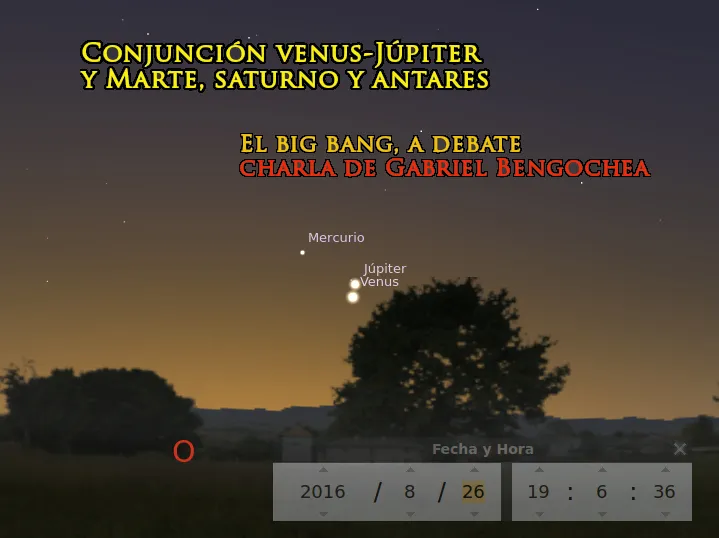
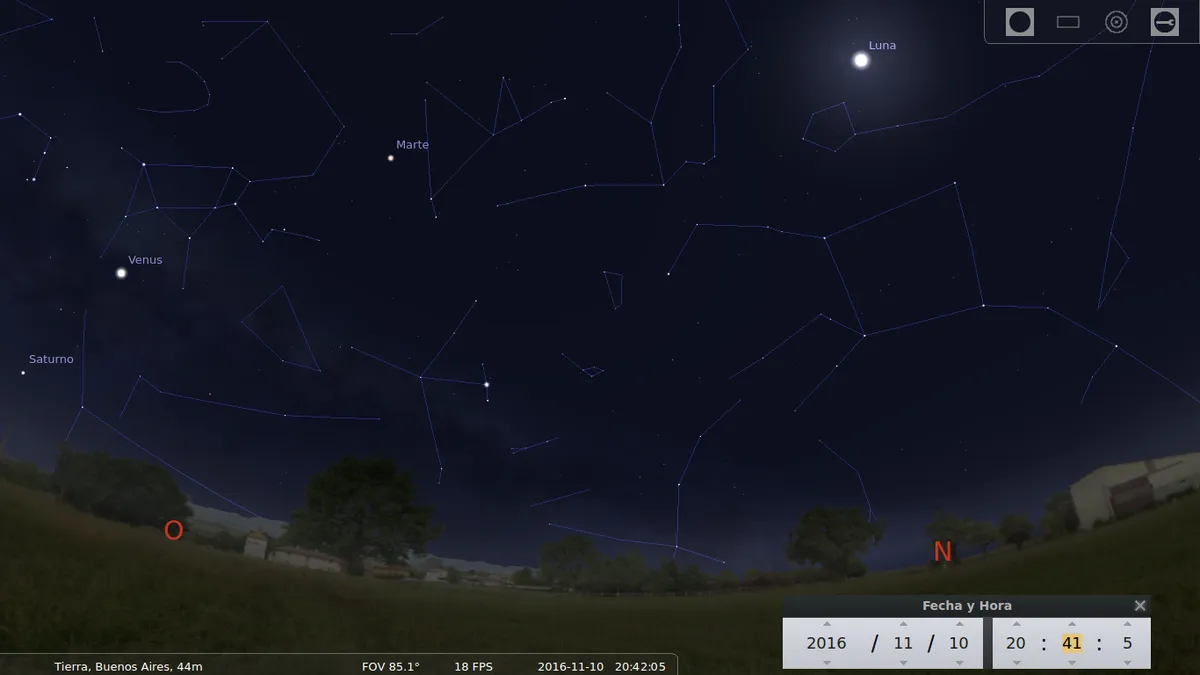
In this sense, the observation could begin just after twilight and towards the west there is the possibility of observing Saturn (very low at that hour), Venus and Mars (as in the simulation illustrated in the initial image).
In urban environments, where the low region of the sky - close to the horizon - is usually blocked by buildings, we may not be able to observe some of these planets about to set.
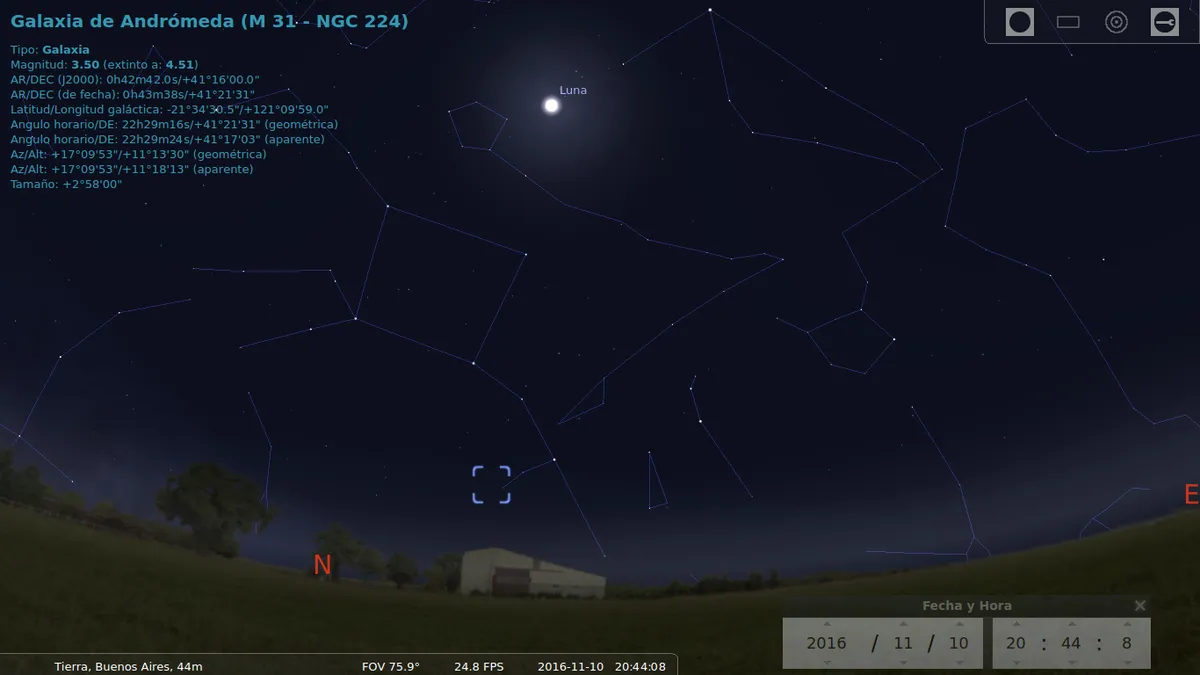
2-If we observe around 21:00, although it is difficult, we could locate M31, the mythical Andromeda galaxy. If we manage to visualize it we might be disappointed to see just a little cloud, but let us know that the object lies almost 3 million light-years away!
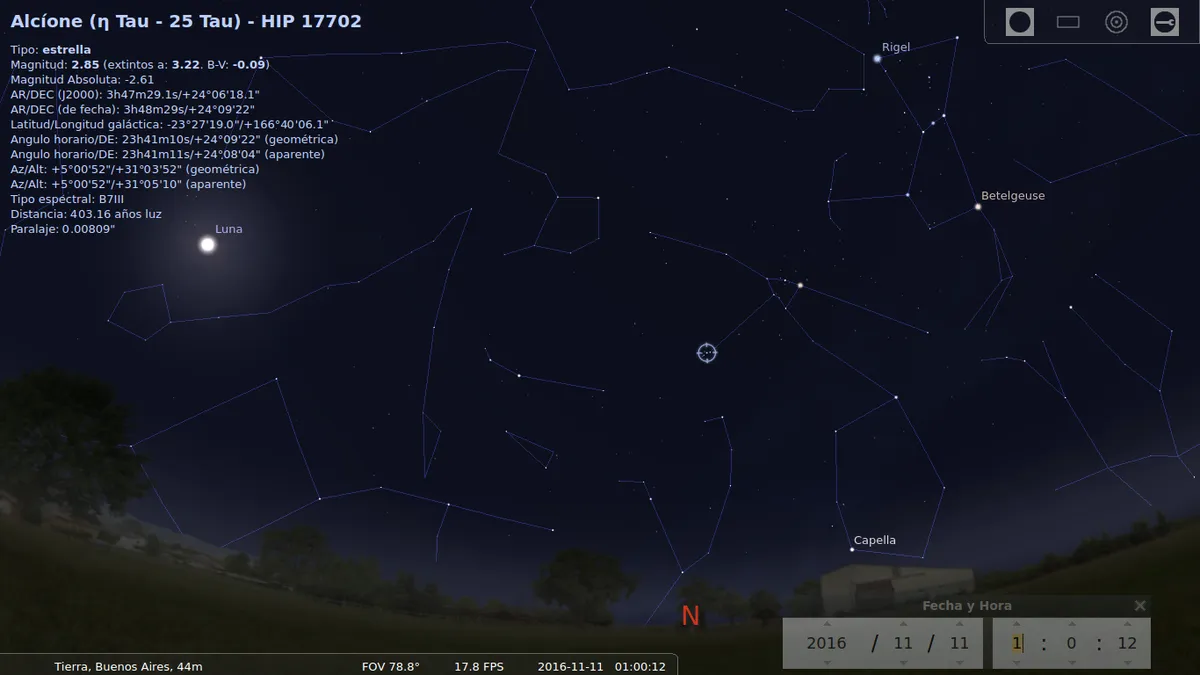
3-If we wait a few hours, we will give time for Orion and Taurus to rise from the east and when they reach a height worthy of observation we could try to locate the Nebula (M42) and the Pleiades or "Seven little goats" (M45).
Therefore, we don't need to wait until Monday. That night the Moon will reach perigee, the point of maximum approach in its orbit around Earth. But the difference between a few days before and a few days after is really hardly noticeable. And, in any case, observing before and after allows for comparison.
It is always recommended that if this activity is carried out by minors, they be accompanied by a responsible adult, considering that it is ideal to do it in a square or outdoor environment and, of course, at night.
Although I am taking Buenos Aires as a reference, the entire Southern Hemisphere is in spring, so it is advisable that even though during the day we have temperatures close to 30ºC, we bring some warm clothing, as it can get cooler at nightfall.
And I also remember that before observing we must give our eyes a little time to get used to seeing the dark sky. The cells of the visual system take a few minutes to be able to observe in dark environments.
Surely astronomy clubs and planetariums in the cities will hold activities and it is very enriching to carry out this type of activity in the company of others.
Observation of the Moon can be done with the naked eye, but with binoculars we can see dazzling details. If we observe together with other people who have medium or large telescopes we could also enjoy using those instruments.
If done in an environment away from urban centers and with some medium-large telescope, trying to observe Andromeda is always a challenge to schedule.
And the Pleiades are a handful of diamonds if we manage to see them from a worthy dark sky. It's no wonder they have inspired poems and songs.
As has the Moon, lunera, cascabelera. Good skies to all!
Sources and related links
- NASA: November Supermoon a Spectacular Sight
http://www.nasa.gov/feature/goddard/2016/novembers-spectacular-supermoon - 2016 Ends with Three Supermoons
https://science.nasa.gov/news-articles/2016-ends-with-three-supermoons
About the images
Simulated images using Stellarium http://www.stellarium.org/es/