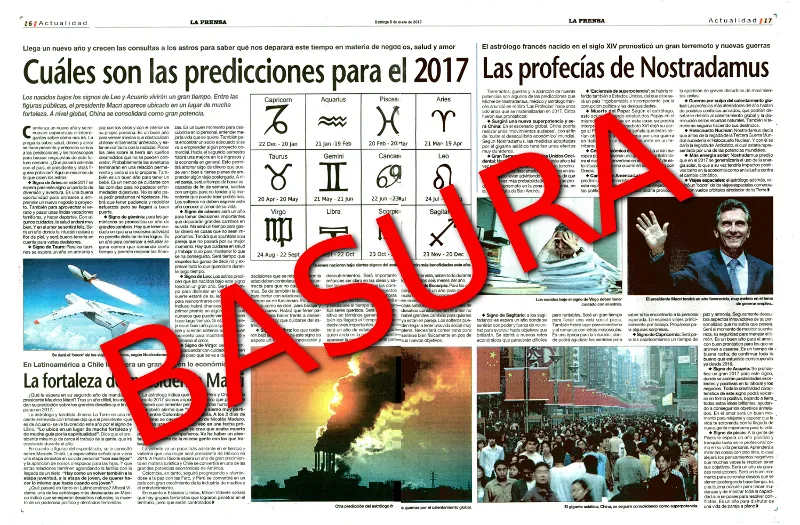
On Saturday, the national morning paper published a note on the supposed influence of the "stars" on food production. What's true about it?
How strange modernity is! Already into the 21st century, we still live in a society that believes in miracles and institutions that canonize.
Today's religious beliefs are more bureaucratic and have a greater imaginative flight than those surely held by Paleolithic inhabitants, but the foundation is the same. That's how modern we are!
As if that weren't enough, we are also now post-modern. Those are the ones who, not entirely satisfied with the progress of modernity, want to return to the obscurantist past, but of course, with the smartphone included.
That must be Gabriela Origlia, a "journalist" for La Nación who writes a string of lies without checking or asking follow-up questions. Wasn't that doing journalism?
But Origlia doesn't care about the truth. She wants to believe. She is a militant of foolishness. And her editors, the same.
Mitre's newspaper, in which liters of ink are often spilled about education and science, publishes postmodern nonsense again and again. Without checking anything. With the conviction of political party militants, but hiding behind the fact that they do "journalism". A national disgrace.
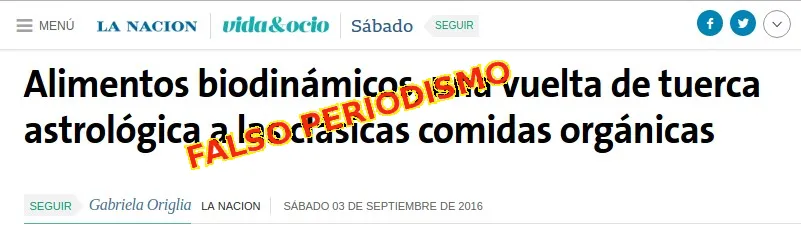
The note in question is titled: "Biodynamic foods, an astrological twist on classic organic foods"[1]
Some excerpts from the note that can be read online:
"CÓRDOBA.- First came organic foods, but now healthy eating is heading towards a new, higher step: biodynamic products. These are foods achieved from the cycles of the stars which, according to producers, function on Earth as a living organism, impacting the elements."
Note the "according to the producers". It's believing, blindly, what the producers say. Heaven forbid one should investigate and ask a scientist or question the producers themselves about the scientific basis. No, that would be diabolical, Origlia and her fourth-rate editors must think. But it continues:
"A biodynamic food uses only natural fertilizers, homemade animal manures; insects or pests are combated with homeopathic preparations derived from plants, and the entire process follows an annual agricultural calendar that considers the lunar phases and the position of the planets, to know the days that are suitable for sowing and harvesting".
Let's clarify a few things before continuing:
The aforementioned biodynamic agriculture is the product of the imaginary mind of Rudolf Steiner, a dark character completely removed from science, but who pretended to be a "researcher".
A true researcher publishes all the details of their research so it can be confirmed or not by the scientific community. Something Steiner never did.
Steiner published some books in which he says he researched this or that. THAT'S ALL.
To top it off, Steiner mixes organic agriculture (which is not in itself objectionable, as production without chemical additives) with astrology!
Astrology is an ideology, a set of false ideas.
The phony Steiner
Let's see what this current of archaic ideas with airs of supposed science says [2]:
"On many occasions, we have been able to verify serious inhibitions in plant growth sown on dates when Mercury, Venus or Mars crossed the ecliptic, and even on dates when the Moon occulted other planets.
The effects are not too serious during the first year, but if the stored fruits are later compared, they turn out to be of worse quality and rot sooner. If the seeds collected in this first year are sown, the following year it will be observed that they are of deficient quality, and even that they are totally incapable of germinating. The eclipses of Uranus have repeatedly produced these effects.
We continued the experiences obtained during the eclipses of the Sun and Moon over the same constellations, but with planets, and it was confirmed again and again that the passage of some planets in front of others, so that occultations almost occur, influences in a way similar to eclipses or nodes. We had to continue investigating alterations that were still unexplained and we were doing that when we found a new aspect that we had not analyzed until then: for example, when a solar eclipse is followed, two weeks later, by another lunar one (when the Moon is at the opposite node with respect to the Sun), or when the lunar eclipse precedes the solar one by two weeks. A similar constellation also occurs when the other planets are in the same plane, with the Earth in the middle, and thus the 'shadow' of the latter is projected onto the Moon. This means that the influence of the planets is not interrupted only when they are eclipsed, but also when they are close to the nodes and in opposition, with the Earth in the middle. It is not clear whether one can speak here of an influence of the Earth's shadow." (The bold is mine to highlight the insanely bizarre)
And later, in the same work:
"(...) The same rhythm that we have described for the Sun and the orbits of the planets also occurs with the Moon. Its orbit around the Earth lasts twenty-seven days. When it has reached the lowest point of its path, it is in front of the Sagittarius region. From there it will rise again, describing arcs in the sky that are higher each day, regardless of the waxing or waning illumination phases.
When after barely fourteen days it has reached the highest point of its orbit, in front of the Gemini region, it will descend again. During this descent, the forces and saps concentrate in the lower part of the plant. The plants orient themselves more strongly towards the earth. If during this period of time plant transplants are made, it will be observed that the plant quickly forms new roots, reconnecting with the earth. This tendency occurs when transplanting, not when sowing.
Thus, for transplanting work, the beneficial coincidences of different rhythms can be used jointly and thereby achieve an increase in certain developments. For example, when transplanting tomatoes, days that also promote the fruit can be chosen, which are the days of Leo. (...)"
As you will notice, there is no research narrated there, there is no data, it is a set of statements that appeals to the principle of authority, therefore, you either believe or you burst.
THE REITERATED ASSUMPTION
This stream of ideas fits within the following reasoning:
The influence of the Moon and the Sun on terrestrial life is proven, therefore, an influence of the planets must also exist.
The reasoning is invalid and false.
The Moon and the Sun are NOT planets. The Moon is a natural satellite, it does not radiate light. The lunar phases are reflected sunlight.
The Sun is a star, an object much more massive than the planets.
That the Sun influences terrestrial life is indeed proven and the main cause is that it is the source of light in the Solar System, light that we living organisms need to live.
That the Moon influences terrestrial life is indeed proven and the main cause is the tidal force, the gravitational pull between the Earth and the Moon which is explained by the proximity of both objects, considering that the force of gravity is INVERSELY proportional to the square of the distance. This last part means that, although Jupiter has much more mass than the Moon, since it is much farther away, it has less gravitational influence on Earth than the Moon.
THE RESEARCH NEVER DONE
However, let's say we wanted to investigate the mythical statements associated with astrology. To do so, one must convert statements into hypotheses, that is, into questions to be answered through experimentation.
If we did so, we could start from the following statement: That Mercury is above the horizon at the moment of planting, generates substantially different results than if planting when Mercury is not above the horizon.
The first step, then, would be to transform such an assertion into a question to be answered.
The second step could be an experiment: we plant lettuce in a plot of land X at times when Mercury is above the horizon. A few days later, when the planet is not visible, we plant the same type of lettuce in another plot of the same land.
The goal is to keep the same variables, with the exception of the planet's visibility.
And then we compare results. All of this must be properly noted and repeated.
Let's assume we start from the notion, coming from traditional agriculture, that out of every 100 times we plant lettuce, 20 will turn out bad (for various reasons), the expected is a 20% rate of bad results.
If after the experiment we notice that in plot 1 the results are 80% good, we would say it is "normal".
If after the experiment we notice that in plot 2 the results are 65% good, we would say something strange is happening.
Note that at this stage we still would not know why we get different results. But if this type of experiment is repeated, by groups of researchers independent of each other and the results are similar, then we could say we have made a discovery, even if we cannot explain it. Already with this we could make predictions.
However, perhaps the different result is due to some variable we did not notice: the composition of the soil, the weather, etc.
Therefore, we cannot transfer a correlation (which is what we found) to a causal relationship.
We would be left with the third step. Trying to find out why we have different results, starting from a piece of data we would already have: perhaps the position of Mercury has something to do with it.
For the third part we could proceed as follows:
We create a model to test, for example, we suggest that Mercury emits special particles that would have to have a certain range of energy, mass, frequency, etc.
And based on this model, we set out to look for the particles. If we find them, Eureka! If not, we would have to revise the model, make some changes or simply abandon that model and think of another.
I give this description only as an example. There is no ONE scientific model. Research can be conducted in various ways.
However, Steiner NEVER did anything even remotely similar. Not point 1, nor point 2, and much less point 3.
WARNING
There is nothing scientific about it. But I reiterate something that is VERY important: separate the wheat from the chaff. Steiner mixes organic agriculture (on which there ARE multiple researches done today) with astrology (on which there is nothing at all).
If what is stated were true, then it would have a great impact for astronomical science. So if it were true it would be very important for it to be made known and really investigated. Astrologers, however, never investigated anything.
CONCLUSION
Let's say I now say that all the people reading this article will have bad luck sometime in their life as retaliation from the "cosmos" for having read this "heresy". Would you believe it?
I suppose not. Then, why should we believe Steiner?
Should we believe the producers? Perhaps they would have explained why they do what they do. Perhaps there have been researches that I am unaware of. Perhaps.
We will NEVER know because the Origlias do not do journalism. They are militants of stupidity. And their editors give journalism courses together with a University...
I express here my absolute repudiation of the unscrupulous fallacy, of fourth-rate journalism, of the pseudo journalist who wrote the article without questioning anything, of her editors who publish any "nonsense" and of all those who wish to return to the worst obscurantism, those from which we clearly have not yet emerged.
"With biodynamics the cosmos is included in the conception of what we eat," she recounts. To the skeptical who maintain that the calendar is "esoteric and astrological," she responds that it does nothing more than reflect the ancient customs of farmers who "followed the cycles of the moon to determine when to plant or when to prune."
In this last excerpt from the article in La Nación the bold text is mine.
What the journalist and the newspaper swallowed is a lie. The Earth rotates, know it.
Final note: The article published on the web has only one comment, negative, indicating that it is nonsense. But also now it is indicated that the article is closed to comments. It is, clearly, covert advertising.
Sources and related links
[1] Biodynamic foods, an astrological twist on classic organic foods http://www.lanacion.com.ar/1934199-alimentos-biodinamicos-una-vuelta-de-tuerca-astrologica-a-las-clasicas-comidas-organicas
[2] Constellations and Biodynamic Agriculture; María Thun – 1984; Ed. Rudolf Steiner.
About the images
Screenshot from lanacion.com.ar