Can we be optimistic that an intelligent ET civilization will be discovered soon?
In a recent article published here, I pointed out that the probability of discovering intelligent ET life is inversely proportional to the distance of the potential civilization. Is it really so?
First, intelligent life is not the same as life. The discovery of life outside Earth, even if microbial, would be wonderful and incredibly important, without a doubt, but of lesser importance than finding intelligent life.
How could life outside Earth be discovered, even if not intelligent?
Technological innovation advances at an ever-increasing pace, so anything said now can very quickly become obsolete. However, with current scientific tools, it seems difficult to discover life without taking samples. The inspection of exoplanet atmospheres, their location in the "habitable zone," the possession of liquid water on such worlds, a certain amount of radiation from the star hosting the planet, are variables that could point to the potential existence of life. But discovering is more than that. In any case, if a planet with such characteristics were found, it would be the discovery of a planet with the maximum potential to possess life forms (according to our only successful case), but one could not say or think that because of such variables there must necessarily be life.
Knowing if such life exists would require another type of examination, such as sending an unmanned probe to take samples from the surface. In any case, a flyby examination by a spacecraft taking images at different wavelengths could also serve, for example to detect algae. In which case it is not illogical to think and say that, therefore, the probability of discovering (non-intelligent) life would be inversely proportional to the distance, since the farther away the world is located, the harder it is to reach and the more time confirmation would take.
It should be clarified that this type of simple life has not been ruled out in the solar system, where we can indeed disregard the presence of intelligent ET life. And the solar system, although on a human scale it is huge, is relatively easy to explore, as we have been doing for several decades. Moons like Titan could harbor life and are relatively close to Earth.
In the case of intelligent life, it is indeed possible to think that its detection does not necessarily require traveling with a manned or unmanned spacecraft, but could be resolved by sending and receiving information.
If we received a message we would have to be cautious, as the scientists dedicated to SETI (acronym for Search for Extraterrestrial Intelligence) have been so far.
This caution can be thought of in three steps:
1-Discard that such a message is due to a natural phenomenon
2-Discard that the message is due to noise from the detection instrument or human sources
3-In case the previous options have been discarded, the only remaining possibility would be that it is an ET message, but it would be necessary to confirm it.
To perform step 1, there are different options, in particular the idea that certain patterns cannot be obtained in natural phenomena.
Let's give an example:
Suppose we are in our house and outside -right in front of the street door- there is a tree with very long branches. The weather is windy.
And we hear a single knock on the door. Maybe it's a person, maybe it's the tree branch that hit the door due to the wind.
But if instead of a single knock we heard a sequence of knocks equal to La Marseillaise, certainly that is not something that can be achieved only by the random action of the wind and the branch, therefore, it is either a person or a French alien!
In an analogous way, the signals received by a radio telescope can be evaluated.
However, suppose the received signal (sound or light) could be graphed as a succession of peaks and valleys with a certain period.
And astronomers knew that such a signal could coincide with a natural phenomenon like that of variable stars. Then determining not only the region of the sky from which the signal comes, but the point source would be very important. If the point source were a variable star with a light curve that matched the received signal, then it would not be ETs calling home.
To determine the point source, again, distance plays its role. If the object were very far away, its point detection could be difficult at least due to the angular size of the object in the sky in relation to its distance.
In case the first two options are discarded, we might want to celebrate the great discovery of human history. But such expectation and jubilation in advance would not be very cautious. Perhaps the previous discard was not done correctly. Therefore, it would be good, before celebrating, to confirm the suspicion. And one way to obtain confirmation would be to send a response message.
Suppose the original message is peaks and valleys representing the natural numbers {1,2,3...}. We could send as a response a series of peaks and valleys only with the even numbers. What should we expect as a response? I can think of only one: the series of odd numbers.
If indeed the second message we received were the odd numbers, we run to shout Eureka! and get drunk worldwide, to the point that some president, due to "errorism," presses the red button...
This confirmation, again, would depend on the distance to the planet in question. The farther away, the more time we would take to get a response.
THE ANALYSIS AS A PESSIMISTIC VIEW
It is not my intention to be pessimistic about the discovery of life or intelligent life. The problem I see is that optimism is excessive...in terms of time! I read many articles that seem to indicate excessive confidence that within a very short time (a decade, two decades) we will have discovered life or intelligent life.
And I think we are deceiving ourselves. From a philosophical position, it is preferable to have lower expectations and have reality surprise us for the better (in which case our mistake will turn into joy), than to have an overvalued anxiety and be disappointed by the speed of a butterfly's wing beat.
Analysis is, first of all, the attempt to understand reality. On that basis and not before, we can mount value judgments, optimism or pessimism. But sometimes we do things backwards.
PROBABILISTIC BASIS FOR (MISUNDERSTOOD) OPTIMISM
On the other hand, this exaggerated optimism has a probabilistic-statistical basis. Whether due to the famous Drake Equation or similar analyses, the conclusions often contain high numbers.
Astronomer Theodoros Anagnos for his thesis at Aristotle University of Greece in 2014 [1] concludes:
Habitable planets in the Milky Way would be 1.4 billion (0.75% of the total stars that would exist in the entire Galaxy). A paper or thesis is evaluated fundamentally by its methodology, which is exactly what I will not do here. For the purposes of this article, let's take for granted that the professional did things right and go to the conclusions. We will see that they use a distance argument, although very different from the one applied above.
First, the astronomer considers a not-so-popular concept: the galactic habitable zone. Just as one thinks of the habitable zone of a stellar system, one can also think of the habitable zone in a galaxy based on data such as the number of supernovae near the center and in the outskirts of the galaxy that would endanger the formation of habitable planets.
After taking certain data from a telescope and using what is known as Monte Carlo simulations, the astronomer concludes that the greater the distance from the galactic center, the greater the probability that habitable planets exist. He illustrates it with these graphs:
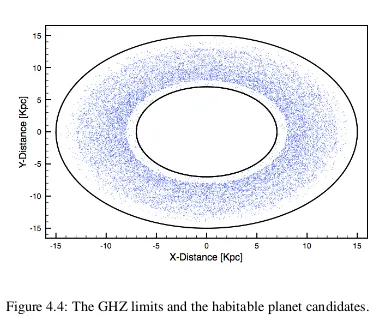
The first graph shows the galaxy as a donut: it is an ellipse in whose center there is a zone where planets would hardly form, whereas in the part dotted in blue, they could form. On both axes the distance is expressed in Kpc, kiloparsecs.
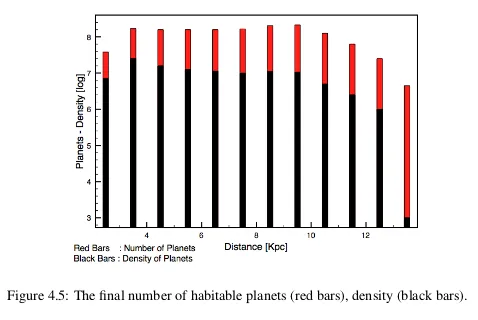
In the following graph we have on the x-axis also the distance in Kpc. On the y-axis we have the logarithm of Planets and density.
The black bars indicate the density of planets.
The red bars indicate habitable planets.
The graph can be read like this: on the left side, where the distance in Kpc is small relative to the galactic center, there are more planets (because there are more stars), but fewer habitable planets (due to a greater number of supernovae), while on the right side, the last bar, there are fewer planets as there are fewer stars, but more habitable planets in proportion.
The variable distance is taken into account, but in a different way than I posed above, but based on the probability that a habitable exoplanet could EXIST. It is because of this type of work that the general public gets the idea that since the number of exoplanets that could harbor life is a high number (in this case, one thousand four hundred million), then the probability of that life existing is high, without considering the probability of discovery... as a function of time (money and other resources).
But it's not that simple. Let's look at an example.
THE PROBABILITY OF ALBINISM
Several sources indicate that the probability of albinism is 1 person in 17,000 [2]. If we extrapolated this data to the world population, there would be 450,000 albino people in the world right now. It's a large number. It will be easy to find an albino. Go out on the street and find an albino person in less than 1 hour.
We could surely say that the greater the search time, the greater the probability of finding an albino (direct proportion).
In some countries it will be easier than in others because, for different reasons, countries like Puerto Rico may have a rate of 1/2000 and not 1/17000. Statistical extrapolation can be misleading.
Note: in the study cited above, it is assumed that around each star in the Milky Way there is at least one planet.
As readers already know, the discovery of 7 planets around a star was recently announced and although three would be in the habitable zone, all could contain liquid water.
In certain stars we will not find planets, while in others, many. The analogy allows comparing stars by their rate of habitable planets with countries by their rate of albinos. The extrapolation will be better with more information.
Statistics and probability feed on data. The larger and better quality the data, the better calculations can be made. In this sense, now not distance, but time, but also human efforts count: the more data on stars and planets obtained, the better calculations can be made and the probability of discovery increases. Not only because with a greater number of observations it is possible to shout bingo!, but also because even if that does not happen in the short term, the greater information will allow astronomers to know better where and how to search, and the calculations will be more precise.
THE TWISTS OF PROBABILITY
Playing a single lottery number and having it come up is unlikely, but not impossible.
What we do know is impossible (if no rule is broken) is winning the lottery without playing. In this case, playing is analogous to researching.
My apparent pessimism - which in truth is realism - contrasts with my optimism based on research. But it is not a foolish optimism. Researching is indispensable for discovering, but there is no natural law or any kind that allows inferring how much effort (in money and time) is necessary to invest to obtain a result. It cannot be known in advance how long it will take to make a discovery.
Just as it cannot be predicted how long it will take for a new Newton, Pasteur, Leloir, Messi, Van Gogh or Cantinflas to appear.
What we can know is that the more we strive to disseminate science, finance it, provide it with human and technical resources, the sooner results will appear, as in sports, arts or other activities.
And with the complication that such summation is not linear. If we take the amount of money invested in Argentine basketball in recent years and we know that in this period at least 1 Ginóbili emerged and then we think: let's multiply the funding by 10 and in the next period we will have a dozen Ginóbilis, we would be wrong.
What we could obtain is a greater number of highly competitive athletes and a higher percentage of the sporting population, which is not a small request.
OTHER PRECAUTIONARY ARGUMENTS
Regarding the discovery of the recent Sleeping Beauty and the seven planetary dwarfs, Investigación y Ciencia has published a set of articles in the past that address the topic from different perspectives. Paul Davies signs a note in the January issue of this year with the title: "Many Planets, Not Too Much Life" in which he states: "We still have no idea whether life is easy or not to arise. It could be extremely difficult" [3].
In the same Spanish magazine, an article by René Heller was published in 2015, whose English version is available on Arxiv [4]. There he indicates that "Some worlds very different from ours may turn out to be much more suitable for harboring life". Note the double valence of this statement: On the one hand, perhaps we are looking in the wrong places, in which case the probability of discovery is lower; on the other hand, it could be an increase in the probability of the existence of ET life.
MEDIA EXAGGERATION
Santiago Do Rego posted on his blog the scan of several pages from the 1987 Muy Interesante magazine [5] that predicted what life would be like in the future. On the first two pages, the illustration and text indicate that by the 21st century, executives would travel to offices 300 km high in flying ships as if they were cars. In 2008, Popular Science magazine published on its cover the article "Where's My Flying Car?" [6]
The triumphalism has reached journalistic newsrooms to the point that some newspaper indicated that the planets of TRAPPIST-1 "are the greatest discovery of modern astronomy". The same medium, however, titled the article "It is unlikely that there is life on TRAPPIST-1, at least as we know it" but reports that "they do not conclude that alien life is impossible" [7]. Perhaps the person who wrote the article thinks that modern astronomy started five minutes ago and that we have just realized that ET life is possible. It was during the 20th century that it was discovered that other galaxies existed, that space-time expands, that time dilates, and how the Sun produces energy, among other things. Although confirmation is lacking, it is almost taken for granted that most of the existing matter is not "normal" matter. The list of the greatest discovery in modern astronomy is long and this discovery is at the back of the line.
In at least two articles on the Space.com site, it is indicated that ET life and intelligent life would be discovered by 2025 and by 2040, respectively [8].
If Newton were alive, he would surely be against "mechanical" predictions, because being very intelligent, he would have learned from his mistakes.
In the lottery of failed predictions, several bought all the tickets. The strength of a forecast is not that it finally gets the result right, but the solidity of the arguments.
CONCLUSION
Perhaps the population's desire to find solutions to earthly problems is what generates this new "faith" in aliens. A desire driven by considering that the day after the discovery we will have flying cars and cell phones that don't explode. But if what is intended to be solved is hunger and the petty political decisions that affect the weakest, I don't think the solution is technological.
If what the general population wants is to be told exactly what is going to happen with absolute certainty, well, the Churches are open and astrologers are eager to take money from the unwary. Tech gurus also make their killing with prophecies that mimic self-help books.
But here we will say something else. I do not celebrate the delay. I wish that life or intelligent life would be discovered as soon as possible so that I can know it in my lifetime. Not because the ETs bring us some answer, but because of the number of questions we would ask ourselves.
Dreaming costs nothing. But discovering does. It costs effort, sacrifice, ingenuity, creativity. But it is worth a lot. The other is worth nothing.
Sources and related links
- [1] Diploma Thesis: Discovery probability of transiting extragalactic planets and habitable exoplanet statistics in the Milky Way, Theodoros Anagnos, Aristotle University of Thessaloniki, 2014.
http://www.astro.auth.gr/documents/diplomas/2014_Anagnos-Diploma-en.pdf - [2] What is albinism?
http://www.albinism.org/site/c.flKYIdOUIhJ4H/b.9260351/k.2B03/Bolet237n_informativo__191Que_es_el_Albinismo.htm - [3] Many Planets, Not Too Much Life
Davies, Paul Investigación y Ciencia January 2017 No. 484
http://www.investigacionyciencia.es/revistas/investigacion-y-ciencia/numero/484/muchos-planetas-no-demasiada-vida-14840 - [4] Better Than Earth
René Heller
arXiv:1503.00701 [astro-ph.EP]
https://arxiv.org/abs/1503.00701 - In Spanish in Investigación y Ciencia
http://www.investigacionyciencia.es/revistas/investigacion-y-ciencia/numero/462/ms-acogedores-que-la-tierra-12905 - [5] Life in the third millennium, according to Muy Interesante from 1987
Santiago Do Rego, May 17, 2008
http://www.doregodiscurre.com/?p=149 - [6] Flying Car on Wikipedia
https://en.wikipedia.org/wiki/Flying_car_(aircraft) - [7] It is unlikely that there is life on TRAPPIST-1, at least as we know it
Daniela Pasik, February 23, 2017
https://www.pagina12.com.ar/21931-es-improbable-que-haya-vida-en-trappist-1-al-menos-como-la-c - [8] Bold Prediction: Intelligent Alien Life Could Be Found by 2040
http://www.space.com/24622-intelligent-alien-life-detection-2040.html
(The article cannot be retrieved currently, but it can be through Google Web Cache)- - Signs of Alien Life Will Be Found by 2025, NASA's Chief Scientist Predicts
http://www.space.com/29041-alien-life-evidence-by-2025-nasa.html - Are we alone? A somewhat personal answer
http://www.noticiasdelcosmos.com/2017/02/estamos-solos-una-respuesta-algo.html
About the images
The initial image is from NASA/ESA/STScI/J. de Wit
Taken from These seven alien worlds could help explain how planets form http://www.nature.com/news/these-seven-alien-worlds-could-help-explain-how-planets-form-1.21512
Graphs 1 and 2 by Theodoros Anagnos.