A somewhat personal view on the possibility and probability of the existence and discovery of ET intelligence. Reflections based on Churchill's essay.
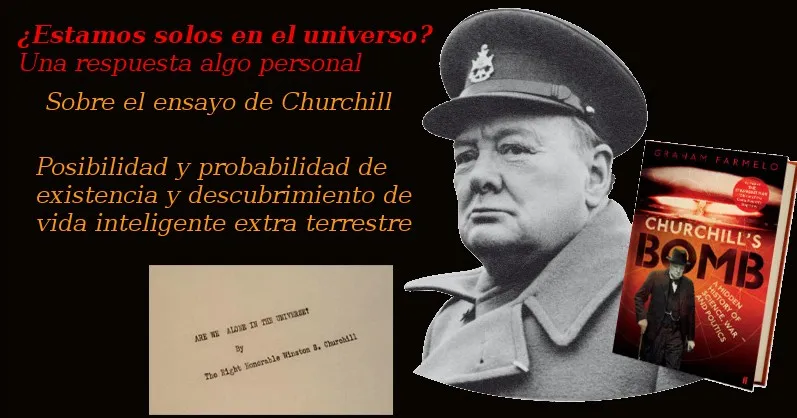
Last week, through an article by astrophysicist Mario Livio published in Nature, the existence of a typed essay by Winston Churchill titled "Are We Alone in the Universe?" [1] became known.
What I will refer to here aims not at what Churchill wrote, but at what Livio says the British politician wrote. The essay has not been made public, I report and, furthermore, I protest.
According to Livio, the essay contains considerations in line with the scientific knowledge of the time (1939) and ends like this (the translation is mine): "With hundreds of thousands of galaxies, each with billions of suns, the chances are enormous that there is a great number with planets whose circumstances would not make life impossible".
The conclusion can then be summarized as follows: Since the universe is immense, the possibilities for life to exist on other worlds are very great.
As Livio points out, this writing is much earlier than the discovery of exoplanets and also than Frank Drake's probabilistic argument in the 1960s.
The astrophysicist also notes that the Churchillian discourse is constructed within the theoretical framework of the "Copernican principle" which includes the idea that, given the vastness of the universe, it is difficult to believe that we humans on Earth represent something unique.
A few years ago, in reference to what the mass media present as possible or impossible, I added a reflection that comes from an introductory text on scientific thought about the three planes of the possible or the impossible [2].
I will synthesize the ideas here: we can think of the possible on three planes. The technical plane, the empirical (our current knowledge about the laws of Nature), the logical plane.
If something is logically impossible, then it is also empirically impossible and technically impossible.
Conversely, if something is technically possible, then it is necessarily possible also from the empirical and therefore from the logical.
However, something can be logically possible, empirically possible and technically impossible (for now). For example, there is no logical impossibility of carrying out a manned trip to Mars, nor is there an empirical impediment (it does not violate any natural law), but up to this moment it is technically impossible.
The technically impossible can be overcome and we already know that in the coming years it will be so in this particular case.
So, following similar reasoning, we can say that it is logically, empirically and technically possible for intelligent extraterrestrial life to exist.
But now let's transform this abstract idea into a concrete one.
1-POSSIBILITY OF ET EXISTENCE
Let's suppose that the readers and I are part of a team of scientists who want to build a radio telescope to search for intelligent ET life. And to be able to do it we need USD 100 million.
Then we are going to see whoever is the minister of economy of a hypothetical country.
The first thing the minister will ask us is whether it is possible that ETs exist. Based on the previous reasoning, we will say yes.
The second thing the official will ask us is how probable it is that they exist.
2-PROBABILITY OF ET EXISTENCE
Possibility and probability are not the same. It is possible to roll a die ten times in a row and get a 6 every time. But it is very unlikely.
Probability is a quantitative way of measuring the possible, based on the theory of large numbers.
To answer the minister, we can use the type of calculation made by Frank Drake and others later.
Drake's idea is as follows: although we don't have a recipe for intelligent life, we do have a successful case: Earth. At least for this case, in our current knowledge, we consider that there were key elements for the emergence of life, such as water in liquid form. We also know that primordial life was very simple and became more complex through evolution and that this lasted billions of years. Therefore, we can add one more ingredient to this supposed recipe: a stable orbit of the planet.
If only a small fraction of stars had planets and only a small fraction of such planets had liquid water and a stable orbit and only a small portion of these had life and only a part of such bodies had produced intelligent life, what would be the result?
Whether we use absolute numbers or percentages, the result is large.
Other arguments similar to Drake's have been made in the following decades, changing the variables and parameters and with quite different results: in some cases, the result is not so large.
However, let's suppose that even the not-so-large results are still many, then the probability of the EXISTENCE of ET life would be hopeful.
3-PROBABILITY OF ET DISCOVERY
Have we convinced the minister yet? No. Thirdly, the minister is going to ask us what the probability is that WE DISCOVER intelligent ET life.
Note the difference between the second and third question. One thing is that the probability of the existence of ET life is high, another thing is the probability that we discover that life.
The probability of finding ET life is low. Why? Because it is inversely proportional to the distance that exists between possible ET civilizations and us (farther away, less probable). Whether for a physical journey of people to be made between the two worlds or for information to be sent and received between both worlds, distance is important because the speed of light is high, but finite.
If there were a million ET civilizations, but they were spread out in the Universe (the known space-time), then given that this universe is enormous, hyper-enormous, very ultra super mega big, then, the probability that any of those civilizations is "close to home" is low.
The closest star system to Earth lies 4 light-years away, which means that if we sent a message (for example using light, a laser or radio waves), that message would take 4 years to reach that system and we would receive any response only 4 years later.
It is unlikely that if multiple civilizations exist in the immensely large universe, one of them lives right "close to home". Therefore, if it is more likely that they live far away, say a hundred, a thousand, a million, a billion light-years away, communication would be practically impossible. If there were an ET civilization a billion light-years away (the universe is much, much larger than that), it would take us a billion years to get a message to them.
4-TWO INTERPRETATIONS WITH THE SAME DATA
What would the minister of economy tell us upon learning this?
According to business logic where a venture is considered based on an advance of capital and its recovery (return on investment) in terms of time, investing USD 100 million to have a "return on investment" (the discovery) 2 billion years later (after sending a message and then receiving a response) would be a very "bad business".
Probability is a very useful form of calculation for decision-making. But data and calculations and results have no meaning of their own. It is we people who give meaning to the data, by interpreting it.
And it happens that with the same set of data, calculations and results, we can make diametrically opposed interpretations.
The minister, with his business logic, would conclude that it would not be "profitable" to set up such a radio telescope for SETI (acronym in English for the search for ET intelligence).
But we, with the same data, could have a different interpretation:
Despite some exceptions, something is impossible to be discovered if nothing is done to discover it (that is, to investigate). It is impossible to discover without research. On the other hand, if we do something, the probability of discovery ceases to be zero.
The only case in which we would be sure of not discovering potential ET civilizations is if we do nothing, if we do not investigate.
On the other hand, the only scenario that assures us that the probability of discovery will not be zero is research.
In science, serendipity [3] is sometimes discussed. Louis Pasteur and his famous phrase about chance favoring the prepared mind [4] are mentioned at the same time.
Yes, it is possible that someday, astronomers studying the HI line (the 21-centimeter line of hydrogen) to investigate the interstellar medium at microwave frequencies, unintentionally discover an artificial message. It could happen.
But since the easiest form of "encounter" is communication, as it is easier to send and receive data than to travel through space, both due to the energy required and the possible speeds achievable, then the most efficient way to discover possible intelligences "foreign" to Earth is through communication, the sending and receiving of messages.
Then, the minister will tell us that the issue is resolved, since if there are civilizations equal to or more advanced than ours, THEY would take care of communicating with us, which would make it unnecessary to "spend" the USD 100 million.
But for communication to occur, there must be a transmitter and also a receiver. Without ears, even if they speak to us, we will not hear. With ears listening to something else, neither. The radio telescopes for SETI are our ears, indispensable for such communication, minister!
5-UTILITY ARGUMENT
The USD 100 million is a large amount, it's true. In the modern economic system, however, things are valued in relation to their exchange (to buying-selling) and exchange only occurs when what is offered is considered useful by someone, that is, someone must need or desire it to use it.
Armaments, which consume much more than USD 100 million, particularly weapons of mass destruction, are created not to be used. If we use them, we destroy ourselves, so they are only created to threaten. But they are not used. Which is incompatible with the economic system based on utility. If there is something useless in modern society, it is weapons. And astronomical sums of money are "invested" to produce them and keep them under lock and key, that is, they are socially useless, only "useful" so that some may have power.
Let's stop doing that and instead, use that money for useful things that are necessary and demanded by populations with laudable scientific arguments: prevent floods, improve healthcare systems, expand and improve the educational system. And let's use a small part of it to search for ET life.
The "return on investment" is impossible to calculate as it is astronomical. The consequences of discovering an ET civilization are difficult to predict (much less in moral terms) but it would bring consequences in all fields of the natural and social sciences, philosophy and religion. From the point of view of an external "threat," its harm would be nil if such a civilization were found very far from home (which is most likely).
The only real, concrete, scientifically validated threat is here. Winston Churchill had something to do with that.

6-ON CHURCHILL
Several sources point out how the British politician was in favor of Il Duce Mussolini for "having rendered a service to the world by fighting the subversives" [5].
He defended neither the English citizens, nor the Jews, nor humanity, but the economic interests of the ruling class of England. Churchill, and therefore, the United Kingdom, knew about the bomb that the United States had to (unnecessarily) bomb Japan [6].
According to Mario Livio, the former British prime minister was "a science enthusiast, but also contemplated important scientific issues in the context of human values". It is the problem of sciences as isolated compartments. If that conclusion is valid when analyzing the unpublished essay, it is not valid in relation to the existing prior knowledge.
Winston Churchill -as well as his successors in office- have not taken "human values" into consideration, but have governed with the same corporate logic as the minister in the previous example. He has been in favor of building weapons of mass destruction, but not using them unless the interests of the class he represents require it, even if that creates a holocaust.
7-CONCLUSION
The (scientific) search for extraterrestrial intelligent life is justified. It is justified even if it takes a long time to obtain results. It is justified because it takes a long time to obtain results. But there are also many other things that are necessary, here and now, that are scientifically justified and are not done. Those who are flooded and starve to death are not "foreigners", despite the vision of current leaders who, like neo-Churchills, legislate against immigrants as if they were aliens. If we received an ET message, such leaders would first think of a "foreign threat" and arm their defensive systems, as several science fiction works propose, like the recent "Arrival" (Denis Villeneuve, 2016).
As Serrat says in the song "Algo personal":
♫ They arm themselves to the teeth in the name of peace, they play with things that have no spare parts and it's the other guy's fault if something goes wrong. Between those guys and me there's something personal.♫
Therefore, the answer to the initial question: it is very likely that we are not alone in the Universe, but we are certainly in bad company.
Sources and related links
- [1] Winston Churchill’s essay on alien life found
Mario Livio, 02-15-2017
Nature 542, 289–291 (February 16, 2017) DOI:10.1038/542289a - NEWLY DISCOVERED CHURCHILL SCIENCE ESSAY UNVEILED AT NATIONAL CHURCHILL MUSEUM
http://news.westminster-mo.edu/uncategorized/newly-discovered-churchill-science-essay-unveiled-at-national-churchill-museum/ - [2] Periodismo de lo improbable, 07-17-2013
http://www.noticiasdelcosmos.com/2013/07/periodismo-de-lo-improbable.html - [3] Serendipia: Descubrimientos fortuitos en astronomía, 09-05-2009
http://www.noticiasdelcosmos.com/2009/09/serendipia-descubrimientos-fortuitos-en.html - [4] Speech by Louis Pasteur on 12-07-1854, in French. At the end it says: "dans les champs de l’observation le hasard ne favorise que les esprits préparés".
See wikipedia
https://fr.wikisource.org/wiki/Discours_prononc%C3%A9_%C3%A0_Douai_le_7_d%C3%A9cembre_1854_%C3%A0_l%E2%80%99occasion_de_l%E2%80%99installation_solennelle_de_la_facult%C3%A9_des_lettres_de_Douai_et_de_la_facult%C3%A9_des_sciences_de_Lille - [5] Winston Churchill: A reactionary bigot
http://weeklyworker.co.uk/worker/960/winston-churchill-a-reactionary-bigot/ - [6] Churchill on the Decision to Drop the Bomb
http://www.nuclearfiles.org/menu/key-issues/nuclear-weapons/history/pre-cold-war/hiroshima-nagasaki/decision-opinion-churchill.htm - Britain backed use of A-bomb against Japan: U.S. documents
http://www.japantimes.co.jp/news/2013/08/04/national/history/britain-backed-use-of-a-bomb-against-japan-u-s-documents/#.WKnhFSF97Sc - "Release when Ready"
http://www.fpp.co.uk/History/Churchill/Japan_surrender_attempts/MS.html
About the images
Initial image taken from the author's page Graham Farmelo, author of the book "Churchills bomb"
http://grahamfarmelo.com/churchills-bomb/
Arrival on IMDB http://www.imdb.com/title/tt2543164/mediaindex?ref_=tt_mv_sm