A simple and fruitful experience in the neighborhood; questions and answers about eclipses.
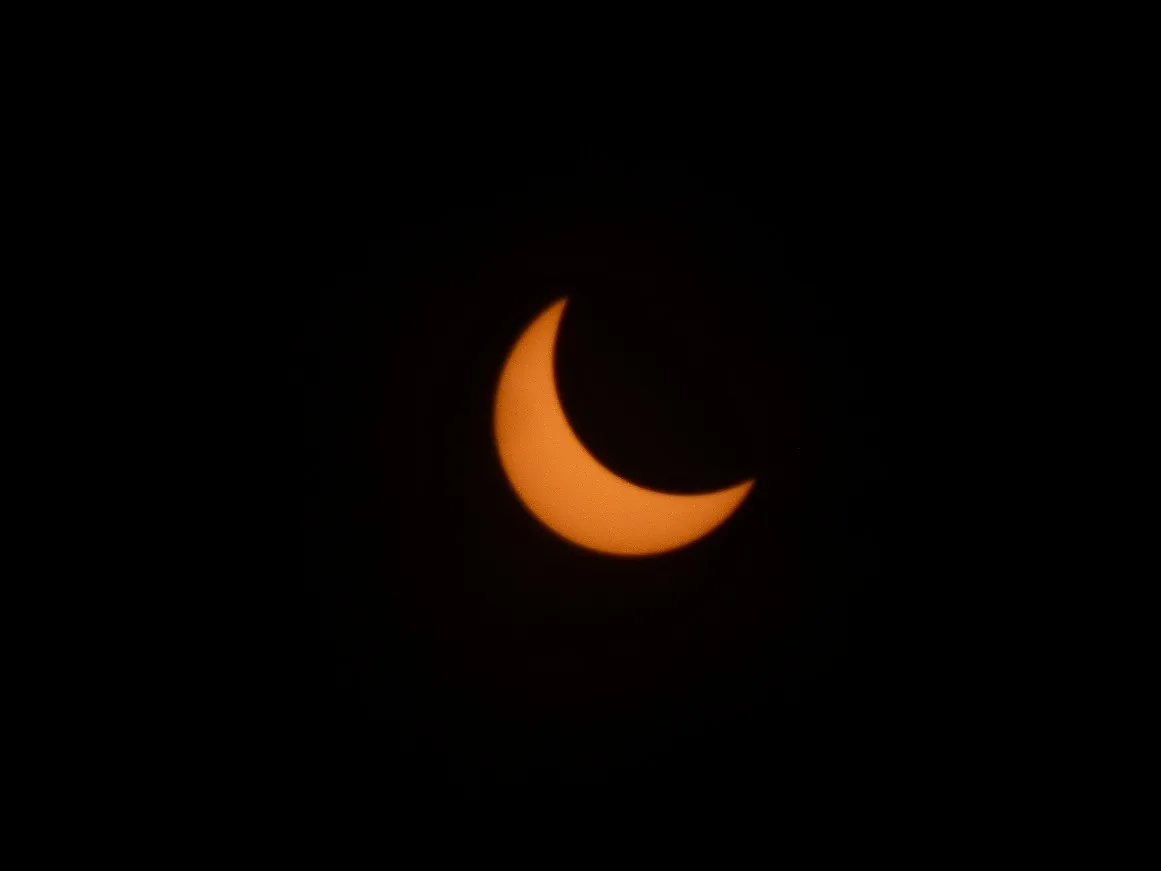
On Sunday morning I went out to observe the solar eclipse near my house, in Buenos Aires, Capital Federal. As was known, from this position it would not be an annular eclipse as in the South, but a partial one, but the weather was favorable as it was almost completely clear and, at that hour, the temperature was not high.
I had seen part of a TV broadcast from Patagonia where they had some cloud problems at that moment, but here in that aspect it was propitious, although the location was not the best. And even less so in Buenos Aires with so many buildings.
But the Sun was high enough and I was able to position myself on a corner to observe the phenomenon that had already started until almost the end, past noon.
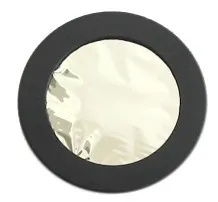
I didn't bring a camera or a telescope, but I did bring a solar filter, composed only of a sheet mounted on a cap. The cap is exact for use on a 40mm telescope. It is evident that with an instrument, even a small one like the indicated one, it would be better seen due to the magnification, but I thought the ideal was to share the observation with those unsuspecting neighbors passing by and that it would be easier without a telescope. With just the solar filter, the mechanics were very simple:
I asked people passing by if they wanted to see the eclipse. If they accepted, I explained that I had a solar filter suitable for astronomy, that they should place it near their face so that the filter covered their eyes and then raise their head towards the sun. Since this is easier than putting the eye to the eyepiece, quite a few people were able to observe.
I also didn't bring a camera with a tripod from which I could have made not only some shots, but a "time lapse" or time-lapse video, that is, a series of photos at regular intervals, aided by a simple device for that purpose. But had I done that, people could only have observed through the camera's screen. It seemed to me that using the filter directly was simpler, without "gadgets".
People of all ages participated in the observation, kids, adults, and older people. In some cases, they repeated the observation a while later. The astonishment of everyone and their gratitude is unparalleled.
The filter used is a Baader, in this case already mounted on a 40mm cap. It can be obtained in some specialized stores in Capital. I don't know its current cost but it must be around AR$ 400, approximately. The cap is the appropriate one for use on a telescope of that diameter, but they are also available in other sizes. In some cases it was possible, some time ago, to get the Baader sheet, without a cap, to mount it on one we already had or making one with some element so that it completely covers the light entrance.
There were some notable expressions I want to share:
-Several people said they saw the bright Moon, to which I had to explain what they were seeing. Of course, the real Moon was covering the Sun forming a bright crescent. So I clarified that it was daytime. "And then?" Then what you are seeing is the Sun and the part that doesn't shine is the Moon. "Ahhhh". And then: "Ahhhhhhhhhh". And they asked to look again.
-In many other cases no explanation was needed because they understood what the phenomenon was.
-Only in one case someone asked me how it was possible for that to happen and I explained it in the simplest way I could think of. I think they understood.
-Several people upon hearing my invitation replied: "No, I already saw it on TV" or "I already saw it on the internet".
-At least 3 people told me: "No, it's already over", to which I responded: "Look, it's not over", while the people walked away.
-Several people told me: "You can't look because it's harmful". Then I clarified (if the person didn't leave quickly) that I was using a special filter for the Sun. Some then asked more and others simply continued on their way.
-Many people simply told me "No, thank you", which shows that astronomical observation does not attract everyone and it is very difficult to know why yes or why not.
-A couple of people, somewhat disappointed it seemed to me by their tone, asked me "And the ring of fire?".
-On some occasions they told me, as a doubtful statement, that something like this would not be seen again. I clarified that it would be seen again, although it is true that it is not very frequent.
-In few cases it was not known that there was an eclipse in progress.
The parade of people only at some point generated a very short "line" of people. At 10 in the morning on a Sunday, the San Cristóbal neighborhood is not very busy, but an hour later the neighborhood starts to gain pulse. Until noon, about 40 people (rough estimate) had observed, almost all for the first time, a solar eclipse.
ABOUT ECLIPSES
1-How often do solar eclipses occur?
There is at least one solar eclipse per year and generally two, in some cases more. However, in each case they are not usually observable from every geographic point and, as if that weren't enough, in those places where they can be observed, part of the population can miss it due to cloudy skies.
2-When will the next ones be?
In 2017 there will be another one (which will only be seen in the USA). In 2018 there will be two partials visible in Europe and Asia. In 2019 (July 2) a total eclipse will be visible from Argentina and Chile, but only in the final part of it. And in 2020 (December 14) a total eclipse will be seen from Argentina (privileged location, towards the south) and in several Latin American countries (Uruguay, Chile, Brazil, Paraguay, Bolivia, Peru).
3-Is a lunar eclipse the reverse of a solar one?
One would have to see what is meant by "the reverse". Certainly, in a lunar eclipse, what hides the satellite is not the Sun nor any other object, but the shadow of the Earth. There is a lunar eclipse very close to a solar one, between 15 and 30 days apart.
For example, regarding the aforementioned solar eclipses for the coming years, there will be a lunar eclipse on July 16, 2019 and another on January 10, 2020, although neither will be observable from the Americas. On the other hand, a total lunar eclipse will be visible on July 27, 2018 and January 21, 2019. In 2020 there will only be penumbral eclipses, which are very unremarkable.
What are eclipses good for?
It should be clarified, first of all, that the following answer is not "teleological," that is, natural phenomena do not have a purpose as they are not conscious beings. However, human beings do have purposes and we can give purposes to these recurring events.
In ancient times, the Greeks used the Earth's shadow projected on the Moon to deduce that the Earth is spherical. They were also able to know, by measuring time, the approximate diameter of the Moon. Thanks to the retroreflectors left by the Apollo missions, during lunar eclipses the Earth-Moon distance can be measured with a laser.
Solar eclipses have been used to calculate the deflection of light from distant stars and thus corroborate the Theory of Relativity (Eddington, 1919).
-Beyond scientific use, why are eclipses important for the rest of the population?
No phenomenon is equally important to all people. The meanings we people give to social or natural phenomena are diverse.
It is possible that the infrequency of these phenomena generates curiosity in us. However, despite their low frequency, they repeat, but never in an identical way. For many reasons we could miss the observation of such events, be it due to clouds, having to do something else, etc.
They are events that can connect people of different social classes, educational and economic levels, partisan ideologies, fans of different teams, adults and children, that is, regardless of social differences.
-Isn't it the same to watch it on TV or the internet?
Surely it's not the same, just as it's not the same to go to a concert, watch a game, or go whale watching as it is to observe the same events on TV or the internet.
However, one thing does not preclude the other. The same phenomenon can be recorded by different people in the world and certain records are very beautiful, for example photos and videos.
Personally, I have never gone whale watching, but I have seen documentaries and I am sure it must not be the same. But since it is difficult for various reasons to go south to observe cetaceans, for now I am content with videos and photos, but if I could, I would go see it in person.
However, as is logical and obvious, not everyone thinks the same and it's not bad that it is so. About tastes...
-Is it okay to say "ring of fire"?
Well, it's just as right or wrong as other formulations like: "The Sun is a golden coin" or "The balls of fire that inhabit the sky." They are metaphors, rhetorical devices. In no scientific article will those terms be used, and instead others like "plasma" will be used. There is no moral principle at stake and they are not "wrong" concepts because if we took them that way, then what would we say about poetry, right?
-Why was it said to be The Eclipse of the Century or a "supereclipse"?
I don't know for sure why some people/media used those terms. In the first case there are several possibilities we can review: it was not the only event of that type that will occur in this century (discarded); it was not the last (discarded) and, to be precise, not the first either, but this is an option not so easy to discard and is the possible reason.
If we take only total solar eclipses (including annular ones) that have occurred from 2001 to date, they were little or not at all visible in Latin America, even less in Argentina. Therefore, it is the first one that could be observed reasonably well (without taking partial eclipses into account).
The other term perhaps in this case is due to it being "better" visible. It's worth remembering something I forget: the prefix super- is written attached to the word and without an accent, unless it is used as a noun, adjective, or adverb.
Sources and related links
- The date information I took from NASA Eclipse, by Fred Espenak, NASA/GSFC Emeritus
https://eclipse.gsfc.nasa.gov/eclipse.html - ESA: THE SCIENCE OF ECLIPSES
http://www.esa.int/Our_Activities/Space_Science/The_science_of_eclipses
About the images
The initial image was taken by the reader, teacher, and friend Pablo González.
http://www.astroeduc.com.ar
The filter image I took from Duoptic, the company where I bought my filter.
http://www.duoptic.com.ar