Excavation has begun for the facility that will house the largest neutrino experiment in the USA: DUNE, as surreal as if David Lynch had made it!

With a ceremony held on Friday, July 21 at the Sanford Underground Research Facility (SURF) in Lead (South Dakota, United States), a group of political leaders, scientists and engineers from around the world marked the start of construction of a major international experiment that could change our knowledge of the Universe. This is the Long-Baseline Neutrino Facility (LBNF), which will house the international experiment DUNE (Deep Underground Neutrino Experiment), to be built and operated by 1,000 scientists and engineers from 30 countries, including Spain, Brazil and Chile.
CIEMAT, the Instituto de Física Teórica (IFT, UAM-CSIC), the Instituto de Física de Altas Energías (IFAE) and the Instituto de Física Corpuscular (IFIC, CSIC-UV) of Spain are participating in its construction.
When completed, LBNF/DUNE will be the largest experiment built in the United States to study the properties of the mysterious particles called neutrinos. Unraveling the mysteries of these particles could help us better explain how the Universe works and why matter exists.
Institutions from dozens of countries will contribute to the construction of DUNE's components. This experiment will attract students and young researchers from around the world, training the next generation of scientists who will lead this field of research.
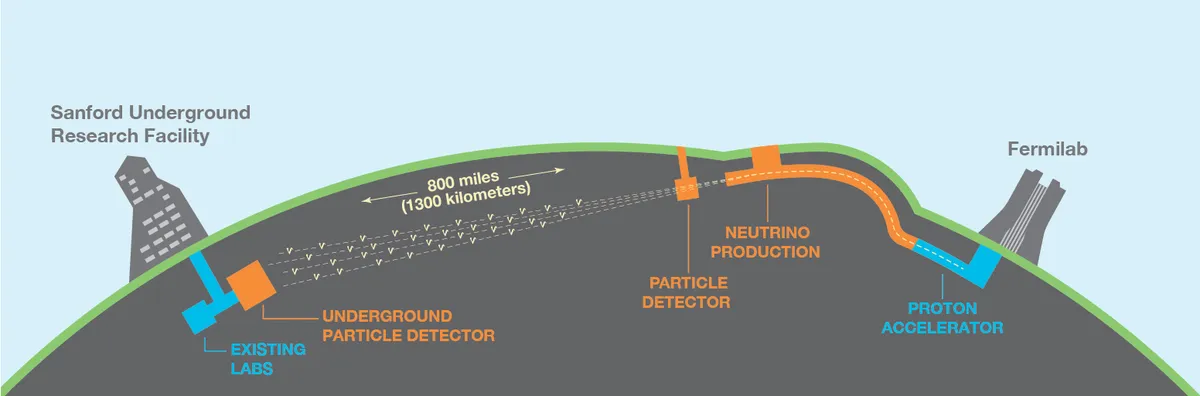
Fermilab, located outside Chicago, will produce a beam of neutrinos and send it 1,300 kilometers through the Earth to SURF, where four large detectors four stories high and containing 70,000 tons of liquid argon will be built underground to trap these neutrinos.
Scientists will study the interactions of neutrinos in the detectors, to better understand the changes these particles undergo when traveling from one point to another in the blink of an eye. Since their discovery more than 60 years ago, neutrinos have proven to be the most surprising subatomic particles, and their oscillation between three different states is one of their greatest surprises. This finding began with a solar neutrino experiment led by Ray Davis in the 1960s, carried out in the same underground mine that will now house LBNF/DUNE. Davis received the Nobel Prize in Physics in 2002 for this experiment.
DUNE scientists will also look for differences in behavior between neutrinos and their antimatter counterparts, antineutrinos, which could give us clues as to why we live in a Universe dominated by matter. DUNE will also observe neutrinos produced in stellar explosions, which would reveal the formation of neutron stars and black holes. It will also investigate whether protons live forever or eventually decay into other particles, bringing us closer to realizing Einstein's dream: the Grand Unified Theory.
But before this, the facility must be built, something that will happen over the next decade. Workers will begin construction by excavating more than 870,000 tons of rock to create the enormous underground caverns for the DUNE detector. Meanwhile, large DUNE prototypes are being built at the European particle physics laboratory (CERN), one of the project's major partners, and the technology developed for these smaller versions will be tested and scaled up when the large DUNE detectors are manufactured.
This facility is funded by the U.S. Department of Energy Office of Science, in collaboration with CERN and other partners from thirty countries.
Four Spanish research centers are part of the scientific collaboration of the DUNE experiment. Their contributions cover both the design and construction of the experiment, particularly the detectors to be installed at SURF, and the studies to optimize the scientific exploitation of the experiment. A crucial preliminary step to building these detectors at SURF is to manufacture prototypes to test the technology. This task, in which Spanish institutions also participate, is being carried out at CERN with the construction of two large prototypes, called ProtoDUNE single phase (ProtoDUNE-SP) and ProtoDUNE dual phase (ProtoDUNE-DP), which will be tested with beams of charged particles starting in 2018.
DUNE brochure in Spanish.
https://issuu.com/gebla/docs/lbnf-dune-brochure-spanish
Fans of Frank Herbert's novel are informed that it is confirmed: DUNE will not search for the spice/melange! And to current followers of Game of Thrones, know that there is nothing new under the Sun and that George Martin's novels are like a neutrino that traveled from 1965 and barely changed flavor.
Sources and related links
Twitter of the CIEMAT - Particle Physics María de Maeztu Unit of Excellence: @cfp_Ciemat
LBNF/DUNE brochure (Spanish):
http://news.fnal.gov/wp-content/uploads/lbnf-dune-brochure-spanish.pdf
CERN Neutrino Platform http://cenf.web.cern.ch/
ProtoDUNE http://cenf-dune-proto.web.cern.ch/
Construction begins on a major international experiment to understand neutrinos http://www.ciemat.es/portal.do?IDM=61&NM=2&identificador=1364
About the images
DUNE diagram. Credit: Fermilab.