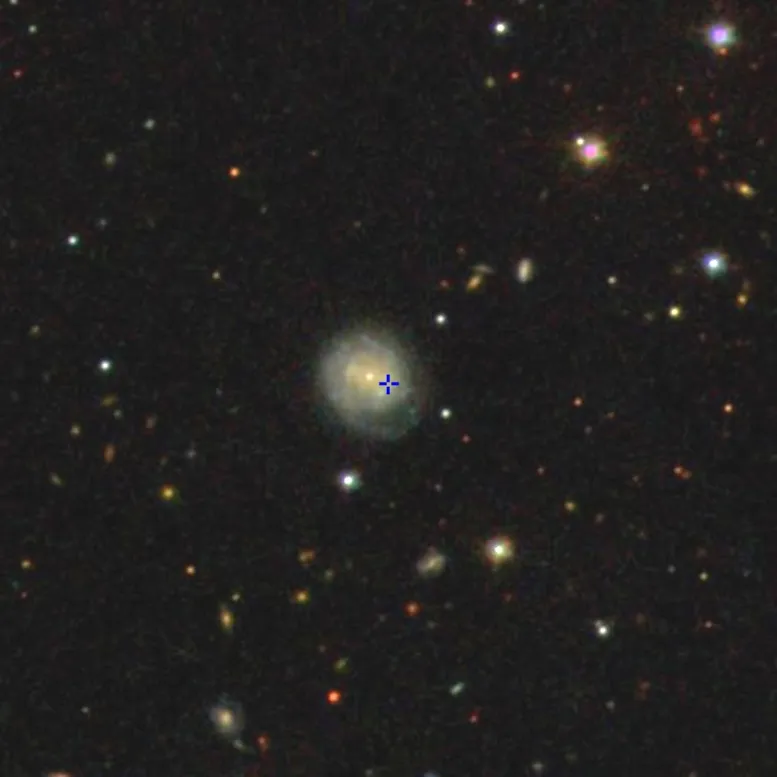
A chance discovery by a Brazilian astrophotographer adds another note to the "supernova song".
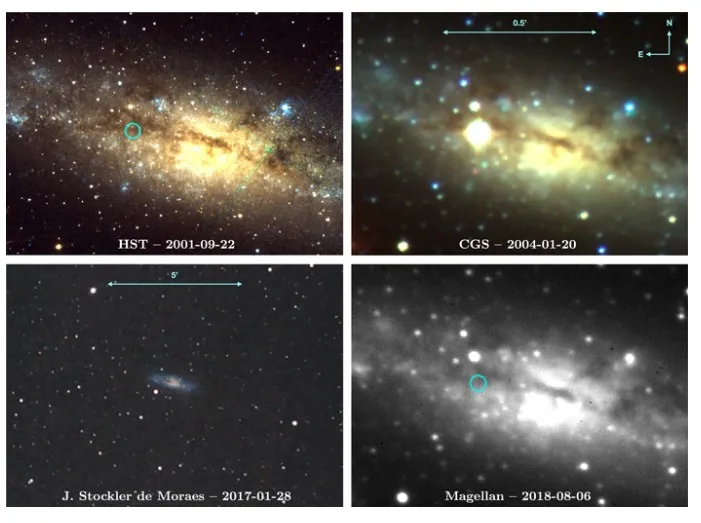
In January 2017, amateur astronomer Stockler de Moraes took an image of the distant galaxy NGC 1892 using his 12-inch telescope.
When he compared his photo with another archival image of the same galaxy taken in 2004 as part of the Carnegie-Irvine Galaxy Survey (CGS), he discovered a difference: a bright source was noticeable in the archival photo that was not in the recent image.
Stockler de Moraes contacted astronomer James Guillochon (Harvard Center for Astrophysics), who evaluated different possibilities, such as a minor planet in our solar system that happened to coincide with the sky location of the galaxy. Guillochon and collaborators then explored other archival images and analyzed the CGS image. The event—labeled CGS2004A—was not in any additional images before and after the CGS observations.
This was published a few days ago in the AAS "Research notes". There they explain why they consider the source to be a Type IIP supernova from 14 years ago (2004) that no one had discovered until now. Other details are also given, such as the equipment Stockler de Moraes used: a Canon 1100D mounted on a GSO 305 mm, that is, a 30 cm telescope.
According to Guillochon, NGC 1892 has a stellar mass of 4 × 10⁹ solar masses, so the fraction of Type II supernovae should be more than half of all supernovae in the galaxy. A Type II supernova is when a massive star collapses.
Another example of how Pro-Am collaboration, between amateurs and professionals, can generate interesting astronomical discoveries.
The supernova song
In February, the YouTube channel Astronomy Sound of the Month published a video with the song "Champagne Supernova" showing the discovery of these events from 1950 to this year, varying the sound frequency and images to match the frequency of findings chronologically.
If you get bored during the first few seconds, fast-forward the video to the year 1990 and be amazed!
Sources and related links
- “Serendipitous Discovery of a 14-year-old Supernova at 16 Mpc,”
James Guillochon et al 2018 Res. Notes AAS 2 165.
DOI:10.3847/2515-5172/aade89 - AASNova: Surprise Discovery of a 14-Year-Old Supernova
https://aasnova.org/2018/09/12/surprise-discovery-of-a-14-year-old-supernova/
About the images
Credit: James Guillochon et al 2018 Res. Notes AAS 2 165.