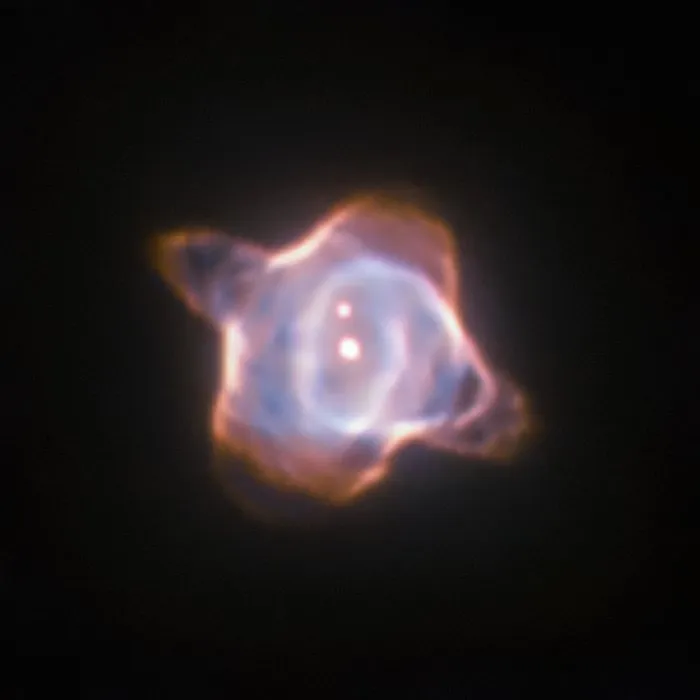
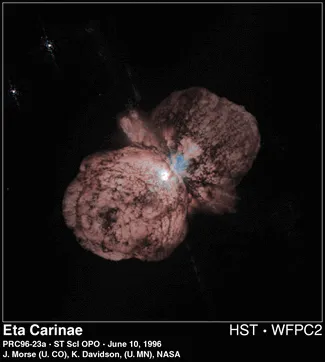
On the discovery of the supernova by an amateur. Was it luck? Is there envy? Was it overrated?
Let's take sports, say soccer or basketball: a player kicks with the intention of crossing the ball into the box, but there's wind, the trajectory curves and it goes into the top corner. Genius or luck? The same with sinking the orange into the hoop. You may have seen videos where a person sinks the ball into the hoop from a great distance. Generally those videos are somewhat deceptive: the person tried "a gazillion" times, but only shows the one where they succeeded.
From the first example it follows that, in social discourse, luck is synonymous with a certain type of contempt or belittlement, therefore, it is a value judgment.
But reality can be deceptive, as I try to show with the second example.
So I think it's appropriate, first of all, to try to understand how things are and then form an opinion.
HOW TO WIN THE SUPERNOVA LOTTERY: ARTISANAL MODE
Let's say we want to develop a strategy to discover a supernova. First we would have to understand what that is. There are different classes of supernovae, but they all have something in common: they are an event, the product of a process. Since the event is significant, notable, it is also a change of magnitude. We call significant changes endings or beginnings. A supernova event is the end of a process, but also the start of another. And it is evidenced by an exponential increase in brightness, by an extraordinary emission of light, radiation.
If that is a supernova, then to find these events one would have to monitor those stars whose development is going to end in that way, in relatively near times. But there is no crystal ball to predict such an event with day and hour. I remember that some time ago it began to be said on the web that the star Betelgeuse would explode as a supernova soon, implying it would be days or weeks or months. Impossible to know with that precision. In reality it could be thousands, tens of thousands or millions of years.
However, when a star is heading toward that end, because it is already part of that process, it changes brightness. So a strategy would be to monitor variable stars. There are regular variables, meaning they change brightness every certain time, almost like a clock. But some take months to produce the change, others years.
If we know that A changes brightness every 3 months and that the last increase was last week, then for the next 2 months and a bit it wouldn't make much sense to monitor it. On the other hand, if B changes brightness once a year and the last increase was 330 days ago, it would be good to keep an eye on it.
This restricts the monitoring and makes the search easier. Great. We're close. We can cut more: some are not observable from our position at this time of year. Others are heavily monitored by the amateur observer community. Others are heavily observed by professionals. One strategy would be to observe the ones that are not heavily monitored. We also discard those that are difficult to observe because they are very low on the horizon. That would be a good path to the glory of discovery. And when we've done it, we'll give the others the Catalan whistle. Lero, lero! Even closer.
But there are a huge number of variable stars. Let's make a list, order it by possibility of observation and moment close to the next estimated brightness increase. Now, to observe.
But...you have to observe a lot if you want to succeed. Every possible night, if the weather allows. And for that we need a telescope. Some variable stars can be observed with the naked eye, but many others cannot. We have to learn to estimate brightness or to make light curves. You have to buy a telescope: for much of the 20th Century it was said that for telescopes, the bigger, the better.
Although this is changing for various reasons, including hybrid telescopes, it still holds because the use of Newtonian telescopes, with a concave primary mirror, is very common. The larger the mirror diameter, the better.
How big do we buy it or make it? 5 centimeters (two inches) is a toy. 10? It's small. 20 is small. Let's say 40 cm.
We buy a DSLR camera to attach to the scope.
The telescope must have a decent equatorial mount to support all the weight. And it must be motorized so the telescope's movement compensates for the Earth's rotation.
And we need to have a place, a space to observe. If we have a terrace and there aren't many tall buildings around, it's ideal. But you can't do it outdoors: setting up and polar aligning a 40 cm beast, heavy, is not easy. So the ideal would be to build something on the terrace, with a retractable roof. That way, we always have the telescope set up, ready to use, without fear of it getting damaged.
It's a good amount of money, but you don't need to be a millionaire. If you work, you can save up and buy it little by little. Also, you have to learn how to use the things, it's better to start with something smaller. It takes time to acquire the equipment, it takes time to learn how to use it. It takes effort.
If you achieved all this, after several years, then yes, you begin your observation campaign for supernova detection.
Despite his optimism, reality is relentless: the probability that you will see a star "at the moment" of the supernova is extraordinarily low. Like finding a needle in a haystack. Like winning the lottery.
That the probability is low will be more noticeable if we think about this same, almost artisanal, process in an industrial way.
INDUSTRIAL SEARCH FOR SUPERNOVAS
We set up a network of robotic telescopes, with their corresponding cameras, in very dark places. We program them to move on their own, photographing different parts of the sky, repeatedly. We connect each telescope to a computer, where the digital images will be stored. And we run a program, an algorithm, that will compare the images taken at different times of the same place in the sky, subtracting them. The images are obtained with inverted color: white background, stars in black. Imagine that in a tiny piece of the sky only a single star is detected. The image will be all white, with a dot in one corner. Then, at another time, the telescope points to the same area again and takes another photo. Another white image with a little dot. Those dots are pixels. If those pixels are subtracted there are two possibilities: that the pixels are identical, in which case it's like doing 1-1=0, meaning they will cancel out and the third image (the result of the subtraction) will be null. Or, if the pixels are not identical, the third image will be different from zero. It's like doing 1-2=-1, or 1-0.2=0.8. In any case, there will be a brightness difference. All this is automatic. You set this up, have a coffee and go to sleep, go out for a walk.
The algorithm has a part that instructs the computer that if it finds a non-zero difference, it displays a message on the screen.
So you, every day, check the computers to see if there is an alert.
If there were one, don't run to shout Eureka! Computers don't discover anything. They detect changes in the images. Those changes could be brightness changes of a variable star about to explode...or something else. You must analyze each case. That's why, if there is a discovery, it's human.
With this strategy, you could perform many more observations. And even so, the probability of discovering a supernova "in the moment" is very low.
So what do we do? Give up? Well, astronomers, amateur or professional, don't give up. They keep doing that thing you know. Amateurs put their eye to the eyepiece. Professionals look at screens. The former may or may not have exclusive dedication (a retiree could dedicate themselves only to that), but professionals can have access to many state-of-the-art equipment, professional instruments and dedicate themselves to that exclusively (many are also teachers).
Because of this, it would be more likely for a professional to make the discovery. But an amateur with practice and determination can perfectly well "compete" with a professional.
In the history of astronomy we will see several cases of astronomers who did not have formal instruction at a university, as happens today, but who started out of curiosity and what they offered most was their tenacity. The novel "La piel del cielo" addresses that custom.
STATISTICAL LUCK
So far, in a simple way, we have an idea of how to search for supernovae. Since in any case it is difficult to make the discovery, it is unlikely to discover one, just because of that we could say that success depends, in part, on luck.
But this concept of luck cannot be related to a derogatory value judgment, because in the case of the amateur, it implies a lot of effort and systematic dedication over...years.
Making the ball into the hoop on the first try is just luck. Making it after practicing a thousand times, no.
Luck found him working, as Pasteur (or Picasso) said. He knew how to interpret what he observed and communicated it appropriately. That is not luck.
You cannot decide if something is luck or not by flipping a coin! It's like being against superstitions...because they bring bad luck. It's like thinking that Independiente lost to Grêmio because the Brazilian team had a better witch doctor. Witch doctors, when they are right, it's by luck. Víctor Buso and Melina Bersten do not practice witchcraft. They do not consult the horoscope.
SUPERNOVAE, "LIVE"
It is worth stopping on this aspect, because in some web comments and on social networks, the discovery was also belittled by labeling it as "false" or "lying" because it is said that an event was observed at the very moment of production, when it is not so. I think it is appropriate to write a separate note about "Fake news in astronomy" to reflect on what we call falsehood and not to put different things in the same bag. But that will be another day.
With a minimum of knowledge, it is obvious and therefore unnecessary to say, that EVERYTHING in astronomy has a delay. We do not observe the light coming from objects at the same moment it is produced. In fact, in our daily life, we don't either. What happens is that in daily life, distances are short and events seem simultaneous, but they are not, it's just that perhaps they are delayed by thousandths of a second.
In the universe, where distances are literally sidereal, the thing is the same, but it's more noticeable. The light from the sun reaches Earth with an 8-minute delay. What we observe is always light produced before the observation. ALWAYS.
So the consideration of "live" or "at the same moment" does not refer to the instant of production of the luminous phenomenon, but to the moment when that radiation reaches Earth.
Supernova events, which considerably increase the brightness of a star, can be observed for different amounts of time: hours, days.
It is possible, then, that someone discovers that a star changed brightness, hours later or a day later, because the change can last. That is the usual. The increase in brightness tends to decline, but not immediately, but can last for some time, relatively short.
But observing a star now, and noticing that it begins to increase in brightness, implies observing "live" something that already happened, but at the very moment that change is detectable on Earth, at the moment the light reaches us. Therefore, it was not a lie. There are some shady gamblers who use "precision" to hide a deception. I do not mention them by name because they use pseudonyms. They are trolls.
OVERVALUATION
Just as I detected a certain disdain, based on the fact that the discovery by the man from Rosario was "fortuitous," added to the confusion about whether it was or was not true that it was made "in the moment," I also detected a somewhat fetishistic overvaluation, based on true data.
It is logical to use certain data and statistics to understand something: that it is very infrequent to observe this phenomenon in that way, just as it is infrequent for an Argentine author to sign a paper as lead author in Nature, are consequences of something, therefore, a symptom. It does not have "value in itself," but rather has value as a consequence of something else, prior.
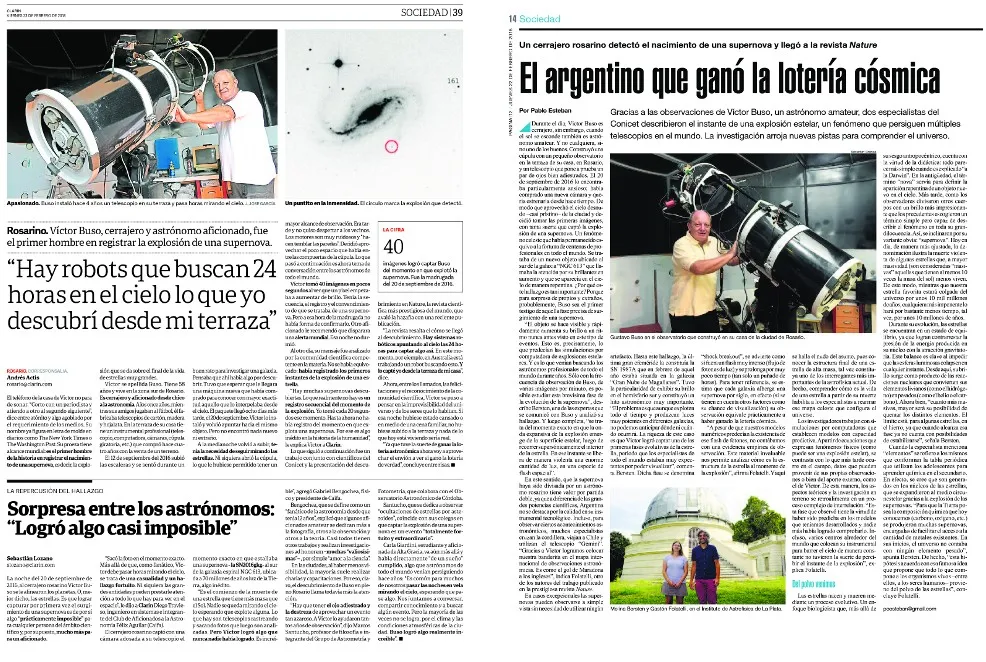
In this case there was a fruitful Pro-Am collaboration, of professionals and amateurs, with the participation of the AAVSO, the American Association of Variable Star Observers. I highlight the fundamental intervention of Sebastián Otero, another Argentine, mentioned in some journalistic articles and who is part of AAVSO. A specialist amateur, a true expert in light curves. He is no fool.
Devaluing Argentine professionals because they don't usually sign papers as lead authors can lead to an overvaluation of the amateur. 'The amateur who beat the professionals.' I've seen some publication on the matter. I'm more concerned about the former.
Some website said that professionals 'envied' the amateur. Yes, it's possible. Healthy envy or bad. It happens in every human group. I hope the former prevails.
Argentine astronomy in the world
Argentina is a peripheral country, with agrarian capitalism, industrially backward. If in recent years it seemed there was an industrial recovery, the truth is it was somewhat deceptive, because in many cases it was mere assembly of parts produced abroad. There are exceptions, like the automotive industry, but even in that case, there is a deficit in the production-import of parts and cars.
Telescopes are not produced in Argentina. And the professional instruments, in Córdoba, La Plata and San Juan, are quite old. The entry into the Gemini South consortium is indeed important and cutting-edge. And there are projects underway for the installation of new equipment.
Many Argentine astronomers have achieved important things in the international arena, some working in the country, others abroad. Human resources can improve, but they are not the problem. I say they can improve considering that with instruments sensitive to other wavelengths, not optical, and cutting-edge equipment, it's necessary to learn to use those technologies in a specific way. But human talent does not seem to be the problem.
Despite those conditions, researchers like Dr. Gloria Dubner or Dr. Gustavo Romero, to name just two, are examples that despite scarce resources, important research can be achieved. And further back in time, José Luis Sérsic or Sahade.
Expecting Argentine professionals to publish in Nature every other day as lead authors, without heavily investing in instruments, is like expecting El Taladro (a team I sympathize with because I lived 30 years in Banfield) to win the Copa Libertadores without buying players, when all the other teams do.
Argentina as a country does compete with other countries. But competing with very different resources, is that competing? A competition between Barça, Real, PSG and Sacachispas, is that a competition?
On the other hand, there is no such competition between amateurs and professionals. It must be said that the verb admits nuances: in Spain, 'competencia' is related to a person's skills to perform a role, that is, with being competent. An amateur can, in some sense, be as competent as a professional, mainly limited to the practical, not so much the theoretical. And, as this story tells, one and the other can complement each other. Competition sweeps away competition, that is its purpose. That's why monopolies exist: because there is competition (No, it's not a contradiction, think about it again). Collaboration is something else.
Is it necessary for the country to make an astronomical investment in instruments?
No, because obviously priorities must be set, which does not mean that the previous or current priorities are the right ones, but it would be illogical for a country that has trouble manufacturing vaccines to invest astronomical sums in building telescopes.
However, within the region and in the Southern Hemisphere, Argentina is a country whose level of academic and technical development is on par with (and at the latitude of) Brazil, South Africa or Australia in surveying the southern sky. Despite that, Europe has two feet planted in Chile, where ESO does a fabulous job.
I believe the ongoing projects in the north will be virtuous and will surely bring new research that will deserve attention. The investments made in those projects may seem onerous, but in the national budgetary context, they are a drop in the ocean. One must invest what one can, based on economic development and social needs. As an amateur, I would love for the country to have monsters like ESO's in the neighboring country. But besides being an amateur, I am a citizen with other social concerns and therefore, on the scale, other things are a priority. That does not mean that, in its context, a moderate investment, which is indeed necessary, is possible.
CONCLUSION
From the statements that came out in the press, it seems that the Rosario native Buso has things clear. He doesn't consider himself a Newton, but he knows he won the "cosmic lottery" and achieved what for many is a kid's dream. But it was the fruit of his effort and dedication and it's something he seems to enjoy. The academic significance and the publication in Nature add to it, no doubt. But the pleasure of searching and finding, with all its difficulties, is priceless.
The collaboration with AAVSO and the professionals from UNLP must be highlighted. I say UNLP because even though they are working in different places, the signatories are graduates of that La Plata institution.
The case of the locksmith is a key to open that Pro-Am collaboration further, which should be just that, collaboration, not competition.
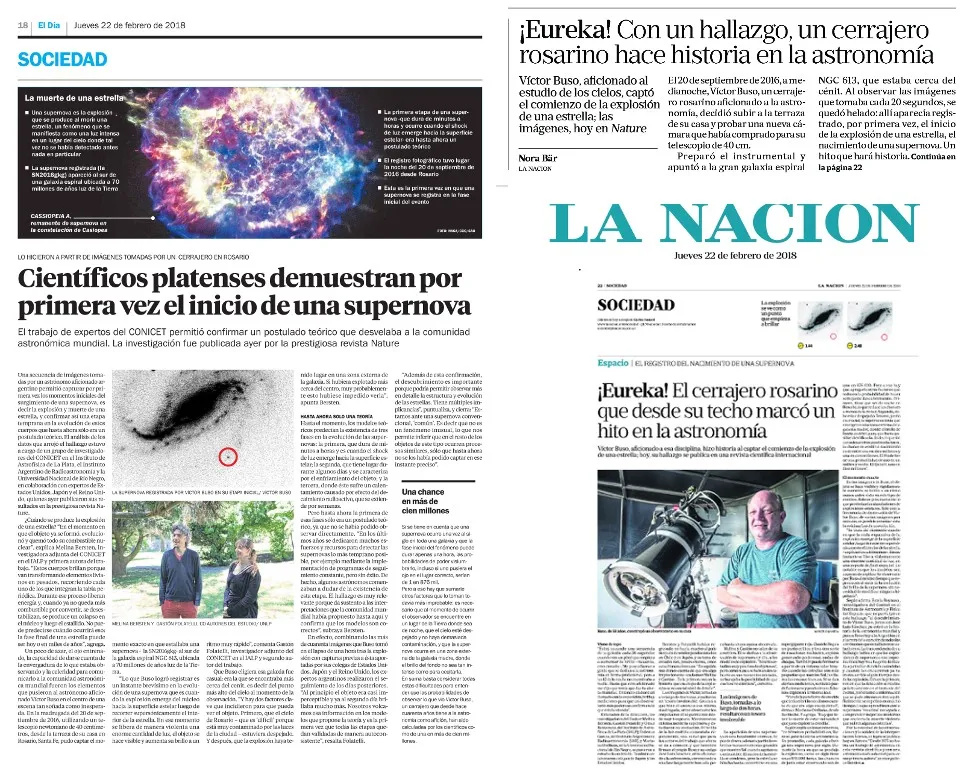
Let's add an anniversary on September 20: in 2016, Víctor Buso dived into the cosmos and discovered supernova SN2016gkg in NGC 613. The work published in Nature was signed by Melina Bersten, Gastón Folatelli, Federico García, Omar Benvenuto, Mariana Orellana, along with Víctor Buso and J.L. Sánchez, plus other signatories from other countries (including Alexei Filippenko).
For regular observers, a new challenge: Find NGC 613, in Sculptor, magnitude 10.
Both the mentioned professionals and Víctor are, without a doubt, already stars in the firmament of astronomical discoverers. It even makes you want to meet them and take a selfie. If we took it at night, with a longer exposure, perhaps, in the background, we might notice a tiny point of light...
Curiosity
The program that reports on the results of games of chance, La danza de la fortuna, popularized by Riverito, Roberto González Rivero, takes its name from the national film of the same name, which had León Klimovsky as its literary advisor, brother of the famous epistemologist, author of Las desventuras del conocimiento científico.
Sources and related links
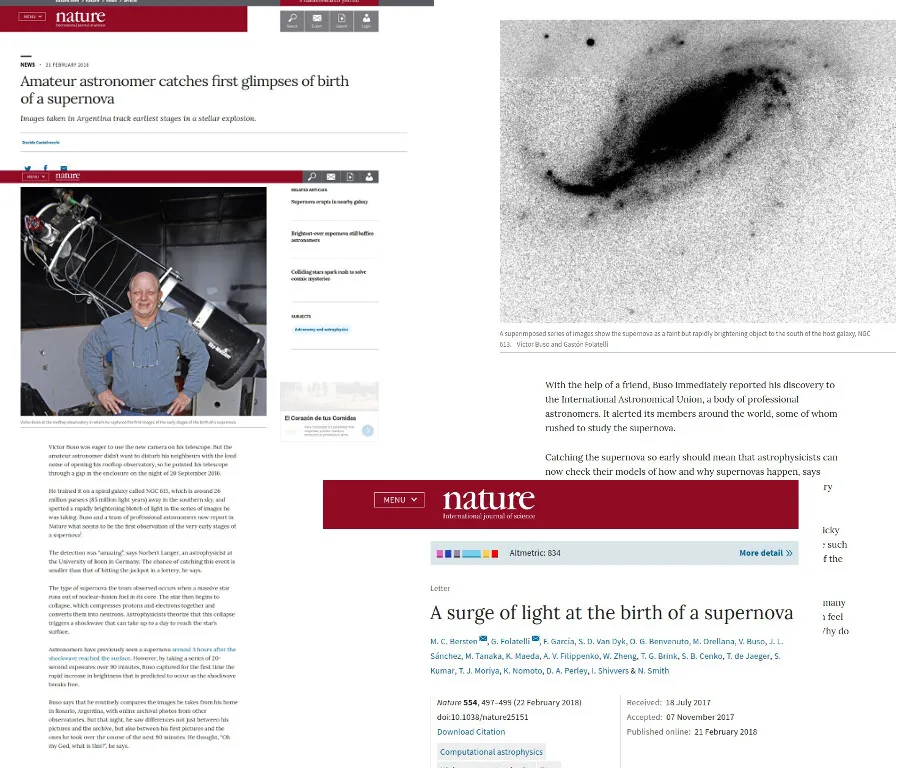
- A surge of light at the birth of a supernova
Bersten, M. C. et al. Nature 554, 497–499 (2018).
DOI:10.1038/nature25151 - Amateur astronomer catches first glimpses of birth of a supernova
https://www.nature.com/articles/d41586-018-02331-4 - El gran descubrimiento de un aficionado argentino a la astronomía que genera envidia en los profesionales
https://www.elintransigente.com/sociedad/2018/2/22/el-gran-descubrimiento-de-un-aficionado-argentino-la-astronomia-que-genera-envidia-en-los-profesionales-479681.html
About the images
Initial gif: Víctor Buso and Gastón Folatelli.
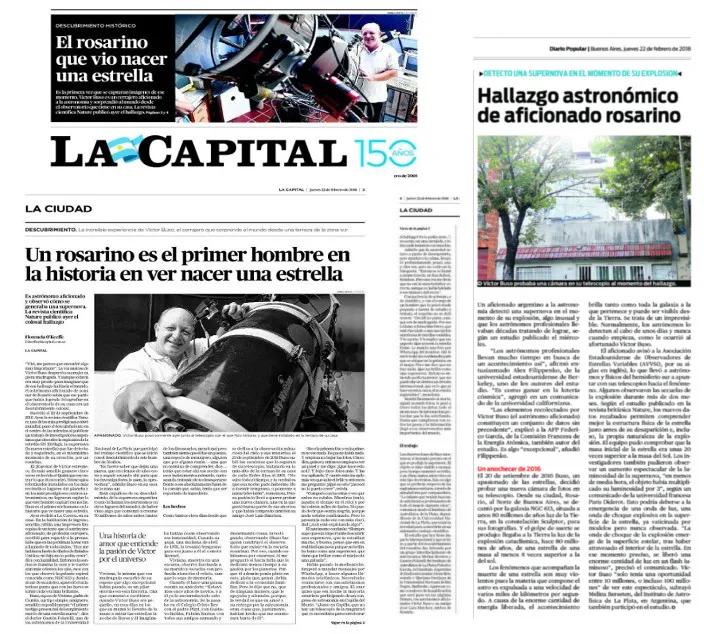
Screenshots of local media and Nature.com.