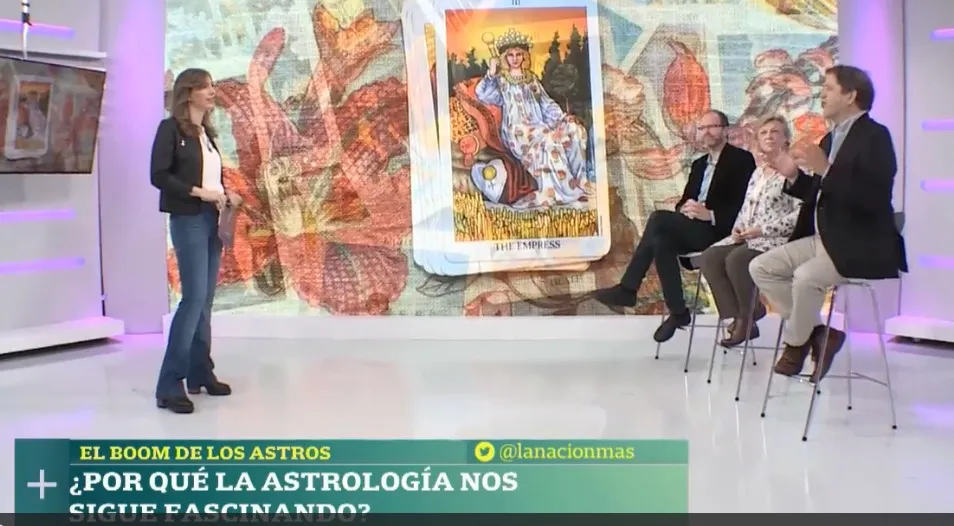
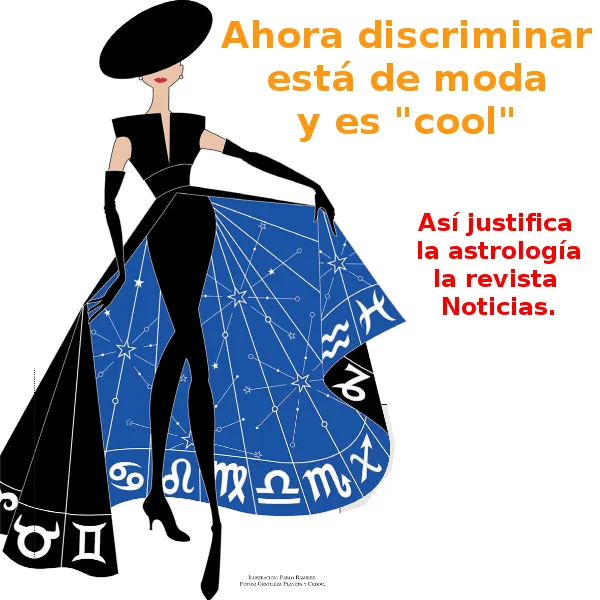
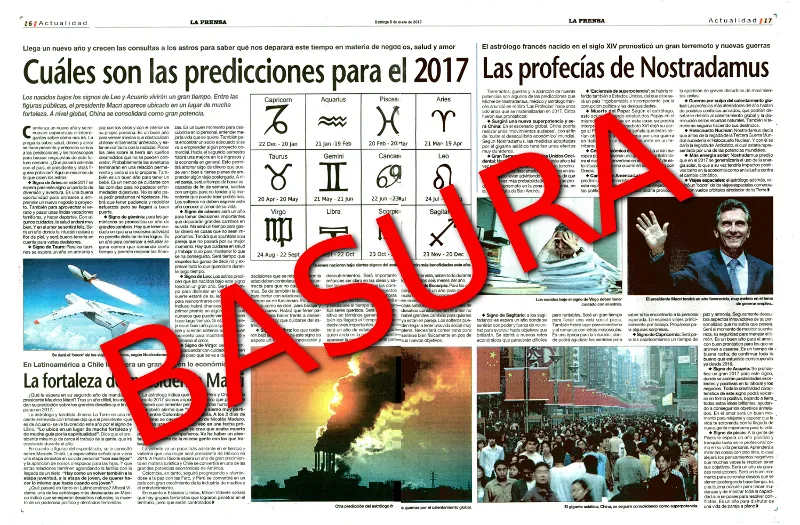
A reflection on an article by Nora Bär in LN.
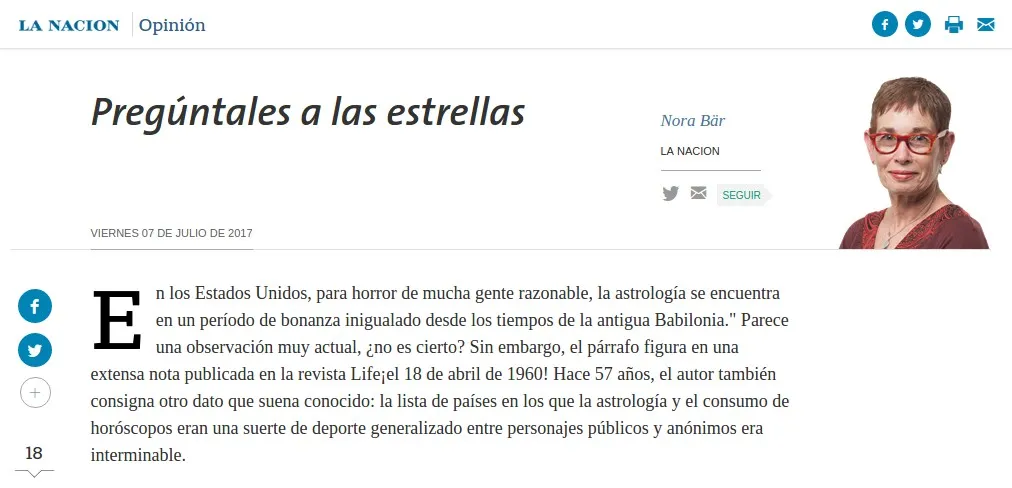
An article by Nora Bär titled "Ask the Stars" is published in today's La Nación. The journalist dedicated to science journalism echoes the current popularity of astrology and finds that "Perhaps the explanation for the success of horoscopes lies in the fact that there is something reassuring about taking free will out of the game and placing our successes and failures in the hands of others (in this case, the stars)."
But to reach that conclusion, she first uses some correct data incorrectly and omits others that she perhaps does not know.
1-Astrology has nothing to do (in any sense) with the stars, but only makes statements about planets of the solar system, the Sun and the moon. Of all these objects, only the Sun is a star, the only one that astrology mentions or takes into account in its discourse. Therefore, for astrology, the rest of the innumerable (but finite) existing stars have no "influence." Nor do asteroids, moons of the various planets of the Solar System, exoplanets and their moons, or any other known astronomical object.
2-Nora Bär uses what I have called "The Ophiuchus reasoning," which consists of three arguments. She does so by citing the Argentine professional astronomer Alejandro Gangui.
But it is a mistake to do so, even when the arguments are true. I have written about this previously in a post titled "The problem is not Ophiuchus."
I will explain: the three arguments included in the reasoning are:
a-The signs in astrology are shifted relative to the constellations.
b-The signs all last the same (one month), while the Sun's passage through the constellations differs in time.
c-There are 12 zodiac signs, but there are actually 13 constellations of the ecliptic (the apparent path of the Sun throughout the year). The "missing sign" would be Ophiuchus.
However, these three arguments (which say nothing about whether astrology is true or not) are easily refuted: astrology has different conventions from astronomy. The only purpose these arguments serve is to show that astronomy and astrology, although they were the same thing in antiquity, are different practices today.
That they are different practices says nothing about what is truly important, which is why they are weak arguments. Using weak arguments with the aim of refuting an idea is counterproductive.
3-Nora omits taking into account that, if one studies the history of astrology (I will cite several books on the subject below), we will see that it is difficult to sustain with historical data that astrology was popular or massive...until the 20th century.
It is difficult to find, not to say almost impossible, that before the last century common people knew their "astrological sign" or had any notion of what it would mean to be a Pisces.
That began to happen when horoscopes were published in print newspapers, a fact that can be traced back to around 1930, in England. During that century, radio also appeared and later TV and the internet.
Until then, whoever wanted to know what fate had in store for them according to astrology could not read a book by Horangel, nor watch Jimena La Torre on TV, but had to personally go to an astrologer and pay. The astrologer, on the other hand, did not explain much (as they do not now) why they said what they said. They only stated relationships between a possible event and the transit of a planet through a "House" or similar things.
That is why, until the 20th century, what happens today did not occur: that people think Geminis are one way and Virgos another, different from Scorpios and Aries. This prejudiced notion, based not only on the moment of birth but on the influence of planets, sun and moon, is typical and exclusive of the 20th century.
If astrology was always a mythology, a prejudice (a strong opinion about something that is poorly understood), since the 20th century it has been a massive prejudice. And that is so because of its circulation through the mass media.
Before, as Carl Sagan pointed out -cited in Nora's article- those who consulted astrologers were Kings, not vassals or serfs.
False knowledge reaches us thanks to the mass media. Since then, the horoscope has become a generalist journalistic genre. Most Argentine generalist newspapers (national and provincial) publish the horoscope. Sectoral content newspapers such as economic or sports newspapers do not. And there are some exceptions among the generalists.
Página/12 never published the horoscope. Tiempo Argentino did publish it while it was run by businessmen and stopped doing so when it became a workers' cooperative at the moment the businessmen washed their hands of it.
The New York Times does not publish the horoscope, although the Washington Post does. The underlying idea in print media is that without the horoscope, fewer copies are sold. An idea never questioned, but also never corroborated. It would be ideal if someday a newspaper like Clarín stopped publishing the horoscope for a week to see what reaction there is from the public.
If the public becomes enraged, then it will have to be noted that people buy the newspaper for that prejudiced discourse and not for the news. Which would corroborate the hypothesis and, at the same time, would speak very poorly about media consumption.
But if there is no great reaction, then my hypothesis could be proven: people do not buy newspapers for the horoscope, but they read it because it is published. It is not published because that discourse is in demand.
Let's think about a future in which no newspaper, no magazine (like the magazine La Nación or Ohlalá) publishes the horoscope. What would it be like?
Well, in the long run, people would no longer think or talk about their belonging to such and such a sign. The concept could be maintained through an oral tradition, from mouth to mouth from parents to children, certainly. But it would be a very weak notion, not supported by other discourses, that would gradually disappear.
However, astrologers need publicity. Sometimes the spaces they have in the media will be paid for. But in many other cases it is different: generally the women (I have already pointed out a gender bias in the horoscope) who grew up and accepted this discourse that integrates them into a group of representation (sign) and distinguishes them from the rest, and who had that enunciative contact through newspapers and magazines, later become journalists and write articles, giving this prejudiced discourse greater circulation.
Therefore, the only path against astrology is not censorship, as an imposition, but the development of strong arguments that demonstrate that astrology has no validity and that, furthermore, it is not necessary.
Yes, we have different personalities and destinies. Can we know scientifically why? Yes, but it is not as simple as the reasons that have been put forward in a vulgar way.
Even science has wreaked havoc on this point. I remember studying that some psychologists stipulated that we people have a certain "type" of personality according to our physical build: thin people are rational, fat people are kind.
Attempts have been made to justify astrology with a scientific appearance based on some studies that link personality with date of birth. Such studies are statistical. Statistical studies explain nothing, they only find correlations that are not necessarily causal relationships (as explained simply in a recent LN article, see below).
But furthermore, such studies are seasonal. Astrology is not. That is, these investigations point to the moment of birth in terms of environmental conditions, which are different at the same moment, depending on the hemisphere. But for astrology, Leos are born in August, in both hemispheres. Therefore, even if those studies were true, they disprove astrology.
Astrology is a blind belief, nothing more. Taken seriously, it is nothing more than a set of prejudices.
For some time now I have noticed something I had not perceived before. Astrology is defended by those who say they are against modern "scientism," but who also say they are against racism, xenophobia, and machismo. Those three practices are prejudiced against black people, foreigners, and women. Others have been and continue to be so regarding Jews, homosexuals, and other groups.
Some endorse astrology under the assumption that it is "popular," but machismo is also popular, and it is false that astrology has been popular throughout history. If it is now a massive discourse, it is due to its circulation in the media.
If Nora's conclusion were true, one would have to argue that then, after thousands of years of humanity, we have not advanced much.
Free will does not exist from the moment we cannot choose when to be born nor can we modify (past) history or the Laws of nature. There is no free will when some are born with a silver spoon and others in the mud. We cannot "freely choose" our future. We are beings conditioned by nature and by the society in which we live.
We have conditioned ourselves negatively many times and positively, other times.
50 years ago, the habit of smoking was "popular." We saw movies in which everyone smoked even in elevators, because that was the reality.
Today it is very frowned upon. In the future, very likely, people will no longer smoke.
How did this happen? Thanks to "scientism" and also thanks to a different message beginning to circulate in the media.
We have to learn some lessons. Among them, not to justify the unjustifiable and not to use weak arguments. Will we be able to, or am I a dreamer?
Sources and related links
- LN: Ask the stars
http://www.lanacion.com.ar/2040411-preguntales-a-las-estrellas - LN: "Datamania" occasionally finds pregnant men
http://www.lanacion.com.ar/2025594-la-datamania-encuentra-cada-tanto-hombres-embarazados
Books on the history of astrology:
A history of horoscopic astrology, James Herschel Holden, AFA, 1996.
The fated sky, Benson Bobrick, S&S 2006.
Escrito en el cielo, Benson Bobrick, El Ateneo, 2007. (translation of the previous)
Astrology and popular religion in the Modern West, Nicholas Campion, Ashgate pub.,2012.
About the images