About the program Signos de los tiempos and its approach to astrology.
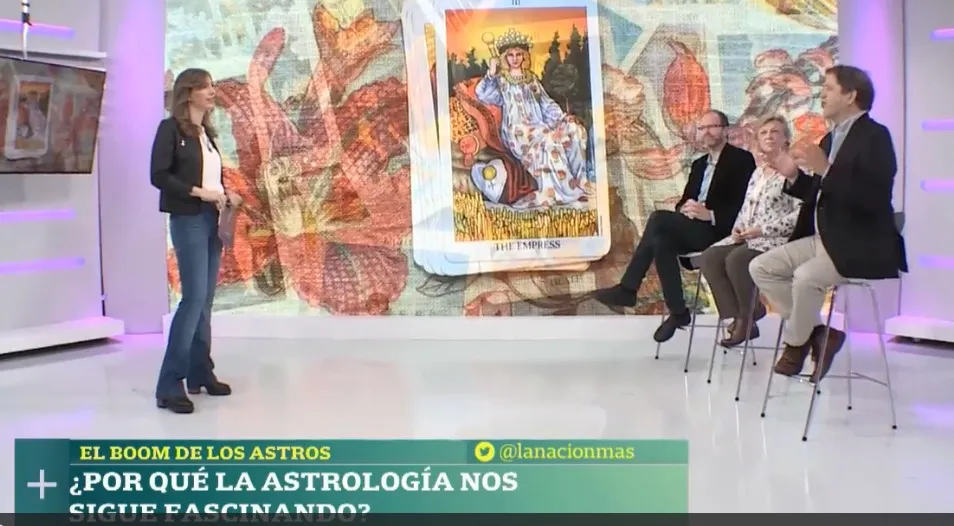
Gisela Busaniche hosts on LN+ the program Signos de los tiempos, which addresses issues of modernity and more specifically of late modernity or contemporaneity. In this case, the topic was esotericism, that is, the occult sciences.
The program can be seen in full -one hour long- on the web (see below).
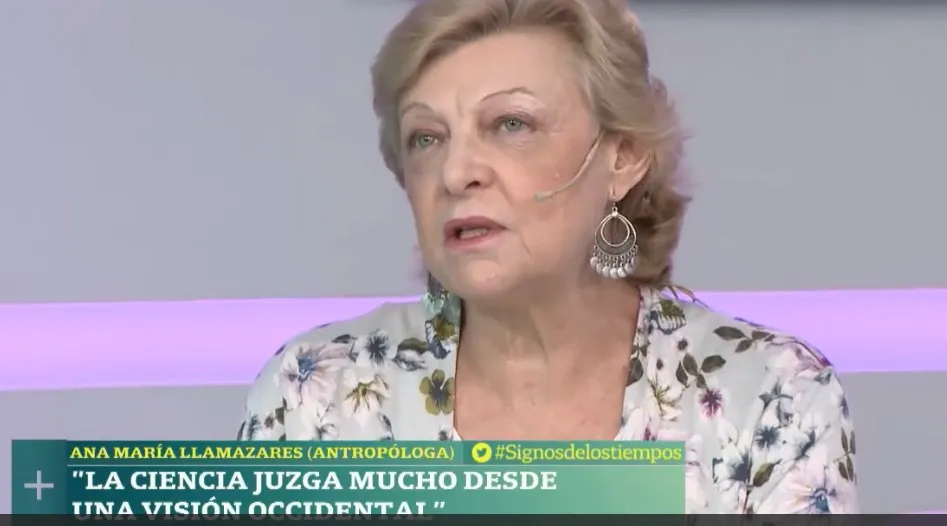
After watching the broadcast, it is possible to say it has three parts. In the first part the journalist presents the topic through questions posed to a panel composed of biologist scientist Diego Golombek, anthropologist Ana María Llamazares and psychologist Miguel Espeche.
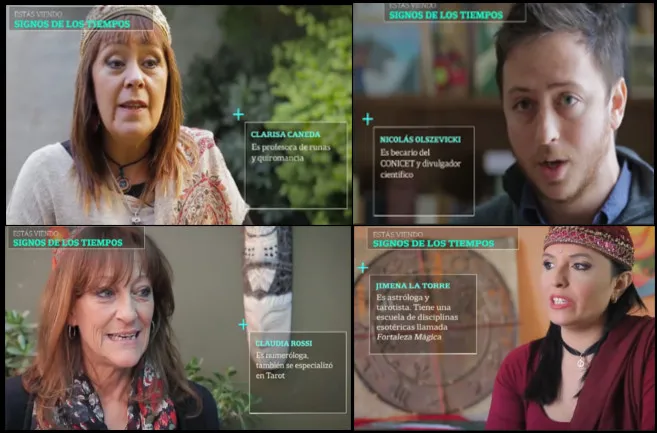
During the course of this section, short video interviews with people dedicated to the occult sciences are also shown: Jimena La Torre (astrologer and tarot reader), Claudia Rossi (numerologist and tarot reader), Clarisa Caneda (professor of runes and chiromancy) as these people are presented on screen.
After the panel reacted to those interviews, another testimony was presented, this time from Nicolás Olszevicki, CONICET fellow and science communicator.
From this segment I want to highlight two comments from the anthropologist. The first is when she points out that "now we are at a moment where this tendency to see things a bit in black and white has been exacerbated. Personally, my invitation is to start seeing the nuances, to start seeing the bridges..." (05:30)
Later, Llamazares says: "What we need is to clean up prejudices" (26:00)
This first part lasts 30 minutes, that is, half the program.
In the second part, Carolina Amoroso appears to talk about two "superstars" of astrology 3.0 (on social media) and the number of "followers" that Mía Astral and Susan Miller have.
From this part I highlight that Busaniche said she was a follower of the first astrologer, while Amoroso said she was a follower of the second.
In this segment, a video is shown in which Susan Miller talks with the snake oil salesman Deepak Chopra and compares astrology to the weather forecast.
Then Romina Salusso appears, who gave a not very serious review of politicians and celebrities who have been linked to astrology.
This second part lasts until minute 52.
The last part is presented by Busaniche in this way (verbatim): "Not only are there super-famous witches like the one you mentioned, but there is a super-famous witch who is also a friend of the house, who is with us, who is the best astrologer, Jimena La Torre"...
In this segment the three journalists (all women) surround La Torre who, in front of a desk, lays out her cards and makes predictions for each of the girls. Finally, at Amoroso's request, very concerned about how the ruling party will fare in the upcoming elections, she indicated that "there will be a loss," to which Busaniche added that then the ruling party "just in case, has to get to work."
ANALYSIS
With these elements I propose a double analysis. First, I will refer to some of the statements made on the program that, at the same time, are part of the shared discourse.
Second, I will reflect on the program itself, from a journalistic point of view.
1-ON DICHOTOMIES AND THE BROAD AVENUE OF AMBIGUITY
A while ago I heard the following reasoning: Bayesian statistics can only be understood and used by those who are not dogmatic, since Bayes' Theorem, in its mathematical expression, has three parts: in the numerator, the probability of a measurement and a "prior" probability and in the denominator the total of possibilities. The important thing is the prior probability, which comes to be what we believe is correct according to "common sense" and which cannot be 100% nor 0%. If we consider that for a certain topic the prior probability is 100% or 0%, then any data collected will only serve to ratify our belief.
Since being sure that something is 100% or 0% possible is being dogmatic, then, Bayesian statistics is not for people with rigid thinking.
What Llamazares says regarding dichotomies and nuances seems to go in the same direction. There is no doubt that many topics cannot be approached from a "black-white" perspective and that nuances indeed exist. But, always?
Let's test if that is the case, with an example:
Juan says: If a person snaps their fingers three times and at the same time shouts "Palangana", then they will win the lottery.
What would Llamazares say about that? What would the reading public of these lines say now? Would the anthropologist say "Maybe that is true, I cannot say that is 100% false"?.
I say: Juan's statement is 100% false. Am I dogmatic for that?
I affirm with total certainty that this statement is false because I start from an unquestionable fact of reality: To win the lottery it is an indispensable requirement to have played. Whether I have directly bought a lottery ticket or someone has bought it for me, if that requirement is not met, whatever I do, it is not possible to win the lottery.
Of course, I could say the same about pregnancies: For a woman to become pregnant there must be a conception, whether natural or artificial. Without that requirement, pregnancy is not possible. However, a large part of humanity has held (and still holds) that some woman became pregnant by the work and grace of the "Holy Spirit". So, perhaps, Llamazares or other "less rigid" people would say the same about winning the lottery by divine intervention.
But let's take one more step: Suppose Pedro has already bought a lottery ticket, just like many other people. Will Pedro have a greater chance of winning or will he directly have the result assured if, in addition, he snaps his fingers three times and shouts "Palangana"?
No, with absolute certainty, Pedro will not have greater chances than the rest by doing that. We can know this in two ways, one theoretical and one empirical. The empirical one involves doing experiments and seeing the results, for which (since it is a statistical point of view) many cases are needed. If I buy a lottery ticket, snap my fingers three times and shout the magic word on 100 occasions, how many times did I win the lottery?
If the person who does that wins in every case, at least I'll be able to say that something strange is going on there and that it needs to be investigated. But I still won't be in a position to point out that one thing (winning the lottery) happens because of the other previous thing (snapping fingers).
The theoretical part involves explaining with a model what relationship there could be (note the use of the potential) between snapping fingers and winning the lottery.
A model is composed of hypotheses that, in relation to known data and logical development, attempt to explain something. It could be like this: Snapping fingers creates a wave that reaches the Lottery building where there is a lottery drum and the wave modifies the ball. The wave also contains the desire of the person who snapped their fingers and shouted Palangana.
This model, however, would have several problems: how is it possible to put desires into a wave? and what happens if two or more people do the same thing with different numbers?
Now, before doing any experiment, it would be appropriate to ask Juan what the foundations of his statement are, why he says what he says, as a consequence of what he postulates that making a finger snap and shouting generates such a consequence.
If the answer is logical and plausible, then perhaps it's worth moving on to the empirical and doing experiments.
What is the foundation of astrology? When an astrologer says that Geminis have communication skills, what is the foundation for that statement?
Astrologers will say several things, but the truth is this: astrology arose when in antiquity coincidences were found, supposed regularities, which, since they couldn't be explained, were given a magical explanation.
For example, there is a war and at that moment the planet Mars is in the sky. Then, on another occasion, a King is assassinated and again Mars is in the sky. From a few cases, a general conclusion is reached: the planet Mars is associated with wars (curiously, as was said of the God Mars, what a coincidence!).
But is it true that when that war or that assassination was carried out, the only thing in the sky was Mars? Couldn't hundreds or thousands of stars be seen in the sky? Weren't there in the sky -even if they couldn't be seen with the naked eye- moons, asteroids, comets, supernova remnants, black holes, galaxies, globular clusters? Why would the war be associated with Mars and not with the other objects?
[In antiquity, the existence of moons around the planets was unknown, just as asteroids or galaxies were unknown. It was not unknown, however, that there were stars, but planets were considered "special," like wandering stars, due to their apparent motion.]
What relationship could there be between a piece of rock or gas (like planets and mountains) and human wars?
Appearances are deceiving. That's how prejudices are formed. That man works, that woman cooks. That man does a job, the woman cleans the house. General conclusion: Men are better at working, women at washing dishes. The mechanism is exactly the same. The mechanism generates prejudices. The same mechanism that Llamazares endorses is the one that -according to her- she wants to avoid. What does "sweeping away prejudices" mean if not combating them with scientific knowledge?
Men are not better than women. We have thousands of scientific pieces of evidence against those who postulate the opposite. The opposite is prejudice.
Perhaps the anthropologist, not having a rigid discourse, has doubts about it. Surely she will think my discourse is very "Western."
Note that the program was hosted by three women. I have said here other times that a gender bias associated with astrology is notable. Most magazines aimed at women (including Ohlalá from La Nación) contain horoscopes and astrological articles, something that does not happen in magazines aimed at men (like the magazine Brando, from the same group).
The astrological discourse is prejudiced in assuming that there are significant differences between people due to their date of birth and not for seasonal reasons (the signs are the same and in the same period for both hemispheres), but due to the supposed and never explained influence of planets (not moons or asteroids or anything else like socialization) on people in relation to personality and future.
But it is also a misogynistic discourse, endorsed by some outdated scientists and postmodern journalists who maintain that things are possible only by desiring them and at the same time that nothing is possible if it is not pre-determined by the apparent position of the planets in the sky. A scam understandable in the ancients (of the past) and not so understandable in the current ancients, that is, the ultra-conservative reactionaries like Paula Urroz (1).
Finally, a reflection on differences and similarities between astrological discourse and weather forecasting is in order. The similarities are that, in both cases, predictions are made and they are quite ambiguous. But the difference is radical: the weather forecast has a logical foundation, based on real data, and is explainable. If we go to the SMN page, we will see that for each forecast there are radar images showing the position of clouds along with measurements of wind speed and direction in a certain space-time. Since we also know what the water cycle is like, that is, the conditions for rain, the idea is to extrapolate the data obtained to know what will happen within a certain number of hours. It can fail, like everything we humans do. But it has a clear, logical foundation, based on current data and a model of the water cycle tested many times. Astrology has none of that, it's just ancient mythology aggiornated.
2-ABOUT THE PROGRAM AND THE COOL PREJUDICES
This is certainly not a neutral and objective program, but rather a clear sign of the times as militant journalism in favor of astrology. This conclusion is not a capricious postulate on my part; I am adhering to what the host said, as a follower of an astrologer. At the end of the program, moreover, Busaniche justifies the discriminatory discourse of astrology, the sexist, misogynistic, and anti-scientific discourse, in that 'I don't know if you have to believe, but it does empower you (sic) and put us in a good mood.'
It is not, then, a journalistic inquiry, but rather a ratification of what is happening, a justification, born from the desires of its hosts.
It is the opposite of what Hugo Alconada Mon does. When someone makes a statement (whatever it may be), the journalist who investigates, who wants to inquire, asks for the foundations of the statement. Only if the foundations are logical, coherent, and plausible will they take the statement minimally seriously.
Recently, I received certain information about the Planetarium of the City of Buenos Aires. Information that I don't like. But it doesn't matter if I like it or not, the only thing that matters is if it's true. However, I am not going to investigate or inquire into just anything, but only those statements that are logical, plausible, based on verifiable information. I cannot echo anything that is said just because I like it or don't like it.
I have recounted here a supposed case of plagiarism in Argentine professional astronomy. It gave me no pleasure. I didn't like the information. I preferred to ignore it, but the important thing is to know how reality is, which does not conform to our mere desires. In any case, if we don't like reality, we can try to change it, but for that we first need to know how it works.
There is no doubt that discourses (words and deeds) originate in ideas. But where do ideas originate? Ideas originate in discourses. We were not born with ideas; we acquired them from what we learned from everyday reality (facts) and from the statements of our parents, from our readings of books, movies, that is, from shared discourses.
It is not possible to know in advance what ideas someone will form, because for each case, there is a particular interweaving of existing discourses, but we can be sure then that discourses are not harmless. Furthermore, there are two phenomena to consider: the phenomenon by which we consider that if something is done by many people it is normal (be careful because there are many terrorists) and the other phenomenon by which we trust 'experts' (principle of authority).
For both reasons, journalism is not an individual and private activity. Amoroso says at the end that one should not fall into magical thinking, 'but yes, know that (the occult sciences) are tools and that whoever wants to use them uses them, and whoever doesn't want to, doesn't, but above all, respect.'
I suppose she is referring to respecting the discourse of others. I suppose Amoroso also applies that to misogynistic discourse or Nazi discourse, right?
Of course, saying the opposite of what Amoroso, Busaniche, and company point out is respectful and possesses as much freedom as they have to say any nonsense.
But if in the gondola of social discourses, from where we choose which discourses to adopt, there is only a soft discourse on astrology, to the extent that doubts are left about what it is and what it isn't, then we will not have freedom, since there will be only one product on the discursive gondolas.
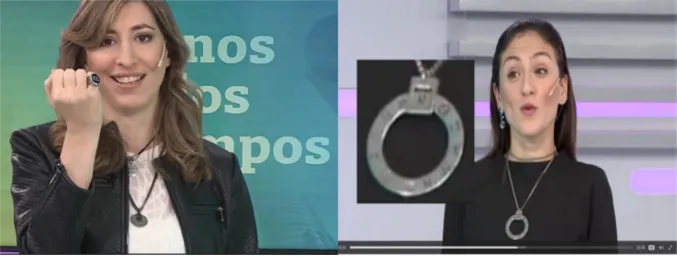
Astrology is nothing more than a millennial set of prejudices. Those of Scorpio have nothing in common and one cannot know what will happen to a person by drawing a chart (of any kind). The discourse and stance of 'just in case,' born from the absolute certainty of not having absolute certainty in postmodern minds, only generates more prejudices. 'Just in case,' Busaniche uses a ring with the number 13. Perhaps 'just in case' she treats black people with contempt and 'just in case' she considers Jews inferior. If a journalist said that on TV, what would our reaction be? What would be the reaction of Busaniche and company? Perhaps they would seek to censor such discourse. I do not seek to censor anyone, but I do combat prejudiced discourses (which are anti-scientific) with arguments. It is the only way to put a different, well-founded discourse on the gondola, it is the only way to achieve freedom.
What is clearly a sign of liquid times is that what is 'politically correct-incorrect' has changed. Until now, sexist, xenophobic, racist discourse has dominated. For decades this has been changing, slowly. For a part of the population - the 'progressives' - sexist-xenophobic-racist discourse is no longer politically correct. But, for the same people, astrology is 'cool.' Modern people with a feudal mindset and a smartphone. Snobs.
Meanwhile, the previous discourse is growing again (a kind of reflux) as is detectable in certain nationalist and ultra-conservative 'rights' like Trump and some officials of the previous government (Berni-Pichetto) and the current one.
Busaniche's discourse does not differ in these aspects from that of Gisela Marziotta, a current party candidate (2). Perhaps all the Giselas are the same (if we apply the same thinking mechanism that both endorse).
Those of us who are rigid, dogmatic, categorical, modern yes, but not postmodern, know that the first name does not determine character. We know this with absolute certainty.
Sources and related links
- The full program can be viewed online at:
https://lnmas.lanacion.com.ar/program/video/3705b9c1-332e-4928-9476-dfe9defd6a27 - (1) LN: Strong rejection of a bill to introduce changes in vaccination
http://www.lanacion.com.ar/2038395-duro-rechazo-a-un-proyecto-de-ley-para-introducir-cambios-en-la-vacunacion - (2) Pseudojournalism
http://www.noticiasdelcosmos.com/2013/05/seudoperiodismo.html
About the images
Screenshots from the video on La Nación.