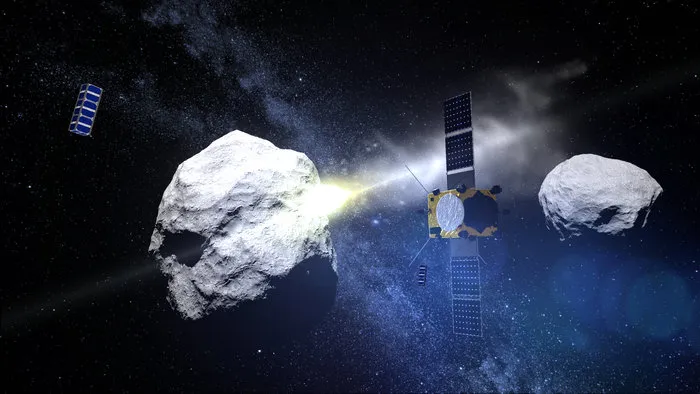
NASA and ESA join forces to carry out the first demonstration of asteroid deflection.
For some years now, in the field of philosophy of science, a classification between realist and anti-realist sciences has been debated. Briefly, for some philosophers, astronomy would be an anti-realist science that studies only images and not things, that creates models of reality (ideas) and does not manipulate. It occurs to me that from this context two consequences arise: an epistemological or methodological one by which the way reality is studied is objected to (for example, due to research on gravitational lenses); the other is pragmatic: astronomy is one of the most "abstract" sciences, since the knowledge obtained from astronomical objects has no concrete consequence in people's lives.
The second consideration, in turn, leads one to ask: what is the purpose, the objective, the need and utility of astronomy? The question gains relevance due to an economic issue, since doing astronomy requires economic resources. Often, when a large observatory is inaugurated, the public wonders why so much money is used to create an instrument that will study, for example, black holes - whose research is unlikely to become concrete, at least in the medium term - while in those countries there are other tangible needs among the population.
It is a fundamental issue that I have addressed here on another occasion. I will refer to the aforementioned philosophical context on another occasion.
Although what has been said is true, there are exceptions. Research on the Sun (and similar stars), as well as studies on the Moon, have importance for human life in a more or less concrete form. Astrobiology applied to planets like Mars or moons of Jupiter and Saturn are more likely to become concrete in the medium term.
Studies on the Sun fall within what can be called "Space weather". And just as on Earth there is hail, in space there are asteroids. The theoretical-practical research of NEOs (acronym for Near Earth Objects) is one of the concrete ways to apply astronomy. The acronym NEA is also used to refer to Near Earth Asteroids.
THE CHALLENGES AHEAD
The first challenge in this regard is to detect asteroids. As is logical, it is easier to discover large asteroids, but those smaller than 100 meters are difficult to detect. In that sense, NASA launched the Asteroid Grand Challenge. Estimates suggest that less than 10% of objects smaller than 300m in diameter and less than 1% of objects smaller than 100m have been discovered.
In 2013, during the Obama administration, the White House held a Google+ hangout titled "We the geeks" on the topic, which was recorded on Youtube.
AIDA: AIM+DART
The AIDA mission (Asteroid Impact and Deflection Assessment) is an international collaboration between ESA, NASA and other institutions involving two spacecraft: NASA's DART and ESA's AIM.
The main objective is to deflect a binary asteroid, that is, an asteroid composed of two objects, one larger and one smaller orbiting the first (these objects orbiting asteroids are called moonlets. There is no standardized translation into Spanish, but I suggest using "subluna"). Amusingly, the subluna in this case was nicknamed "Didymoon".
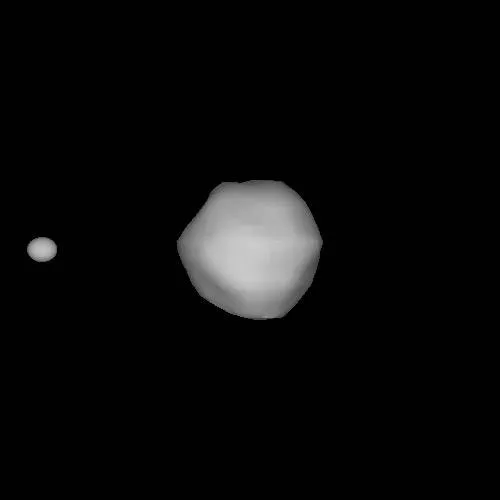
The object will be (65803) Didymos whose primary body is almost 800 meters in diameter and the subluna is 150 meters.
https://youtu.be/L4qGdR_dkFA
NASA video based on (185851) 2000 DP107, very similar to Didymos. Credit: NASA.
DART will be a bullet spacecraft, as it will crash into the subluna at a speed of 6 km/s with the help of a camera and specific software. The collision will change the speed of the subluna in its orbit around the primary body by a small fraction (1%), enough to be measured by telescopes on Earth. To put it simply: it is a practical mission to learn how to deflect an object, without the deflection itself being dangerous.
DART will use solar electric NEXT propulsion, based on the Dawn mission, which reduces vehicle costs and makes mission timing more flexible.
The AIM spacecraft is a set of instruments that will arrive at Didymos before the impact to conduct a close-up study (measurement of mass, density, shape, etc.) of both bodies. Then, at a safe distance, it will examine the impact and take measurements of the momentum transferred to the subluna. It will also deploy a surface package (MASCOT-2, Mobile Asteroid Surface Scout) to characterize the moonlet before, during and after the DART impact.
The launch of AIM is scheduled for October 2020 and a rendezvous with the double body in May 2022. DART would be launched in late December 2020 and would arrive at Didymos in October 2022 when the asteroid will be 11 million kilometers from Earth, allowing observations by telescopes and radar from the planet.
BACKGROUND
Didymos was discovered by Joe Montani in 1996, but it is not the first of its kind. (185851) 2000 DP107 was the first near-Earth binary asteroid to be observed by imaging. Radar observations in 2000 provided images that revealed its shape and orbit. The double object made a flyby of Earth in 2008 which was used to gather more data.
SCHEME
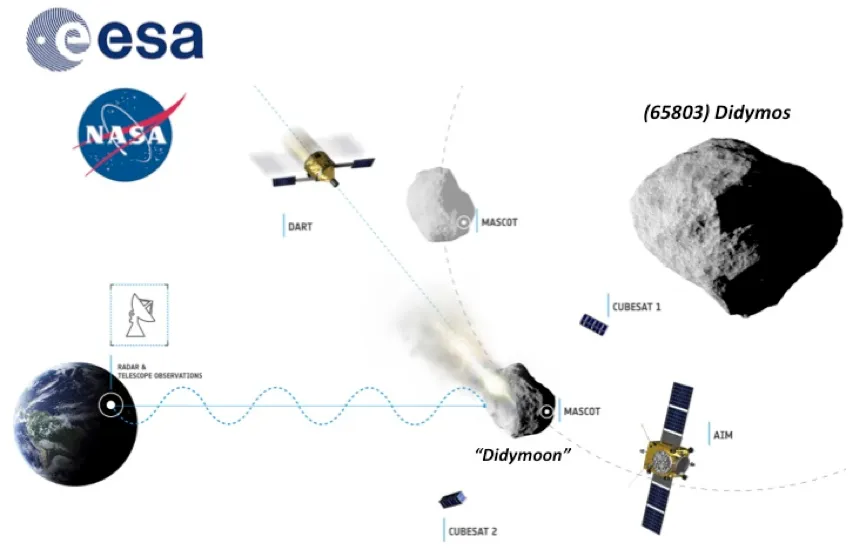
This image illustrates the scheme of the AIDA mission:
(65803) Didymos and "Didymoon" (the subluna), the DART spacecraft that will impact the moonlet, AIM which will arrive earlier and leave MASCOT-2 on the subluna, the radars and telescopes that together with AIM will take measurements of the collision and two small Cubesat satellites (one of which will carry the ASPECT payload) which will also take data on the objects.
Below is an explanatory video from ESA, in Spanish, about the mission.
DON'T PANIC
Scientists consider that the objects of greatest concern are those with diameters of 1km or more. 93% of those objects are known, as indicated on the Johns Hopkins page. Smaller objects burn up (that's why they shine) and disintegrate upon entering the atmosphere and even if they managed to reach the planet's surface, it must be considered that the mass of oceanic water is enormous, so the probability of impact on solid ground is low. Despite that, the impact of 300-meter objects could cause destruction, but not on a global scale. The Chicxulub Crater is often cited as evidence of the collision of a large asteroid that could have caused the disappearance of the dinosaurs 65 million years ago. Such an asteroid would have been about 10 kms in diameter.
Assuming that larger size means greater mass, then one thing is deflecting a 150m moonlet and a very different thing is deflecting an object several kilometers across. But you have to start somewhere.
However, perhaps the biggest problem regarding the survival of the species is not in the cosmos, but right here: whether through wars or through industrialization based on generating profits (instead of satisfying social needs). In fact, are these NASA and ESA missions being done to protect humanity or because some companies will make a great profit? It's not just about mere survival, but about living a dignified life. In that sense, there are many measures taken by the world's governments that truly generate a devastating impact on people's quality of life. It's not bad to develop space "umbrellas," but humanity also requires other kinds of protections.
Sources and related links
Radar Imaging and Characterization of Binary Near-Earth Asteroid (185851) 2000 DP107
Naidu et al arXiv:1503.01743 [astro-ph.EP]
https://arxiv.org/abs/1503.01743v2
Asteroid Impact Mission (AIM)
http://www.esa.int/Our_Activities/Space_Engineering_Technology/Asteroid_Impact_Mission/Asteroid_Impact_Mission2
https://www.nasa.gov/planetarydefense/aida
Why NASA decided to deflect for the first time an asteroid that will pass near Earth http://www.bbc.com/mundo/noticias-40488728
https://www.nasa.gov/feature/what-is-the-asteroid-grand-challenge
We the geeks: Asteroids https://obamawhitehouse.archives.gov/blog/2013/05/28/we-geeks-asteroids
NASA’s First Asteroid Deflection Mission Enters Next Design Phase at Johns Hopkins APL http://www.jhuapl.edu/newscenter/pressreleases/2017/170630.asp
ASPECT CUBESAT MISSION TO A BINARY ASTEROID DIDYMOS https://www.hou.usra.edu/meetings/lpsc2016/pdf/2059.pdf
What is the Asteroid Grand Challenge?
https://www.nasa.gov/feature/what-is-the-asteroid-grand-challenge
About the images
Initial image. Illustration of AIM and Cubesat
Credit: ESA - ScienceOffice.org http://www.esa.int/spaceinimages/Images/2015/06/AIM_and_CubeSats_watch_impact
Image 2: Naidu et al., AIDA Workshop, 2016
Image 3: NASA
Explanatory video from ESA in Spanish at http://www.esa.int/spaceinvideos/Videos/2015/04/Asteroid_Impact_Mission/(lang)/es