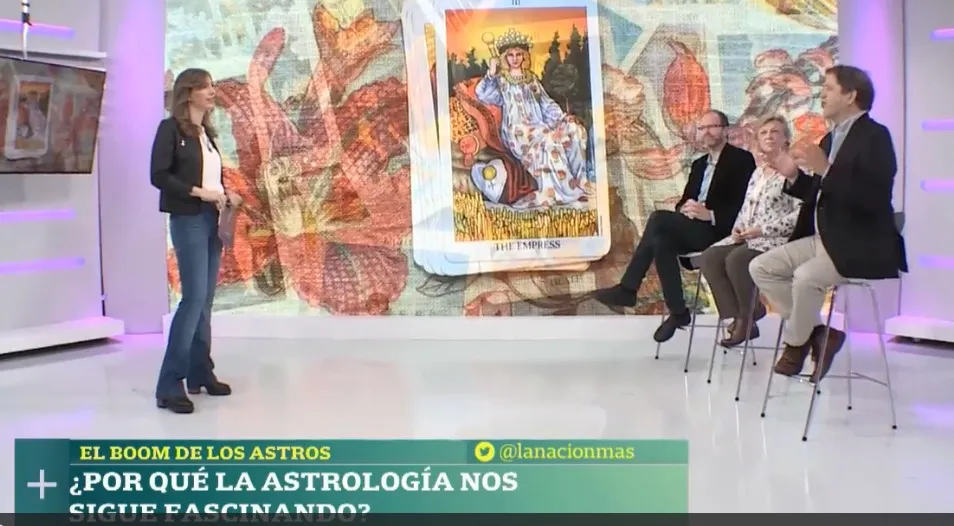
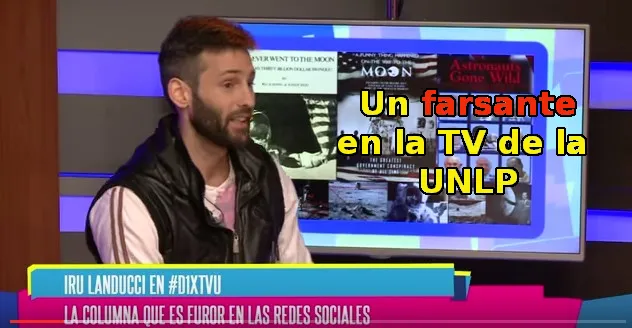
Reflections on a television program that addresses topics of pseudoscience.
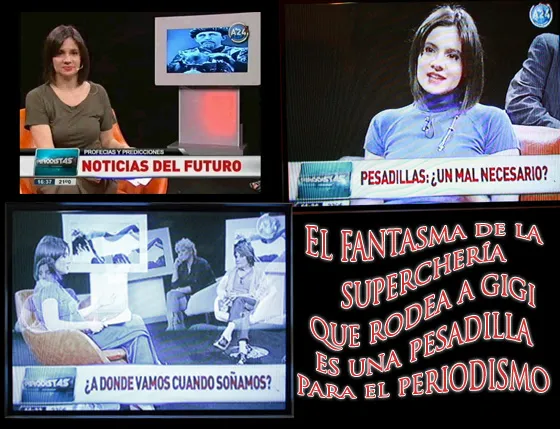
For a few weeks now, I've noticed that the program Periodistas, broadcast on the América 24 channel and hosted by journalist Gisela Marziotta, has addressed topics of pseudoscience.
The topics so far have been varied, but with a common denominator: magical thinking. Prophecies-predictions; Ghosts and other herbs; Precognition and astral travel; UFOs (ET spacecraft), were the topics in the broadcasts I was able to watch.
Instead of talking here about those topics themselves, I would like to stop and think about the work of the producers of this program and only on some aspects. That is, I want to think about the modes of production of the discourse of the mentioned program and not specifically about the topics treated there in particular.
I wonder: What the production and the journalist-host do, is it journalism? I'm going to try to answer it in parts.
For the DRAE, journalism is: The capture and treatment, written, oral, visual or graphic, of information in any of its forms and varieties.
From this point of view it is clear that what is done on that program is journalism. But, to be more precise, is it good or bad journalism?
Does it matter WHO says it or does it matter WHAT or HOW it is said?
Both things. I understand that the message is more important than the content, but also that the messenger is PART of the message. To account for this, I will explain it this way: All human beings need to trust others. This is so because we cannot solve our problems, needs and desires individually. Unless an individual knows everything, they need to trust others, be it the dentist, the accountant, the doctor, etc.
When we visit a professional, we do not trust them blindly, since if we notice that a lawyer or an accountant is not doing things right, in our favor and legally, we have elements to distrust and change professionals. That is so as long as, as I said, we have knowledge that allows us to doubt the ROLE and/or STATUS of those professionals.
But when we do not have those elements (data, information, knowledge), then trust becomes closer to being absolute than lucid.
And it is there when the probabilities of harm increase. Proportionally, the responsibility of those professionals also increases. And transitively that of the communicators who "validate" those people by presenting them as "experts" in something. (1)
So the WHO matters because it is a SIGN.
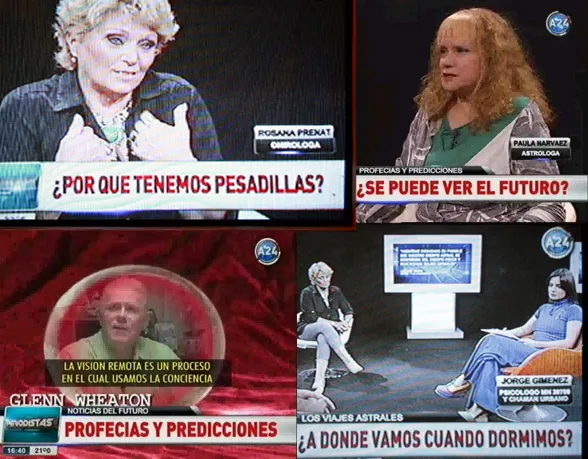
THE WHO
As I indicated before, we could start from the notion that the message is more important than the messenger. This notion is valid and I share it based on my opposition to the Principle of Authority it contains.
But it is also a naive or incomplete position, because as I said the Who is part of the What.
In a journalistic program there are, usually, several WHOs. There is the journalist-host themselves and there are usually guests on a program, who, as in the case study, are presented as "experts" in an area, identifying them in some way. In the program in question the guests are very varied, although with a common denominator: they are people who make statements, assertive statements, about what we could call "objective external reality". That last concept may be debated, but it is a whole topic in itself, which exceeds the objectives of this post. Let's say at least that statements are made that are not part of our dreams, imaginations and emotions, but refer to other "things or phenomena" that are "outside" of us (although inevitably they are also subjective because we perceive them with the senses and analyze them with the brain and they are also stimuli that produce emotions).
Psychologists fundamentally deal with "ideas" and not with "things". The psychoanalytic "meaning" is a connotative meaning. What that idea generates in me. In my interior.
But psychologists do not dedicate themselves to the study of "things", but only to their subjective effect inside us. If I am afraid of thunder and lightning, a phobia, a psychologist could inspect what that stimulus generates in me and try to trace why. They will be personal, intimate answers, impossible to extrapolate to everyone else. And that have nothing to do with the thunder itself. How thunder or lightning is produced is outside the analysis of psychology.
Now, if I say that I am afraid of lightning, does it imply that WE ALL MUST be afraid of it?
For me thunder can "mean" something personal, but aside from that, "thunder" also means other things, which we can extrapolate if what I study is not "inside me".
I can say what thunder "means" as a natural sign linked to the methods of analysis of the natural and exact sciences that will tell me how thunder is produced.
Talking about what thunder produces on a television program can include the personal sphere, that is, the psychological. But it CANNOT exclude the "natural" sphere. Ultimately, aside from what I "feel", what is thunder from the scientific-natural point of view? This is so, in particular, if I start from the hypothesis that all thunder is a sign of something that is going to happen inside us, since there I am establishing a causal relationship.
Or are things AS we FEEL them?
I understand that only with logical-rational arguments we cannot encompass all of reality, because beyond what meteorology tells us, human beings have "reactions" to thunder. I understand then that as part of the approach of a television program, what thunder means in a psychological or anthropological way is investigated.
In the television program in question, topics are addressed that seem to refer to "external objects" such as extraterrestrial spacecraft, elves, ghosts, divinations.
I say they refer to apparent "external objects" because the characters invited to the program say they "detect" those "things" or refer to causal relationships between, for example, stars and people, although others refer, from psychology, to what we "feel", that is, to "ideas or imaginations".
It is at least questionable that if they talk to me about the influence of the "stars" at the moment of birth, they bring an astrologer and not an astronomer. It is journalistically questionable. I question the WHO they bring, which is also a questioning of the journalistic HOW. It is about the lack of a criterion of breadth, on the one hand, and the blind trust of the person producing the discourse in such "experts", without any questioning and validating their message. Hence the WHO is important, because it is a SIGN of several things.
But it is not the only sign that will matter to me. There comes the WHAT and within the content is the form, the HOW. Note that what I am saying is that the WHO conditions and shapes the WHAT and HOW.
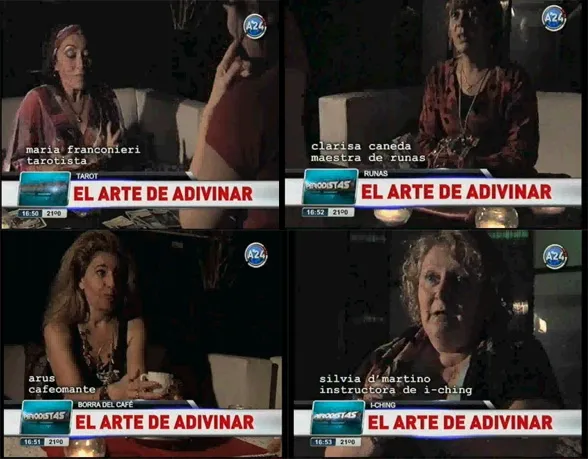
THE HOW
I ask myself two easy-to-answer questions.
1-Is every hypothesis valid?
To help answer this question, I allow myself to ask a clarifying and exaggerated sub-question:
1a-Is the following hypothesis valid?
"If a midwife repeats the word 'Plin' three times out loud before the minute of a child's birth, such a child will have a dire destiny."
If the reader considers such a hypothesis valid, they probably believe that EVERY hypothesis is worthy of investigation. There are people who think that way. Everything can be investigated, no matter how ridiculous a hypothesis may seem.
I do not think that way. I consider a hypothesis valid if it is "educated," that is, if it starts from established (prior) knowledge and observations of reality, or to put it another way, if there are indications that warrant making a postulate.
This last point is an important criterion. Hypothesis 1a is not only counterintuitive, it is ridiculous because we have no elements, indications that allow us to think such a hypothesis.
Astrological postulates possess ridiculous hypotheses because they are not supported by indications from reality. It may be said to me that it is scientifically proven that the Sun and the Moon (which are not planets) do have an influence on our lives. But although that is true, it is NOT true that this influence is on our personality and future. Regarding THAT type of influence, there is NO SCIENTIFIC indication. So taking this starting point, to then tell us that therefore there are indications to think that perhaps the planets also generate an influence in our lives is ridiculous.
However, if we accept the influence of the Sun and the Moon from a scientific point of view, then we must address the possible influence of the planets from the same point of view, which clearly will not validate astrological postulates.
But when talking about astrology, they talk about planets, the Sun, the Moon, constellations. Topics that can easily be seen as scientific. For the layperson, the jargon can be confused with scientific jargon, although clearly it is not. Hence they are called pseudosciences.
But suppose that Marziotta and her production answer this first question affirmatively. That is, they think that every hypothesis, no matter how ridiculous, is worthy of investigation.
Let's go to the second question.
2-Is it enough to formulate a hypothesis to consider it true?
That is, is hypothesis 1a true?
Suppose we tell ourselves that such a hypothesis is valid. Ok. Is it true?
How do we know if it is true or not?
Does it matter? Is there something between the postulate and the conclusion or are one and the other the same thing?
If we think that the postulates of astrology are worthy of investigation, how do we know if they are true?
Is it enough for an astrologer to say so?
If we remember how I started this post, we will see that I point out that the WHO matters. But the WHO, which is part of the WHAT, is included in the HOW, because an astrologer does something (or does not do) different from what an astronomer does.
How do we think we can know if the planets exert some influence on people?
Will we do some experiment or simply say that the ancient myths and legends are true and that's it?
From the way we answer these simple two questions, we will construct a discourse. In the mass media, discourses have CONSEQUENCES, precisely because of what I indicated at the beginning, in (1). Not taking this into consideration is profoundly irresponsible. It is pseudojournalism.
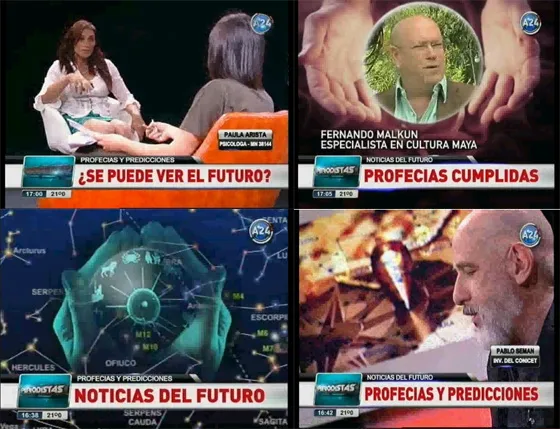
I insist on the distinction between "ideas" ("inner world") and "things or phenomena" (referring to the external world). I can have an aversion against "Gigi" individually. For example, I could "feel" that she has "bad vibes". There is nothing objectionable about that. I refer to something personal and intimate.
But I CANNOT cheerfully start saying that "Marziotta brings bad luck or has bad vibes", because that statement would refer to the "external world", that is, to a cause-and-effect relationship by which every person who comes into contact with the journalist will have "bad luck". The first I can "feel", the second is no longer a personal feeling and has consequences for third parties. I would be saying how the world external to me is. And I cannot do that in any way. It is not enough for me to postulate that she brings bad luck to indicate the truth of such a statement. If I am going to say such a thing, I must justify it.
By the way, if hypothesis 1a is valid, this bad luck hypothesis I am imagining now would also have to be. And, in case there is any doubt, I do not think that way. It is an example (somewhat tricky, yes, but without offensive intent, just a somewhat more pedagogical example).
How does the astrologer know that the planets exert an influence on our personality through the "photo of the sky" at the moment of birth, as she claims? There are no questions about it, so I infer that the hypothesis is taken as valid, but what is worse, it is taken as true just because she postulates it. And, in part, it is so because it is pre-supposed (from ignorance) that the astrologer "knows," even though nothing is inquired about how she knows. It is blind trust, not lucid. That could be explained in various ways, for example, by a state of mind that does not want to know the truth, but wants to be told what it "needs" to hear. Is that journalism? Or, in any case, is it good journalism?
Just as we speak of pseudosciences, that is, types of discourse that are related to science by jargon and modes, by appearing as a discourse of the same genre as the scientific one, but are not because they do not follow the "methodology" and scientific research, it is also possible to speak of pseudojournalism.
This pseudojournalism is characterized, among other things, by not seriously answering the two questions I just asked. Or by answering them lightly.
I want, to conclude, to make one point clear: in academic circles there has been talk of a search or an epistemological formulation of science journalism, and texts are found that refer to a "precision" science journalism. I believe some care must be taken in not being too restrictive and failing to recognize that just as there is specialized journalism aimed at limited or narrow audiences, there is also journalism whose audience is larger and heterogeneous. The latter leads to a simplification that I understand is beneficial and necessary so that knowledge does not remain locked in an elite.
That is, I am not demanding that a television program produce a discourse in the same way and with the same method with which academic discourses are created.
Moreover, I am doing here a somewhat unorthodox discourse analysis and taking only some basic elements.
It is also true that there is some critical point at which one must decide between being simple or being true.
About the images
- The four images are screenshots taken from television with a camera or by directly capturing the live internet broadcast.