Some notes on the media coverage of the solar eclipse.
For various reasons I was unable to do an exhaustive follow-up of the coverage by the most important media outlets in terms of audience, although I did manage to see some TV segments.
Although it was clear that the coverage was different on TV channels simply because the channels TN/El Trece sent a reporter to the USA, in general the approach was similar, with some common elements noticeable:
1- Informational confusion about when and how long the phenomenon would last.
2- Absence of specific terminology (totality, umbra, etc.).
3- Additional or "color" information of little importance (for example, about the merchandising).
4- Exaggeration about a phenomenon that is, basically, the same every time it occurs, but which in this case was magnified only because it could be seen in its complete form in the USA.
5- Little participation from experts, astronomers, and also a low presence of other specialists (journalists or amateurs). The comments I was able to hear provided by Nora Bär on LN+ were well-informed. In another case, the former director of the Planetarium, Lucía Sendón, was consulted. The only thing I can add in this regard is an unanswered question: Why did they consult the former director of the Buenos Aires Planetarium and not the current one? I'll keep my thoughts on the matter to myself. On one channel, an astrologer and a professional astronomer were interviewed simultaneously. The former said the things we are accustomed to from such a character who seems to have come out of a comedy sketch. The latter said nothing to the contrary about astrology. (The strategy of silence is in fashion...)
6- On that same channel, while the event began to be broadcast from the USA, the journalist-host said that astrology is a science that studies the relationship between astronomical objects and people...
7- It was said that having seen the event live from the USA was like participating in a "World Cup".
8- In some cases it was mentioned that the phenomenon had scientific value, but the explanation of what that value was left much to be desired.
9- A reporter, from New York, explained -with the cadence typical of a CNN journalist and moving his head as if he were Max Headroom- the same thing that could have been said from...Quilmes.
10- Some reporter discovered that when the Sun is "covered" the temperature drops. Careful, he validated it with a thermometer, just in case.
11- Emphasis was placed on the jubilation of the American public during the scarce minutes when the bright day darkened as in twilight, even though the effect is not very different from a stormy day covered in clouds.
12- A meteorologist said he had not looked at the weather forecast, for superstition.
REFLECTION: I WAS THERE (SO TO SPEAK)
In these times it can be inferred that in part of society there is a longing to show oneself, to say "I was there", with the difference that in the past a souvenir was used and now they take selfies. It follows the line of what is socially accepted-celebrated that, while finding union, also finds differentiation (I was there, you were not). Perhaps it is also a social phenomenon by which experience is valued (the motto of tourism) as a unique and unrepeatable sensation, that thing you can't miss because it's once in a lifetime, a paraphrase of "carpe diem". And there go the readers of the book "1000 unmissable experiences", which now instead of a book is a meme. And it is not very different from a communion, even though the current "I was there" is virtual (spectators of screens) and even if many people congregate, each one is in their own world, like an elevator or a subway at rush hour.
ASTROLOGY AND SCIENCE
I would like to focus on point 6. For many people, including social communicators, astrology is a science; while for other people, whether astrology is a science or not is of little importance.
To explain why it is important and in what sense, I will use an example:
Suppose a journalist receives a call from someone who gives her information and points out that Person X, a political leader, is corrupt. The logical thing would be for the journalist, immediately afterwards, to ask what the basis is for such an accusation. The arguments could be varied, but let's think of at least two classes:
Class A of response
1- The informant says he believes Person X is a corrupt politician because he dreamed it;
2- The informant says it because he interpreted the prophecies of Nostradamus;
3- The informant bases it on what he heard at the hairdresser from the friend of the brother-in-law of the cousin;
Class B of response
1- Because he had access to Person X's sworn statement and noticed that the income is less than the expenses.
Let's evaluate both classes of foundations:
The responses of Class A have no importance because reality does not conform to people's dreams or anyone's prophecies or rumors. But also, in all three cases, they are assumptions impossible to investigate.
On the other hand, the Class B response, if true, makes the accusation plausible and it would have to be investigated. And this last part is indispensable because the plausible is not the same as the true. But at least it would merit an investigation and until there are conclusive elements, the journalist should not publish anything.
What I have just described could be called "journalistic method", even though journalists might act in different ways, in general terms, there is a method there based on objective data and not merely on the inner subjectivity of some person.
Well, something similar happens with what is called "science": there are methods better than others that aim to know what reality is like, in an approximate way. There is no single way to do it, but in general terms it can be stated like this:
It starts from some objective data, an attempt is made to form a model that allows those pieces to fit together logically, and from that, predictions are made about what the remaining pieces should be like. This last part aims to investigate whether such predictions occur in reality. If so, the model has support; otherwise, the model will have to be revised.
It is not very different, in general terms, the work of journalistic investigation; of judicial investigation; and of scientific investigation. In all three cases, the goal is to understand how something happened based on the collection of evidence, expert analysis/experiments, and the construction of a model that starts from some hypothesis. Of course, I am overlooking important differences between these three social practices to focus on the basics.
If that is considered the "correct path" in both journalism and Law, then the same should be said of science. Imagine that in the Ordinary Justice system a Judge convicts a person of a crime based on the dreams or internal feelings of another person. Neither in Law nor in Journalism is "it seems to me" enough. In science, neither.
Astrology, on the other hand, does not follow this path. The "foundations" of astrologers are similar to those of Class A. It is just a set of associations made in antiquity, that is, preconceptions, coincidences from a biased perspective and nothing more. There are no experiments, no scientific study of the planets, not even a "model" that could hypothetically explain how the relationship or influence between planets and people would be. In general, when asked, astrologers will only stammer that it is "a matter of energy," but if it really were energy -as physics understands the term- it would be investigable, although astrologers have never investigated anything. If, on the other hand, such "energies" were not physical or material, but spiritual, then it is just a matter of belief or disbelief, and therefore it is not a science.
That people with such a level of ignorance work in the media and boast about it does not surprise me.
For a long time, astrology has massively eclipsed astronomy.
Sources and related links
- The frequency of the unrepeatable in astronomy
http://www.noticiasdelcosmos.com/2016/06/la-frecuencia-de-lo-irrepetible-en.html - UNTREF: Dictionary: Ponele
In the following link, a definition of this word so commonly used today. In the blog text, it could be replaced by "something like that" or "similar, but not the same."
http://untref.edu.ar/diccionario/buscar.php?q=153&p=ponele
About the images
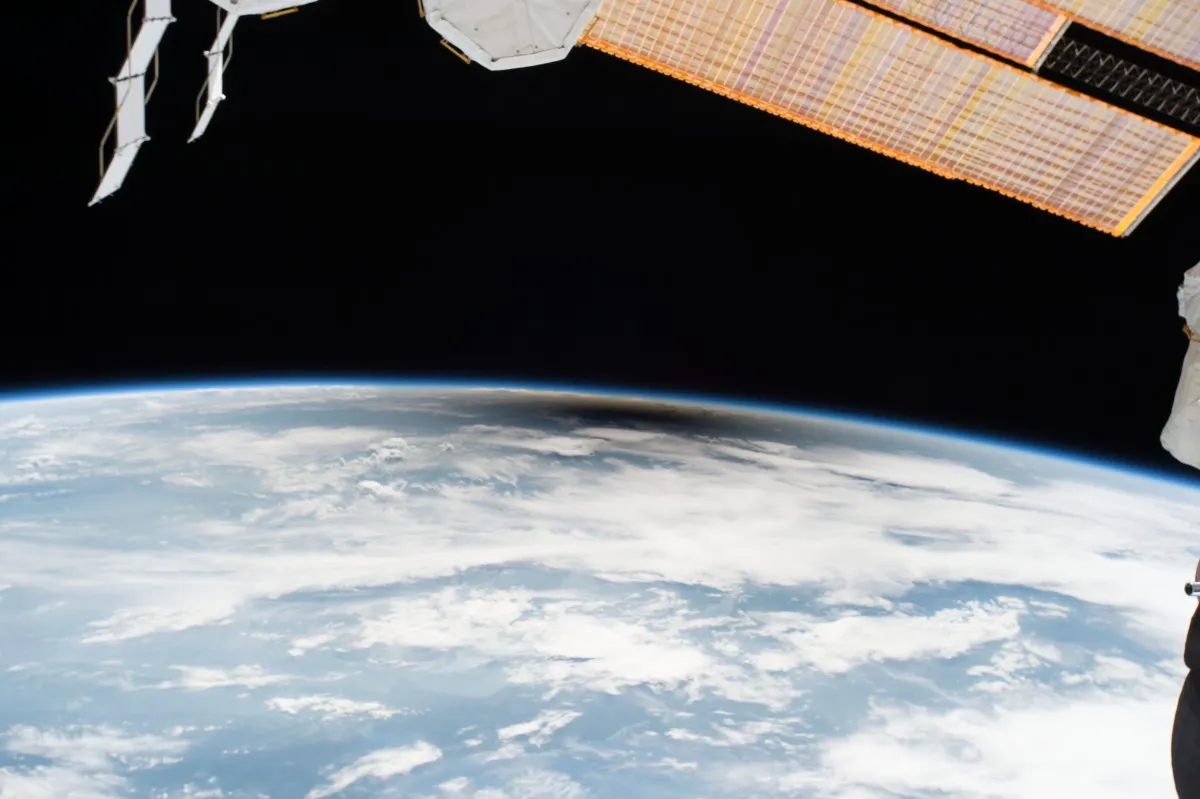
NASA: The Eclipse 2017 Umbra Viewed from Space https://www.nasa.gov/image-feature/the-eclipse-2017-umbra-viewed-from-space-2