Reflections on a background theme, based on current events. The role of astronomy in a historical sense.
I have mentioned on other occasions two debates in the philosophy of science on which I have not taken a clear position.
One dilemma considers astronomy as an "anti-realist" science since it is based only on the manipulation of images and not on the manipulation of objects, and therefore would be "only" a theoretical construction. Someone would say that for this reason, astronomy is only a construction of ideas from images, like Platonic philosophy.
On the other hand, astronomy is considered an abstract science since its knowledge does not change people's daily lives, that is, a knowledge that has no concrete, pragmatic utility.
There is an aspect that seems to be left aside in relation to astronomical knowledge and on which I propose to reflect here, starting from a very controversial text, which I have not read, but which I know from an article published in Revista Ñ.
In a recent article in that publication titled "¿Qué precio pagarías por la memoria?", David Rieff presents his controversial essay "Elogio del olvido", in which he argues against the cult of the collective past.
The note indicates: Rieff advocates for Nietzsche's "active forgetting" as a possible option in places where remembering leads "to war more than to peace, to rancor and resentment". "If our societies dedicated a minimal part of the energy they apply to remembering to forgetting, peace in some of the worst places in the world could be closer," he argues.
It is not far from the so-called Ho'oponopono philosophy.
I will not refer here to Rieff's book because I have not read it, but several passages from that interview strike me as repulsive. In particular, the following: I spend quite a bit of time in South Africa and there those who have sympathized with the dictatorship understand that forgetting is the best solution. And the victims, logically, are in favor of memory. One of the main questions of the book is how much we want to pay for remembrance.
Historical memory (collective, of a society) does not have to be the engine of revenge -on this point I could agree with the author- but of Justice, which is not achieved with "forgetting".
MEMORY AND ASTRONOMY
What is astronomy? There are many ways to answer. It is not far-fetched to say that it is an attempt to "construct" Universal memory or history, understanding in this case Universal in the most literal sense, as opposed to the concept of Universal History associated exclusively with human history.
Memory is not just a set of memories left in our nervous system by lived experience. That, in any case, is personal memory. The debate about geocentrism and heliocentrism is part of human history, but we cannot say that we remember it in the lived sense, because it was four centuries ago (despite the fact that there are still people who debate it today...).
That memory is therefore not lived, but historical, and History is a SCIENCE that is built on the basis of different evidence and clues: written documents, sites and a whole series of "traces" left by natural and social processes.
There is a not-so-distant past that was documented by human beings in their time, but there are other human and natural pasts that were not documented in their time by anyone and that we cannot remember, but must first discover. Archaeology and paleontology are, in their own way, similar to astronomy, with different objects of study.
If we took Rieff's recommendation literally, we would have to stop doing those sciences, lest we discover that the past was unjust. A stupidity as big as the Universe. The issue is how to deal with the past, especially in relation to injustices.
ASTRONOMICAL PHILOSOPHY OF MEMORY
If astronomy teaches anything through the acquisition of objective data, it is that nothing in the Cosmos is eternal. Nothing lasts forever and nothing is exempt from change. Nothing is immutable. Stars may seem immutable on a human scale, since their processes last millions to billions of years, but they are not.
Moreover, the same thing that causes a star to form is what condemns celestial bodies to their destruction: gravity. But it can also be said the other way around: what destroys stars is what allows new next-generation stars to exist, enriched with the material produced by the previous generation.
That is precisely why we live in a world with carbon. First-generation stars based almost exclusively on hydrogen, some helium and a pinch of lithium-7, produced other heavier elements in their thermonuclear process. By expelling the outer layers of their atmospheres, those stars were being destroyed and at the same time "sowing" in interstellar space the materials so that other stars could form, but now with new materials.
From that very long process from star to star we arrive at our Sun with planets that possess many enriched elements. We are the product of stellar births and deaths. Stars, however, do not have life because they do not have cells.
Celestial bodies are, then, "units of opposites", in which two components are present, struggling with each other, through which one generates the other. Gravity generates radiative pressure that gives the star equilibrium. Provisional equilibrium (even if it lasts millions of years) that later breaks so that the cycle can restart.
Universal History is like that. Not only the History of the Cosmos, but also human History.
HUMAN PHILOSOPHY OF MEMORY
First there were struggles between tribes or clans; then between city-states; then between Nation States (hence the wars for independence). But this process did not end. History did not end. The recent attacks in Barcelona, as well as the previous ones in France, Germany and other European countries; the wall between the U.S. and Mexico; the immigrants fleeing oppression; those persecuted for political reasons; those disappeared by repressive forces, and a long etcetera, clearly show that History continues its cycle.
What unites us is, at the same time, what separates us and the equilibriums are provisional, almost an illusion.
Are we like the stars? Remember: Stars are not alive. They have no cells, no memory. Not wanting to exercise our memory is like wanting to stop being human and being like stars, inanimate objects, without life, without history. The history of the stars is written by us (or rather, by astronomers). Stars have no history because they have no memory.
We do, even if it doesn't seem like it. While some "exploit" others, it's hard to achieve a "balance". Messi, a soccer star, said that most of us want peace. I don't believe it. Does peace mean that a good, very talented kid earns millions of dollars for kicking a ball, while doctors and teachers earn a pittance? Peace is not just the absence of bombs. Peace is justice. Justice is ending the exploitation of some by others.
The pharaohs exploited the workers and slaves who built the pyramids. No, it wasn't ET.
Feudal lords exploited the serfs.
Yes, stars explode and create novelty. Certainly, modern industry creates many very useful and beautiful things, but also under the exploitation of some people by others.
Going back to the past is not a good option, as neo-hippies think. Making those who think differently disappear, even less so. Staying in the same wheel, also not. Perfect and immutable balance is an idealization, it does not exist. Always, always, we will have to be on guard to prevent all kinds of human exploitation.
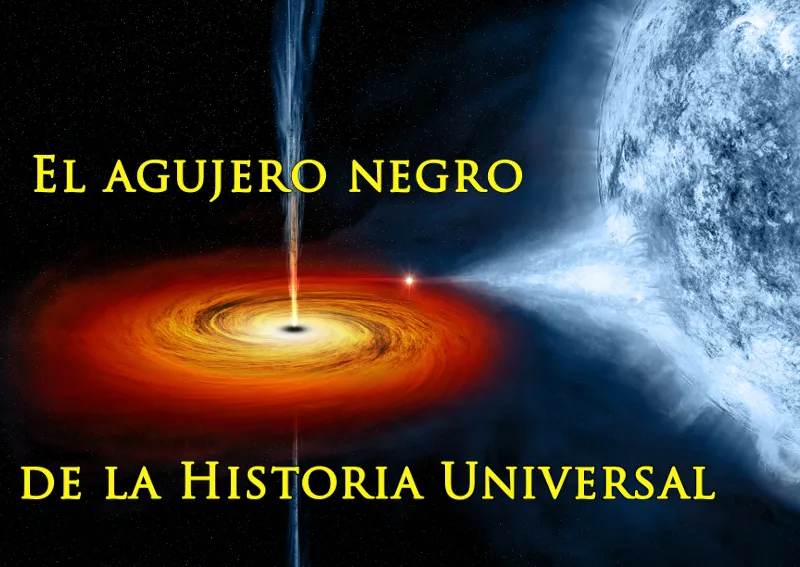
If we don't, we will become the black hole of Universal History. Do you feel the gravity? That's where we're heading.
Sources and related links
Revista Ñ: ¿Qué precio pagarías por la memoria?, by Raquel Garzón, 08-18-2017 (retrieved on the day of the post)
https://www.clarin.com/revista-enie/ideas/precio-pagarias-memoria_0_ryAMWerdb.html
About the images
Illustration: Credits: NASA/CXC/M.Weiss