They managed to cancel a seminar called by the Institute of Science.
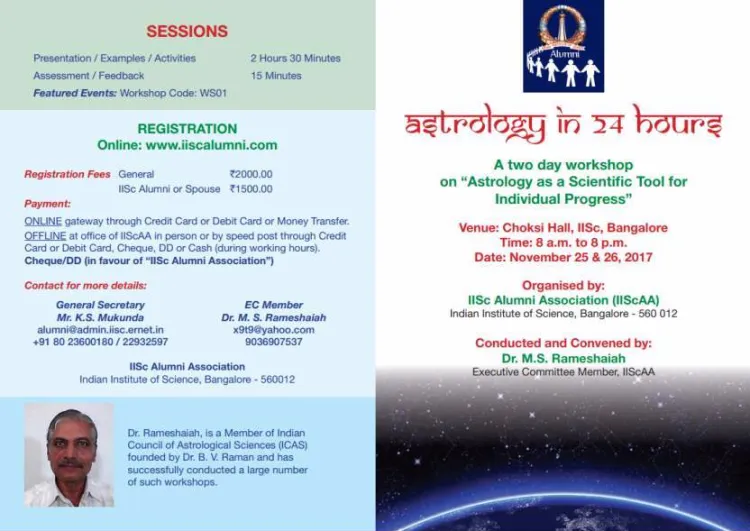
The Indian Institute of Science (IISc) scheduled a workshop titled "Astrology as a Scientific Tool for Individual Progress" for November 25-26.
When the fact became known through the media, part of the scientific community protested and finally the seminar was canceled.
According to The Print, as a formal protest, members of the alumni association wrote a letter to the Institute's director, Anurag Kumar, saying: "Astrology is a belief system that has no scientific basis. Scientific experiments conducted to test the predictions of various astrology systems have shown that it is only as good as chance."
The Times of India noted that the organization Breakthrough Science Society (which previously organized protests against pseudoscience and organized the March for Science in India), supported the students who sent the letter.
According to an article published on Nature.com, the conservative political party in power - Bharatiya Janata Party (BJP) - has shown support for giving astrology a place in universities.
The renowned scientific publication indicates in its note that many scientists prefer not to speak on the topic for fear of losing their jobs.
In addition to astrology, activities and speeches about "panchgavya" are also generating debates about pseudoscience. This name designates a preparation or drink consisting of a mixture of five derivatives of the cow (considered sacred): urine, dung, milk, yogurt, and butter.
Scientists are not against conducting scientific research to learn more about these "millennial" preparations, but serious research could potentially refute those hypotheses.
The Breakthrough Science Society group drafted a memorandum this year in relation to the March for Science. It states: "Recently attempts to spread unscientific beliefs and superstitions are on the rise. Often, unscientific ideas that lack evidence are propagated as science, supported by people in high positions."
My position
In my opinion, as we already know, no one can be forced to think in a certain way. Or, if they can, it is not desirable. The goal is to distinguish between a belief system as a set of ideas that one does not want to investigate, but accepts by preference, and scientific research whose objective is to try to understand reality through experiments and observations, that is, the collection of data and its logical analysis.
On the other hand, modern States should separate themselves from religions and belief systems, without promoting them in any way. Paradoxically (or not so much), rulers who say they are against religious fundamentalisms and theocracies, upon taking office, swear by placing their hand on a book considered "sacred."
Beliefs are ideas and as such, they are harmless because ideas do not leave or enter our heads. Telepathy does not exist. But ideas give rise to discourses, whether enunciative (what is said) or factual (what is done). Therefore, faced with discourses based on prejudices, it is necessary to produce explanatory counter-discourses so that the general public can contrast one with the other and be able to decide better.
In modern globalized society, discourses circulate, although they take somewhat different forms in each place.
In Argentina, as I have said here many times, astrology still has a place in media discourses. And I have pointed out on different occasions that a gender bias is observed, as these discourses are aimed, above all, at women.
The ideas that these discourses are harmless, inoffensive, mere entertainment and minority are not properly supported by objective data and the only consequence of upholding them is silence, which is why there are many more discourses in one direction than in the other.

Sources and related links
- Indian scientists urged to speak out about pseudoscience
https://www.nature.com/news/indian-scientists-urged-to-speak-out-about-pseudoscience-1.22957 - Astrology workshop at IISc stands cancelled
https://journosdiary.com/2017/10/29/astrology-iisc-cancelled/ - Astrology workshop in IISc cancelled after alumni & scientific backlash
https://theprint.in/2017/10/31/astrology-workshop-iisc-cancelled-alumni-scientific-backlash/ - Astrology event at IISc called off after protest
https://timesofindia.indiatimes.com/city/bengaluru/astrology-event-at-iisc-called-off-after-protest/articleshow/61313815.cms - Breakthrough Science Society
http://www.breakthrough-india.org/