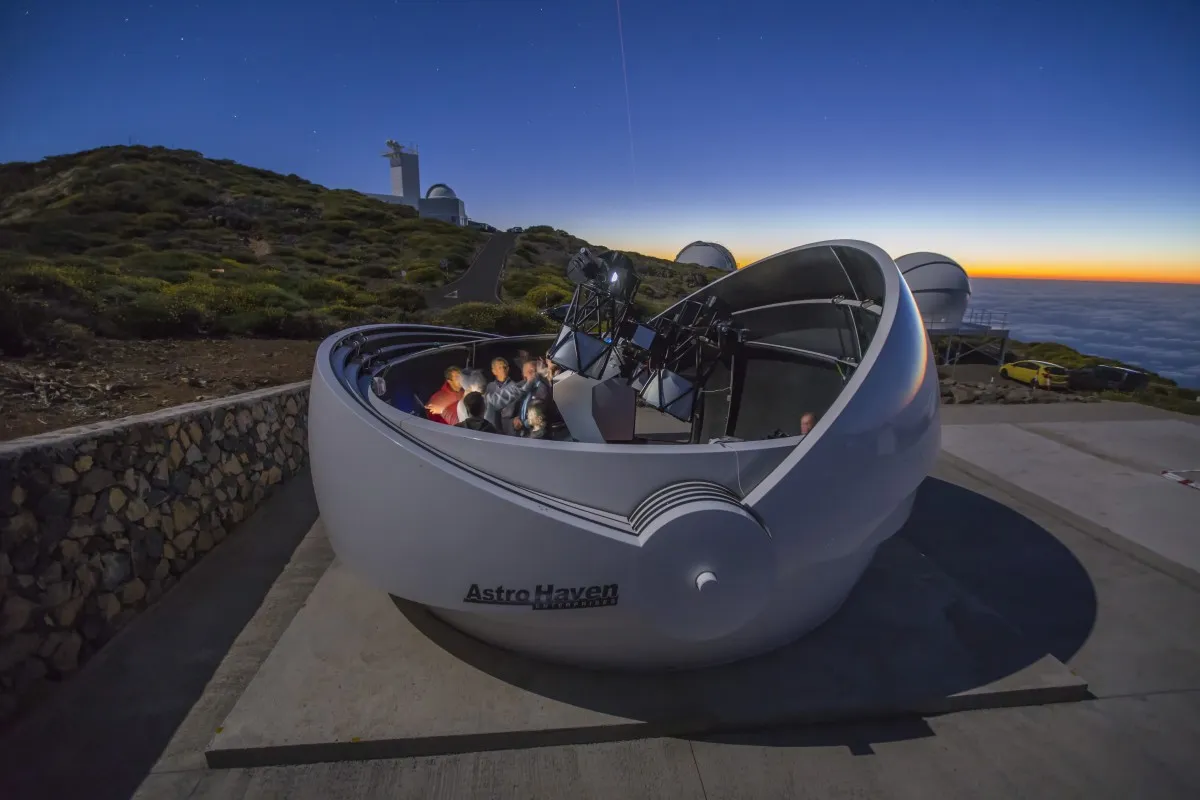
Argentine scientists are part of an international collaboration to build two instruments, one of which will be installed in the Salta Puna, to measure the B-mode polarization of the Cosmic Microwave Background radiation.
A BACKGROUND STORY
Around 1964, two Bell engineers discovered a signal while setting up an antenna. The signal was compatible with what Gamow and others had called the cosmic microwave background radiation (CMB) and was the great boost that the Big Bang Theory received.
Since then, several satellites have been sent to investigate that radiation in more detail: COBE, WMAP, and Planck. What was discovered is that this radiation is not completely homogeneous, but anisotropies were found.
A certain degree of polarization was also discovered. It is called polarization when electromagnetic radiation has some preferential direction, as happens with sunglasses.
POLARIZATIONS
Physicists differentiate between two forms of CMB polarization. E-mode polarization is related to small irregularities in the way the matter that later formed galaxies was distributed. B-mode polarization is related to primordial gravitational waves, produced in a primitive form, very close to the Big Bang.
WAVE ASTRONOMY
A rising trend in contemporary astronomy is linked to the detection of gravitational waves. Within this trend we could also include the need to study B-mode polarization, since by doing so, knowledge about the early universe would be obtained.
Studying polarization requires measuring it. Despite some attempts made so far, this polarization has not been measured. For that, an experiment called QUBIC was designed, an international collaboration between France, Italy, the United Kingdom, the United States and...Argentina.
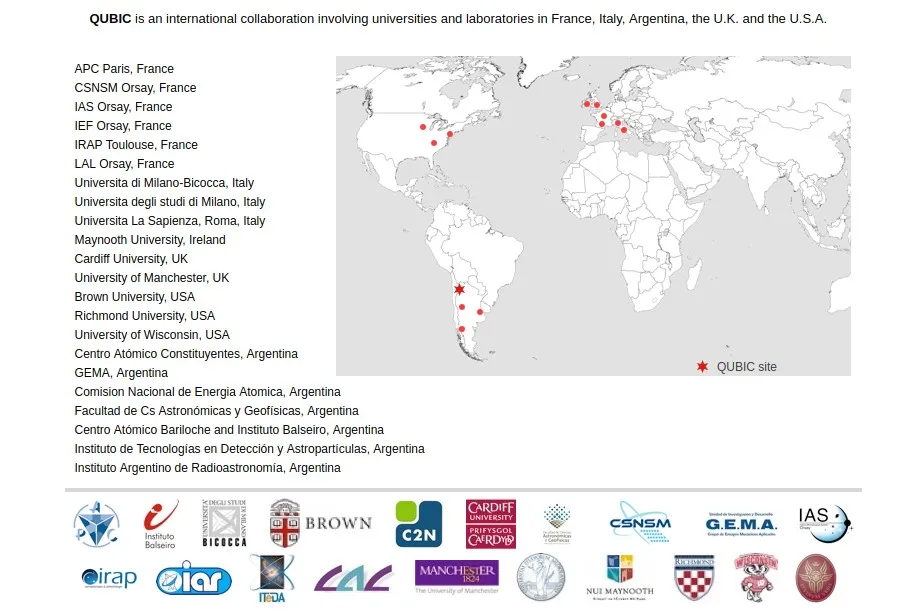
For this, it is planned to install an instrument in the Salta altiplano, in Alto Chorrillos, near San Antonio de los Cobres, 200km from Salta and at 4800 meters above sea level.
It is also planned to install a second instrument at the Franco-Italian Concordia station in Antarctica.
The Alto Chorrillos site had already been evaluated for installing the LLAMA radio telescope between Argentina and Brazil. CONICET obtained a twenty-year loan from the provincial government for an area of 400ha. For QUBIC only 100 m2 are needed.
The installation of the instrument is scheduled for mid-2018 and its commissioning would be at the end of next year.
The detection of primordial B-mode polarization could confirm that there was an inflationary stage and its characteristics.
The Argentine collaboration includes researchers Alberto Etchegoyen, Diego Harari, Beatriz García, Clementina García and Gustavo E. Romero.
What does QUBIC mean and what are the instruments like?
Q and U Bolometric Interferometer for Cosmology, that is, Q and U Bolometric Interferometer for cosmology. Q and U are two Stokes parameters, a set of values that describe the polarization state of electromagnetic radiation. They were defined by George Gabriel Stokes.
The instruments under construction are described in the white paper (indicated below) which I will roughly translate:
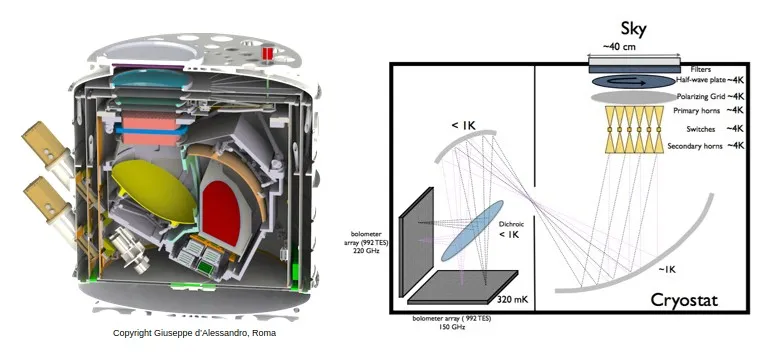
The proposed bolometric interferometer is the millimeter-wave equivalent of the first interferometer dedicated to astronomy: the Fizeau. It was obtained by placing a mask with two holes at the entrance pupil of a telescope. Then "fringes" or interference lines were observed in the focal plane of the instrument. In this case (see figure) some horn-shaped antennas or "horns" are used that act as diffractive pupils just behind the window of a cryostat. The electric field coming from a direction in the sky experiences a phase difference due to the distance between the horns. The back horns re-emit the field preserving the phase difference inside the cryostat. The interference pattern arising from the pairs of horns is formed in the focal plane of a combiner that is, in fact, a telescope that superimposes the electric fields of all the horns at each point of the focal plane. The polarization of the incoming field is modulated using a half-wave plate or retarder. A polarization grid separates both polarizations towards two different focal planes, each of which measures a combination of the Stokes parameters.
Each instrument would have 400 horn-antennas, designed to be efficient across the 150 and 220 GHz bands.
An article about the experiment and Argentine participation was published in issue 156 of Ciencia Hoy. It states: "The placement of this kind of facilities in the heart of the Salta puna will bring with it the need to improve, among other things, the energy supply, communications, and access roads to the site, as well as to build in this and possibly in San Antonio de los Cobres respective headquarters that include laboratories and can be shared by QUBIC and LLAMA. It can also be expected that certain economic benefits of these projects will be disseminated among the inhabitants of San Antonio de los Cobres in the form of demand for goods and services and job offers".
Sources and related links
- QUBIC Argentina
https://fisica.cab.cnea.gov.ar/particulas/html/qubic/ - QUBIC: The QU Bolometric Interferometer for Cosmology
arXiv:1010.0645 [astro-ph.IM]
https://arxiv.org/abs/1010.0645 - QUBIC International
http://qubic.in2p3.fr/QUBIC/Home.html - CIENCIA HOY: "QUBIC. An international observational cosmology experiment with Argentine participation"
by Argentine members of the international QUBIC collaboration
Volume 26 number 156 July-August 2017.
http://cienciahoy.org.ar/
About the images
Credit: QUBIC Collaboration.