Astronomers detected the passage of an object that would be exterior to the Solar System, having a hyperbolic orbit. It would be the first extrasolar or exoasteroid. An unexpected visit.
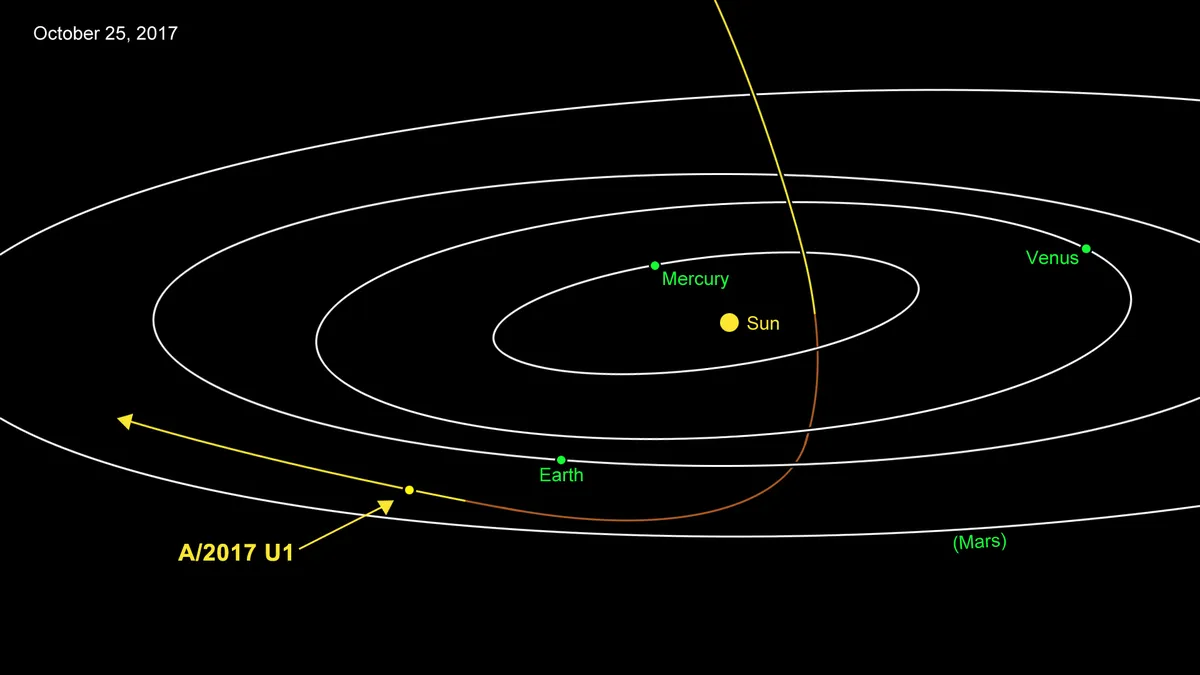
The object was discovered thanks to the PanStarrs Survey and was named C/2017 U1, assuming it was a comet. But with more observations, the very next day they began to discard that characterization in favor of an asteroid.
The origin and composition of the object are therefore of great interest to astronomers who are pointing telescopes at the object to capture all possible information during its rapid passage through the Solar System. And with more observations, data will be corrected. So far it has been observed at magnitude 22 (very, very faint) and about 400 meters in diameter.
The credit for the discovery goes to Rob Weryk who identified the object on October 19 with observations made through Pan-STARRS 1 located at Haleakala, Hawaii. Later, reviewing previous data, it was discovered that the telescope had detected the object earlier.
The orbit was outlined in the initial image of this post and here we see it in motion:
The object came from the direction of the constellation Lyra at a speed of 25 km/s. It approached the solar system from "above" the ecliptic -the plane in which the planets and most asteroids orbit the Sun- so it had no close encounters with the planets. On September 2 the small object crossed the ecliptic right at the orbit of Mercury and its closest approach to the Sun was on September 9. It is difficult to detect an object near the Sun due to the star's light. With the gravitational boost from the Sun, the object shot out towards Earth and passed 24 million kilometers from home on October 14. Now, again above the planets and traveling at 44 km/s relative to the Sun, the object is heading towards Pegasus.
"We have long suspected that these objects should exist, because during the process of planet formation, a lot of material must have been ejected from planetary systems. What is most surprising is that we have never seen interstellar objects passing through like this before," said Karen Meech, an astronomer specializing in small bodies at the IfA, the Institute for Astronomy at the University of Hawaii.
By the way, the object was discovered while searching for NEOs, Near-Earth Objects, but it does not fall into that category and there is no need to be alarmed about a possible collision.
Here it is, this is it:
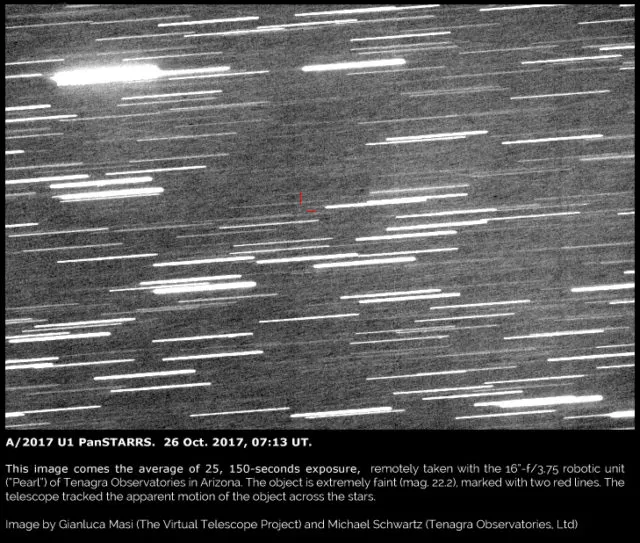
This image was made from 25 exposures of 150 seconds taken remotely with the telescope at the Tenagra Observatories in Arizona. The magnitude 22.2 object is marked with two red lines. Image by Gianluca Masi (The Virtual Telescope Project) and Michael Schwartz (Tenagra Observatories Ltd).
A precedent for an object with a hyperbolic orbit was C/1980 E1 (Bowell), a comet discovered by Edward Bowell in 1980.
Sources and related links
- Small Asteroid or Comet 'Visits' from Beyond the Solar System
https://www.nasa.gov/feature/jpl/small-asteroid-or-comet-visits-from-beyond-the-solar-system - Astronomers Race to Study a Mystery Object From Outside Our Solar System
https://www.nytimes.com/2017/10/27/science/interstellar-object-solar-system.html - C/2017 U1 (now A/2017 U1) PanSTARRS: the first interstellar comet or asteroid ever? – 25 Oct. 2017
https://www.virtualtelescope.eu/2017/10/25/c2017-u1-panstarrs-first-interstellar-comet-ever-25-oct-2017/
The enigmatic object A/2017 U1 just discovered in our Solar System: a new image (26 Oct. 2017)
https://www.virtualtelescope.eu/2017/10/26/enigmatic-object-a2017-u1-just-discovered-solar-system-new-image-26-oct-2017/
About the images
Credits: NASA/JPL-Caltech