In the Universe, brown dwarfs, red dwarfs, white dwarfs, blue dwarfs and black dwarfs tell us that size is not what matters.
Is the cosmos like a chessboard? The comparison is tempting. For the analogy to work in the Universe there would have to be white and black objects (that shine and that do not); and six types of "pieces".
It is said that biologist TH Huxley said: "The chessboard is the world; the pieces are the phenomena of the universe; the rules of the game are what we call the laws of Nature. The player on the other side is hidden. We know that his play is always fair, just, and patient. But also we know, to our cost, that he never overlooks a mistake, or makes the smallest allowance for ignorance". In the 19th century, the Frenchman Frederic Villot would have said: "The king represents the Sun and the queen, the moon. The former is sometimes on a black square and other times on a white one, which gives us alternately day and night..." (1)
However, astronomers know that astronomical objects are not only 6 (like the chess pieces), and that they are not white and black, but there are several intermediates, which is why they use the color-magnitude diagrams developed by Hertzsprung and Russell.
In the Universe observable by humans, the cosmos seems, instead, like a game of dwarfs. No, dwarfs, to the delight of feminists, making it more like a game of checkers than a chessboard. But we will see that it resembles a game of Chinese checkers more than a Western one. Have you ever seen a Chinese checkers board? I forbid you to look it up on the internet...
BROWN DWARFS ARE DWARFS
First we will deal with brown dwarfs which, certainly, are not stars. By definition, stellar objects produce energy, radiation, through different mechanisms. When those mechanisms achieve hydrostatic equilibrium they are called "stars" and when they lose that equilibrium they are called "exotic objects". Brown dwarfs, on the other hand, are sub-stellar objects, failed stars, therefore they are giant planets, much larger than Jupiter, but which do not have enough mass to start the nuclear fusion process. If they are planets, then, they should be "dwarfs", and in this game of checkers, they don't fit.
Note: many of these objects do not orbit a star, which means they are not planets. In any case, they are quasi-stellar objects.
RED DWARFS: LONG LIVE THE LITTLE ONES
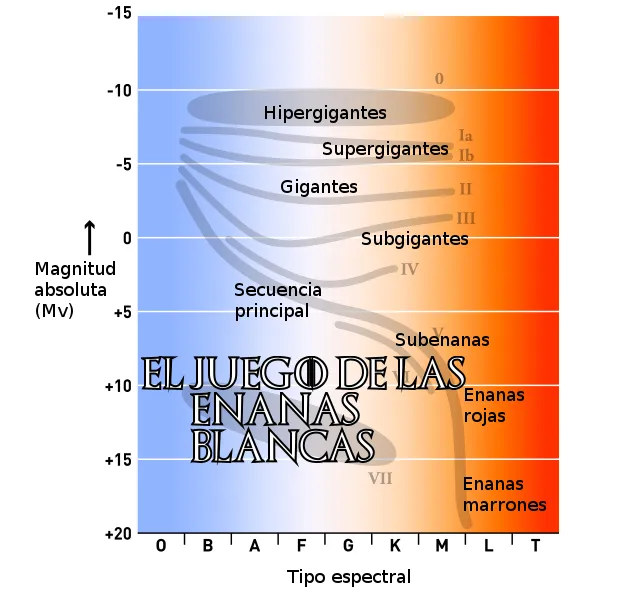
Red dwarfs are low-mass stars relative to others. If we take a Hertzsprung-Russell diagram, also known as an H-R diagram or color-magnitude diagram, we will see that stars that achieve hydrostatic equilibrium form a path called the "main sequence". Stellar objects in that sequence, since they are not the giant stars outside that path, are then dwarfs. If you look at one of those diagrams (see below), you might think that dwarfs are a minority, but such illustrations do not take quantity into account, they only describe spectral types.
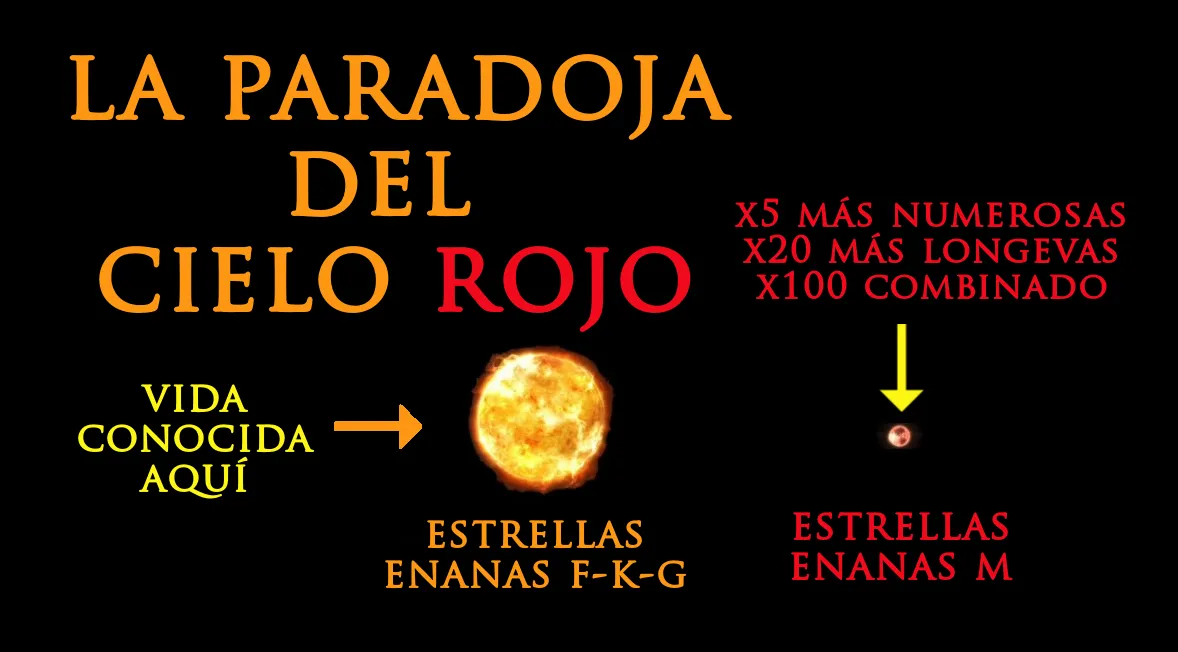
Unlike what we sometimes experience in everyday life, in physics and particularly in astrophysics, red is less energetic than blue. Red dwarfs are cooler stars. They are characterized as stars of spectral type M, between 0.075 and 0.5 stellar masses. That is, a red dwarf has less mass than our Sun. They are little stars, but they are very numerous, the most common in the Milky Way. Of the sixty stars closest to the Sun, fifty are red dwarfs, including Proxima Centauri.
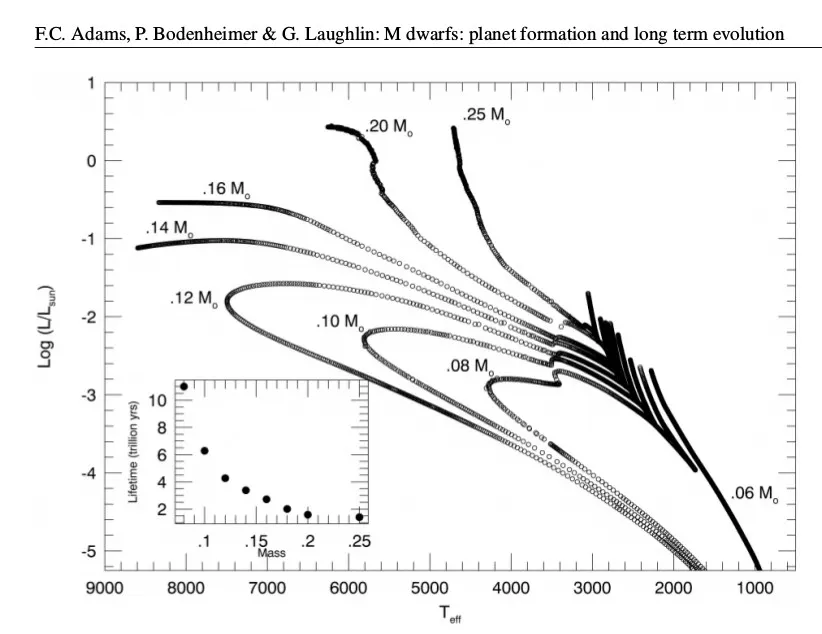
What do red dwarfs become? It is hard to say because since they are convective, meaning that helium does not accumulate in the core, they have a very, very, very long life. The estimated life of red dwarfs is greater than the life of the Universe so far, therefore, in the observed universe, no red dwarf stars are found in a sufficiently late stage to leave the main sequence. However, with physical knowledge and computational simulations, it can be theorized that many red dwarfs will eventually go through a red giant stage, subsequently they would be blue dwarfs, then white dwarfs and finally black dwarfs.
Generally speaking, the universe shows that the greater the mass, the shorter the lifetime. It is not the triumph of the most massive, but of the least massive. But, as we will see, it is not just a matter of size, but of density.
WHITE DWARFS: DENSE AND PERSISTENT
Intermediate- or low-mass stars, like our Sun, will go through a period of red giants, which leads to a planetary nebula whose remnant is a white dwarf. The white dwarf period will reach the vast enormous majority of stars in the universe. This stage is reached when intermediate- or low-mass stars no longer achieve hydrostatic equilibrium. Let's explain this: Gravity compresses hydrogen atoms, which, in doing so, increase in temperature. At a critical point, that density and temperature allow the atoms to fuse, expelling energy in the form of radiation in the process: the star shines. But if there were only gravity, the star would never finish forming and would collapse. It happens that gravity creates its own enemy: radiative pressure. In this dialectical process, to quote Heraclitus, like a struggle of opposites, the gravity that allows fusion generates as a consequence that this energy emerging from the star's interior in all directions produces a pressure "in the opposite direction" to gravity. That is why the star achieves "equilibrium," which can last billions of years. This equilibrium then depends on pressure, and that on fusion. Since the original hydrogen is not infinite, at some point it runs out. Then the agile little star expands and fuses carbon and oxygen. If that process cannot continue, because mass-temperature does not allow it, then the outer layers of the atmosphere are expelled and after a planetary nebula phase, a bare stellar core remains: the white dwarf.
These little stars will be very small in volume, but have a lot of compressed mass. They lost half of their original mass and compressed it into a very small volume, the size of Earth. Their strength lies there: in grouping. This very dense exotic object degenerates matter. Although it can no longer have equilibrium by radiative pressure, another type of pressure appears given by a degeneracy of matter due to the Pauli Exclusion Principle. That is, it is a pressure generated by the way matter can be ordered taking into account that electrons cannot share the same state.
In massive stars, but not too massive, a similar degenerative process occurs with neutrons, producing neutron stars that are also composed of degenerate matter.
White dwarfs, compact and very hot, lose energy very slowly, as they cool. Since this process lasts so long that it is greater than the age of the Universe, it is difficult, as in the previous case, to know their subsequent evolution. But it is possible to theorize that gradually, as they lose energy and temperature, they will fade until they become black. This process is so slow that if galaxies faded away due to the expansion of the universe, white dwarfs would still persist. Sirius B is the closest white dwarf (about 8 light-years). Another is Procyon B, both make up binary systems.
Stellar classification and systems
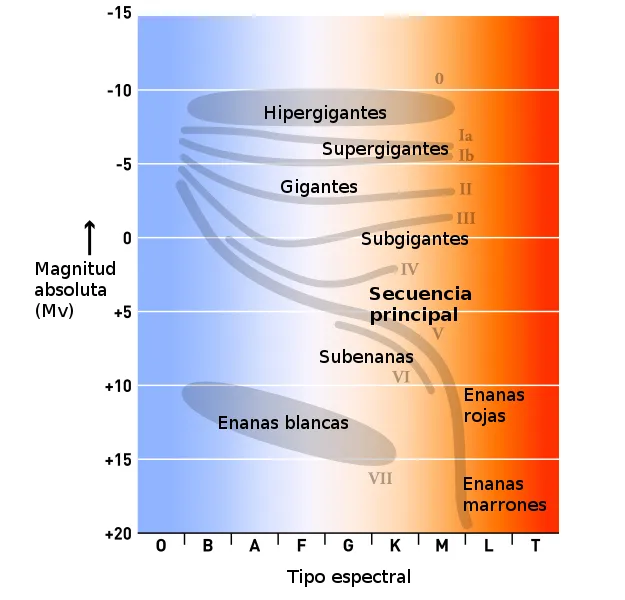
In the H-R diagram, Roman numerals will be seen that are used in the Morgan-Keenan-Kellman (MKK) classification, also known as the Yerkes system in relation to the Yerkes Observatory where William Wilson Morgan, Philip C. Keenan, and Edith Kellman worked, to differentiate stellar types according to certain absorption lines. Thus, luminosity class 0 corresponds to Hypergiants, I for supergiants, II bright giants, III regular giants, IV subgiants, V main sequence (dwarfs), VI subdwarfs, VII white dwarfs.
The Harvard system, developed by Annie Cannon, uses letters according to color, with subdivisions: O stars, blue; B blue-white; A white, etc. K and M stars have less than 1 M (solar mass). Our sun is a G2 star.
BLUE DWARFS
In red dwarfs less than 0.25 M (solar masses), instead of increasing their surface like a red giant, it is possible that they increase their surface temperature, becoming bluish. However, when they finish their hydrogen fuel, they would become white dwarfs.
BLACK DWARFS
From what was said before, the theoretical possibility, never observed, arises that white dwarfs, as they fade, become black dwarfs, now without radiation, and instead of being ultra-hot like white ones, they would be ultra-cold, like the background radiation. One might wonder if these stars formed by protons will last forever. That will depend on the half-life of the proton, which seems not to decay, but perhaps it does over a very long period of time, perhaps 1040 years. By the way, it has been calculated that there are more possible chess games than atoms in the universe. Note: until a few decades ago, "black dwarfs" were named as failed stars, that is, what is now called brown dwarfs.
THE END OF WHITE DWARFS
For degenerate electrons to balance the star by pressure, it must not exceed the Chandrasekhar limit of 1.44 M. If that limit is exceeded, the object will become a black hole or neutron star. The role of white dwarfs in Type Ia Supernovae must also be considered: in those cases, a white dwarf orbits around a common center of mass with another star from which it steals matter until collapse occurs.
CONCLUSION
The universe is a game of checkers, not chess. And of Chinese checkers. And of dwarfs, more than giants. The biggest does not always triumph. White dwarfs teach that grouping (density) is more important than size, that equilibria are not eternal or infinite, and that the degenerate is more common than it seems.
Sources and related links
- (1) The astronomer and the chessboard, by Rohit Gupta
http://www.thehindubusinessline.com/blink/explore/the-astronomer-and-the-chessboard/article6341747.ece - Adams, F. C., Bodenheimer, P. and Laughlin, G. (2005), M dwarfs: planet formation and long term evolution. Astron. Nachr., 326: 913–919. DOI:10.1002/asna.200510440
- R. F. Jameson, M. R. Sherrington, A. B. Giles; A failed search for black dwarfs as companions to nearby stars, Monthly Notices of the Royal Astronomical Society, Volume 205, Issue 1, 1 November 1983, Pages 39P–41P, https://doi.org/10.1093/mnras/205.1.39P
- A Dying Universe: The Long Term Fate and Evolution of Astrophysical Objects
Fred C. Adams, Gregory Laughlin (U. Michigan)
arXiv:astro-ph/9701131
https://arxiv.org/abs/astro-ph/9701131
On wikipedia https://es.wikipedia.org/wiki/Enana_blanca https://es.wikipedia.org/wiki/Enana_negra https://es.wikipedia.org/wiki/Enana_azul_(etapa)
About the images
Wikimedia User:Spacepotato [GFDL or CC-BY-SA-3.0], via Wikimedia Commons