After 12 months in office, the effects of Trump on the sciences have been as bad as feared, according to Nature. But is Trump the problem?
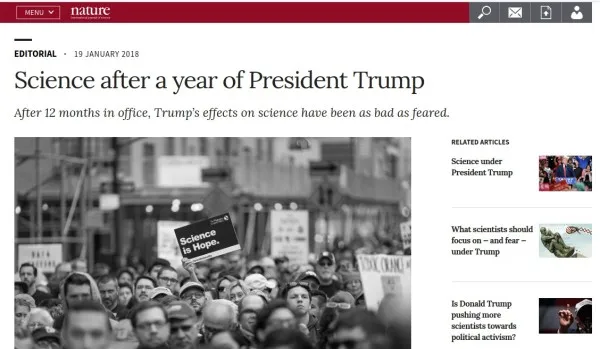
What follows is a translation done by me of an editorial note published in the journal Nature on January 19. At the end, some comments of my own.
After a year of President Trump, scientists in the United States are doing their best in difficult circumstances and Nature applauds them for that. It is increasingly clear that Trump has been as bad for various aspects of science as we feared. Most crucially, the role of science and scientific advice in public life has been repeatedly undermined.
When writing after his electoral victory in November 2016, this magazine tried to look on the bright side and suggested that Trump could still "leave behind his harmful and unpopular attitudes and embrace reality, rationality, and evidence".
How wrong we were to be optimistic. After 12 months in office, Trump's impact on science can be clearly divided into two categories: bad things that people expected, and bad things they did not expect. The long list of items in the first category includes the U.S. abandonment of the Paris climate agreement, rollback of government regulations (environmental agencies in particular) and the failed record in appointing a science advisor. His administration cut funds to foreign organizations that promote public health but mention abortion, weakened restrictions under the Toxic Substances Control Act, and censored the use by government agencies of phrases like "evidence-based" and "climate change". Advisory groups, including one on HIV, have been dismantled, and scientists with grants from the Environmental Protection Agency were censored from the agency's boards.
In the second category, Trump's campaign rhetoric promised a travel ban on Muslims, but the full and chaotic details were worse and more divisive and disruptive than even his declared opponents would have imagined. Scientific organizations lined up to complain about the potential loss of talent.
There are also some bad things that critics expected from Trump, but have not yet occurred. Budgets at key science and health agencies remain unchanged (though this is largely thanks to resistance in Congress to making cuts); censorship of fetal tissue and stem cell research has not arisen; and Obama-era programs, including the Precision Medicine Initiative, remain in place for now.
One good thing has happened: Trump unleashed a wave of political activity by scientists motivated to oppose him. (And, of course, nations from China to France are offering opportunities as U.S. leadership disappears). Those who celebrate the values of science must continue fighting. Scientists and politicians must continue challenging the president's actions and try to keep him at bay.
Relations between science and politics
If one analyzes the Nature editorial and takes into account other articles published by that and other science journals, it is possible to arrive at two general considerations about the relations between science and politics:
1-Scientific theories can be debated, they are not absolute truths. But they are debated within the framework of scientific thought, that is, in relation to objective data (which must always be interpreted) and formal logic. Theories are called into question when evidence (experiments, observations) indicates something different. A theory is not denied just because we don't like it, just as it is not endorsed just because it pleases us.
Hypotheses are not created by mere creative whim, but to solve some problem, for example a discrepancy between a current theory and observations of reality. Hypotheses are not created so that reality is as we wish it to be from a philosophical or ideological position. A theory will not be highly regarded when it lacks sufficient evidential support. In summary: the sciences are the best tool for trying to understand reality. When data is forced to fit a prior stance, it ceases to be science.
2-Scientific work is just that, work, therefore it is also a right to be defended, which leads to thinking about some form of unionism in the sciences. But knowing reality better is a right and a need of society as a whole, not just scientists. Therefore, science policies should not mobilize only the directly affected actors in the sciences, but the entire community of researchers and society as a whole. For the defense of jobs, as well as in defense of a better knowledge of reality, a science policy that solves theoretical and practical problems is necessary and indispensable.
From the first point it follows that in those sciences that involve people as the object of study (the social sciences, but also the environmental ones) "moral values" interfere, of what is supposedly right or wrong, what is convenient or not (for some sectors) and certainly, economic interests also have influence. In the case of climate change, there are vested economic interests, but it should be noted that the reduction of emissions and "alternative" energies also drive many businesses. Ultimately, the notion of climate change does not end business deals, but rather these deals change markets.
Therefore, what is seen is a struggle of some economic octopuses against others, added to supposed religious-moral values of what is "right" according to some interpretations of supposed sacred scriptures, which are conveniently forgotten when it is economically inconvenient.
TRUMP IN THE WORLD
The Argentine sociologist Silvio Waisborg published an article in The New York Times on "cultural conservatism" in which he says that "The shift to the right on the continent and the growing influence of religion in politics puts a tailwind behind a cultural reaction that aims to undo some of the greatest social achievements (...)"
"Dare to know!" Kant said of the Enlightenment. But someone cut the power to the "Age of Enlightenment." Trump is an exponent of that. There are others. Recent newspaper articles have reported the Argentine president's consultation with a "Buddhist harmonizer." I don't think political leaders need to consult priests, pastors, or "harmonizers" to make their decisions, such as cutting scientific research positions at CONICET or firing workers from INTI. Those consultations could only be used as excuses. Ideologies can be defined in many ways, among them: a set of false arguments to justify the unjustifiable.

The advance of cultural conservatism should not deceive us. It is not that conservatives are bad and liberals are good.
But a large part of the world's population seems to choose the lesser evil among the dominant parties. And so the bad and the worse take turns. Meanwhile, if those we choose win, we become fanatical defenders. And if they lose, fanatical detractors.
It is necessary to always exercise critical thinking. And even more so when those with whom we might have greater affinity are in power. This is true within scientific thinking and therefore also "outside" of scientific thinking. If we are more convinced by the Big Bang theory (Standard Model), then it is necessary to be critical of that theory, because what would it imply not to be?
We must stop justifying the unjustifiable. Permanent criticism is the only admissible "scientific" attitude. What the Nature editorial says about increased scientific politicization is true. But is that politicization a permanent critical attitude? It doesn't seem so.
CONCLUSION
A professor of semiotics at the University wrote a paper on the internet and new media. He said this: "The internet made people believe it was a new medium of communication. However, the internet is a new technology, the first one that does not differ from previous ones but brutally overlaps, confuses, and exceeds them."
I often use this phrase as a reference to a general process: confusing a problem with a solution. The internet is not the problem; rather, with its appearance, we began to realize pre-existing problems we hadn't noticed. Communication problems predate the internet, and technologies are not a problem or a solution "in themselves," but will or will not be so depending on the use we make of them.
Trump is not the problem, he is a symptom. If Trump were the problem, then it's not a big problem because, unless he becomes tyrannical, he won't last long in power. If the Constitution is not amended, at most he will last 8 years. Then another will come. The problem is that we always vote for the same thing recurrently. It's as if we had to choose between the Big Bang and the Steady State. Yes, the first seems better. But does it explain everything or does it have problems? Defending that theory CANNOT mean hiding its problems, but the opposite. It's not about favoring that theory BLINDLY, but about finding the best answers, those that come closest to reality, those that solve problems. Everything else is fanaticism.
The only way to avoid fanaticism is through permanent criticism. Not criticism for its own sake, but reasoned criticism in the face of problems that actually exist. Criticism can be objective, even if done with passion. We cannot do it any other way; we are people, not robots.
Waisborg is right that there are many who dream of the advance of conservatism (which is a regression). And others who dream and are content with removing Trump. It is true that many justify the unjustifiable. But I believe, like Lennon, that it is possible to imagine a better world. They'll say I'm a dreamer, but I'm not the only one. However, the dream, the utopia, are insufficient. To achieve it, we must develop the mechanisms that make it possible. That's why Kant was right: Sapere Aude! he wrote on September 30, 1784 in Königsberg, and it is as relevant as the internet.
Sources and related links
- Science after a year of President Trump
https://www.nature.com/articles/d41586-018-01001-9 - http://trumpvsscience.com/
- The new cultural conservatism, by Silvio Waisborg
https://www.nytimes.com/es/2018/02/07/opinion-waisbord-nuevo-conservadurismo-cultural-religion-estado-laico/ - Macri's "harmonizer" and her role in the decision to support Triaca
https://www.clarin.com/politica/armonizadora-macri-rol-decision-sostener-triaca_0_BkjFy0vIM.html - Macri found in Buddhist harmonization the way to open his intimate universe
http://www.perfil.com/protagonistas/macri-encontro-en-la-armonizacion-budista-la-manera-para-abrir-su-universo-intimo-0726-0034.phtml
A SOCIAL DEFINITION OF MEDIUM OF COMMUNICATION (The aging of its technological versions)
José Luis Petris and Rolando Martínez Mendoza
AVATARES de la comunicación y la cultura, No. 2. ISSN 1853-5925. August 2011
Kant, Immanuel. Answering the Question: What Is Enlightenment? Buenos Aires, Aguilar, Altea, Taurus, Alfaguara, 2013.
About the images
Initial image: Screenshot from Nature.com site
Image 2 from https://climatefeedback.org/evaluation/analysis-of-donald-trump-climate-statements/
Image 3: Perfil.com site