Some contrasts between science and the soccer world championship.
In a previous post I established a comparison that a reader found somewhat forced. It's true that it can be somewhat forced, but valid:
The best understanding, diagnosis, strategy and forecast regarding potentially hazardous asteroids is achieved with the accumulation of more and better data.
That is also valid for soccer forecasts, like those being made by some media outlets and particularly, certain scientific initiatives like the one from the Instituto del Cálculo of the Universidad de Buenos Aires (UBA) materialized on the site 301060.
In this regard, then, it is worth contrasting scientific forecasts with pseudoscientific ones:
In the first case, using UBA's data, of the first 48 matches already played, the Institute got 30 right, 60%.
Is that a lot or a little?
Given that in soccer there are three possible outcomes (win, draw, lose), if the options were taken as equally probable, then one would expect a success rate of 33%. Getting 60% is therefore good.
However, there are two possible analyses of the forecasts:
-The verification of the results, in a statistical form.
-The validation of the method: logical and based on data.
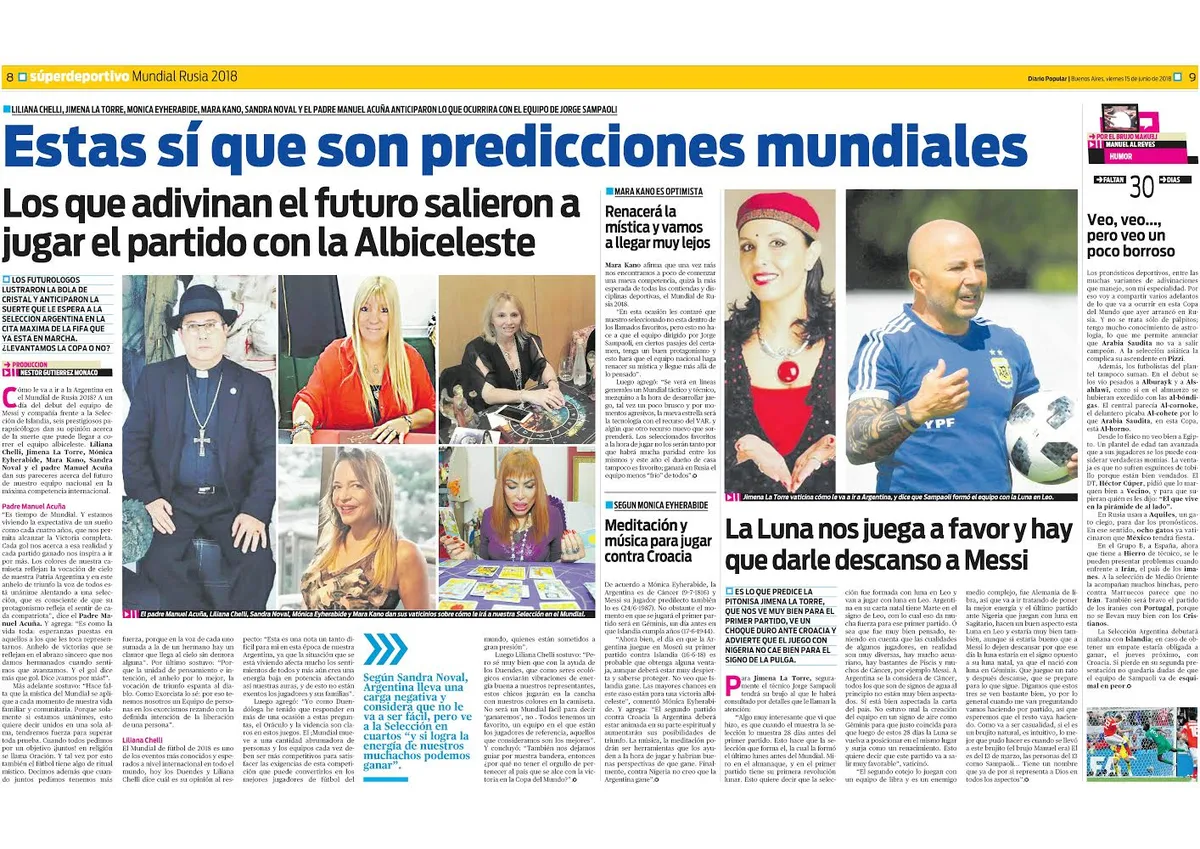
Both characteristics distinguish scientific forecasts from those that are not, but I emphasize the second point. To contrast, I leave here an image of the central pages of an Argentine morning newspaper, published on June 15. The article consults astrologers about how Argentina will fare in the World Cup.
Note the ambiguity of the answers and how in no case is it explained how those conclusions are reached.
I also add two articles published on news portals in which astrologers were also consulted, particularly about how the national team would fare against Nigeria. As is evident, they did not get it right, despite the fact that getting a single result right is much easier than getting 30 out of 48 right (see links below).
Making scientifically-based forecasts for the World Cup can be good "leverage" for science outreach.
The participation of different countries can also be fruitful for greater knowledge of them in relation to their geography and history. Even migrations, so in vogue due to the controversial measures adopted by some nationalist governments that encourage xenophobia, could be a topic starting from the inclusion of athletes of different origins than those selected, like defender Umtiti, originally from Cameroon, established in Lyon since childhood.
When the ball eclipses science
Another approach is possible that also allows a contrast between science and soccer, more specific to astronomy.
In March of this year it was learned that the European Southern Observatory (ESO) suspended Brazil as a member country. The organization is a consortium of European countries that owns some of the world's most important telescopes in Chile. In 2010 Brazil was invited to become part of it, but the agreement was never ratified.
Brazil's membership as a (provisional) member country enabled professional astronomers from the South American giant to have more observing time. According to the Sociedade Astronômica Brasileira (SAB), about 300 astronomers collected data using ESO telescopes, which resulted in about 3% of the world's astronomy papers being signed by professionals from Brazil. "In terms of scientific publication rates, our performance at ESO was not very different from countries with a longer tradition of observing the skies like Germany, France or the United Kingdom", said Reinaldo de Carvalho, president of SAB, as reported by Physics World.
The 2010 agreement was approved by Congress in 2015, but never ratified, which is why since April 1 of this year, Brazilians must request observing time like any other country.
Astronomer Gustavo Rojas, from the University of São Carlos, said "While membership in ESO would have cost around €270 M, we invested €290 in the renovation of a single soccer stadium to host the 2014 World Cup". And he added that "It is the new generations of astronomers who will probably be most affected by the suspension from the consortium."
The €270M would be over a decade, at a rate of €27M per year, including €130M as an entry fee. ESO had planned to use that income for the E-ELT.
Physics World indicated that Brazil's return as a member will not be soon, due to the country's "austerity program" and the little enthusiasm for science and technology from the current administration.
It is worth remembering that in 2016 Brazil also hosted the Olympic Games, an event for which it made a multi-million dollar investment, but a large part of the structures created for that purpose were later abandoned.
A good piece of news from last year is that Russia, together with Spain, would launch the World Space Observatory (WSO-UV) in 2023. Hopefully, austerity policies will not cut budgets so that research on real stars with advanced technologies can continue.
World sport is more of a spectacle than a true promotion of sports activities linked to better health and quality of life. Millions are moved because the public wants to see "the stars" like Messi, CR7 or Neymar.
Evidently, the World Cup generates a huge audience. Space exploration also achieved it with the first moon landings. Perhaps the next time astronomy generates as large an audience as a World Cup will be with the arrival of people on Mars. Or when we follow, live, direct, via streaming and HD, the approach to our world of a large asteroid on a collision course. The ratings spikes will be as high as craters and the media will make their fortune with that truly "impactful" news. Analysts will say that the situation was reached due to a lack of sufficient information about asteroids, which in turn is a consequence of budget cuts in science.
Conclusion
The World Cup can serve as a lever to address -in school or at home- topics of natural sciences, social sciences or mathematics. Probability calculation is applied basic science. But the World Cup can also eclipse the sciences.
To be able to predict human behavior, whether individual or social, the development of the social sciences is necessary. To forecast the behavior of astronomical objects, instruments and professionals are needed (the opposite of cutting back on science and education). None of that is provided by astrologers and other shady charlatans who get more press than astronomers. It's easy to check: Name two local professional astronomers (from your country) and two astrologers and evaluate the result. If that isn't an eclipse...
June 30 Asteroid Day
Asteroid Day is a worldwide organization co-founded in 2014 by Dr. Brian May (astrophysicist and former guitarist for the rock band Queen), Rusty Schweickart (Apollo 9 astronaut, 1969), Danica Remy (member of the B612 Foundation) and filmmaker-director Grig Richters (creator of the documentary 51 Degrees North).
It is a movement declared of educational interest by the United Nations whose objective is not only to track and study asteroids but also to analyze the measures that can be taken in order to preserve life on our planet in the face of possible major impacts with these objects.
Asteroid Day is celebrated every June 30 in commemoration of the largest recorded impact between an asteroid and Earth (June 30, 1908, Tunguska, Russia). It is believed that said asteroid was an object approximately 40 meters in diameter. As a result, an entire forested area the size of a large city was devastated.
https://asteroidday.org
Sources and related links
- 301060
https://301060.exactas.uba.ar/ - Brazil suspended from European Southern Observatory
https://physicsworld.com/a/brazil-suspended-from-european-southern-observatory/ - Clarification of Brazil's participation in ESO
https://www.eso.org/public/spain/announcements/ann18015/ - The shocking deterioration of Brazil's Olympic venues six months after the Games
https://www.infobae.com/fotos/2017/02/10/el-impactante-deterioro-de-las-sedes-olimpicas-de-brasil-a-seis-meses-de-los-juegos/ - Brazil delays stargazing pact
https://www.nature.com/news/brazil-delays-stargazing-pact-1.13670 - Brazil ignites telescope race
https://www.nature.com/news/2011/110126/full/469451a.html - According to the stars, Argentina is eliminated against Nigeria
https://www.minutouno.com/notas/3078125-segun-los-astros-argentina-queda-eliminada-nigeria - Astral predictions for the Argentine National Team ahead of the match against Nigeria
http://caras.perfil.com/2018-06-21-333351-__trashed-10/?_ga=2.48203495.1322318676.1529356275-1856801995.1524384256 - Russia and Spain collaborate on a space telescope to investigate the origin of life in the universe
https://elpais.com/elpais/2017/10/27/ciencia/1509121701_244662.html - World Space Observatory – Ultraviolet (WSO-UV)
http://www.wso-uv.es/index.php?id=33