Regarding a reader's query about a supposed constellation shaped like a Y with a broken stem...
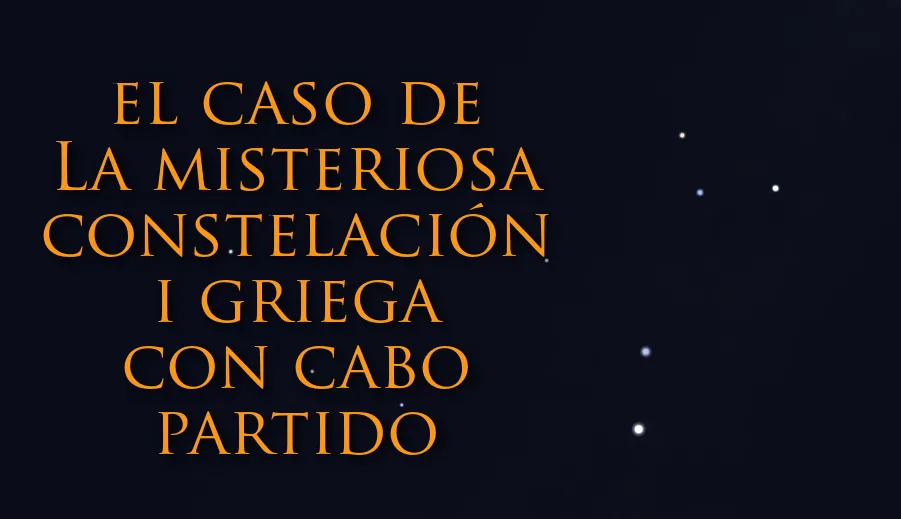
A reader named Fernando writes to me, consulting because he says he observed, early this morning, around 1:00, a constellation shaped like, I quote: "A Greek Y with the stem broken" (sic), towards the cardinal point South. And he clarifies that he used the Stellarium program at home and didn't find any group of stars that looks like that.
The first thing to say is that always, when making queries about a sky observation, it is necessary to indicate:
Observation location: country, city
Complete date: day and time, without ambiguity (either use the time in 24:00 format or indicate AM/PM, but saying "at one o'clock" is not sufficiently meaningful).
Approximate cardinal point of the observation
Approximate height in the sky of the phenomenon.
They may seem like many requirements, but they are actually simple data. Regarding the cardinal point, if you don't know it and don't have a compass, there are options: on one hand, cell phones may have a compass in which case you can consult it. On the other hand, if you know, approximately, where the Sun set or where it rises, then you will know West and East, respectively, and therefore also the remaining cardinal points. If the observation is made near our house, it is common that we know if the Sun hits our window in the morning (that would be pointing East) or in the afternoon (pointing West), for example.

Regarding the approximate height in the sky: the concept of sky comes from an older one which is the "celestial sphere". We can imagine that what we call the astronomical sky is a sphere surrounding the Earth. There is a part of that sky that we cannot see because it is below the horizon, therefore, if the sphere has 360º, what we can observe is half, 180º. If I use my arms in such a way that I raise my right arm pointing upwards and I place my left arm perpendicularly, pointing to my left, a 90º angle is formed. If what I am observing is near, approximately, in relative terms, where the index finger of the right hand points, it is at 90º height in the sky. If it is lower, I can estimate how much. If it is halfway between both hands, it will be 45º. If one had precision, better, but if not, an approximation is enough, which can also be "high, medium or low" height in the sky. For the separation between objects, quantification is also useful and this is usually used: a fist=10º.
So, first of all, even though I already thought I knew the answer, I took the precaution of replying to the email asking for this data again. I also asked something else that will prove vital, as will be seen shortly. Fernando told me in his original email that he had used the Stellarium program. My question was whether in the program's configuration, when he opens it by default, he can see many star names or few.
Fernando's response was this:
Location: West of Greater Buenos Aires, Argentina.
Complete date: Tuesday, February 13, 01:00 (one in the morning, one hour after 24:00)
Cardinal point: near South
Height: the broken Y at medium height. Jupiter, below.
Stellarium: several names.
With this information I was able to answer what I already imagined: What Fernando observed was the Southern Cross and "the pointer" of Centaurus. And I can easily demonstrate it, with images:
If I open the Stellarium program, in my case, version 0.14.3 on Linux Ubuntu, by default, for approximate date and location according to Fernando, I would see this:
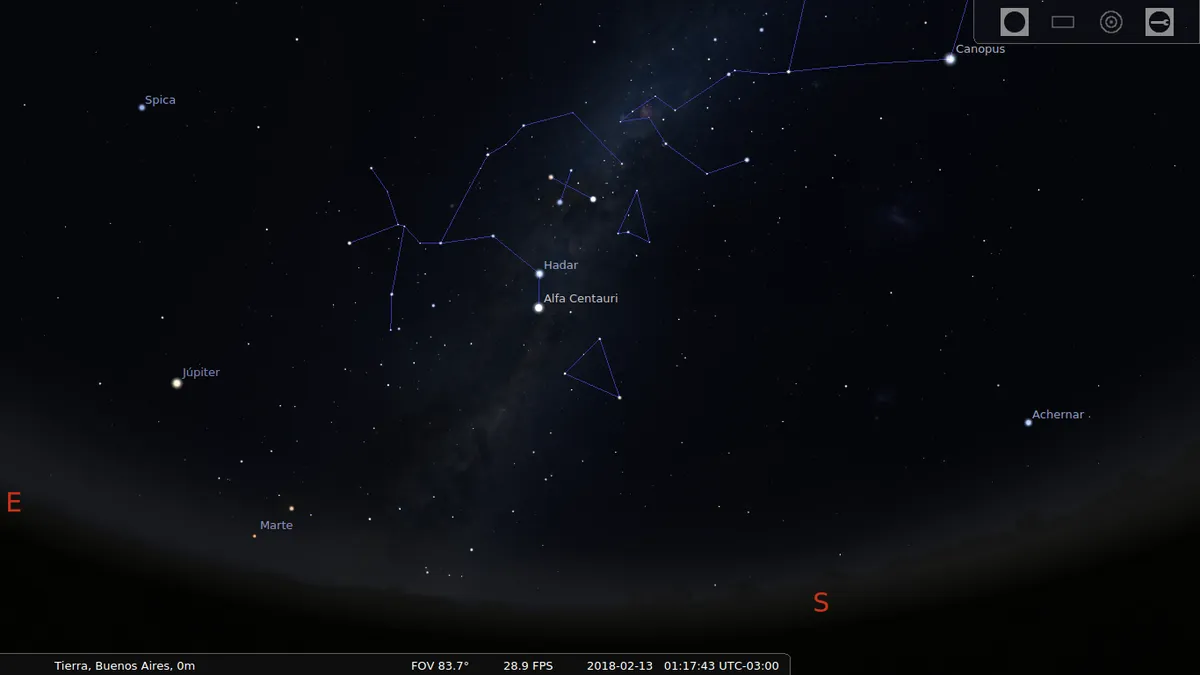
But Fernando told me he saw many names. So I changed the configuration so that many names are seen and you would see this other:
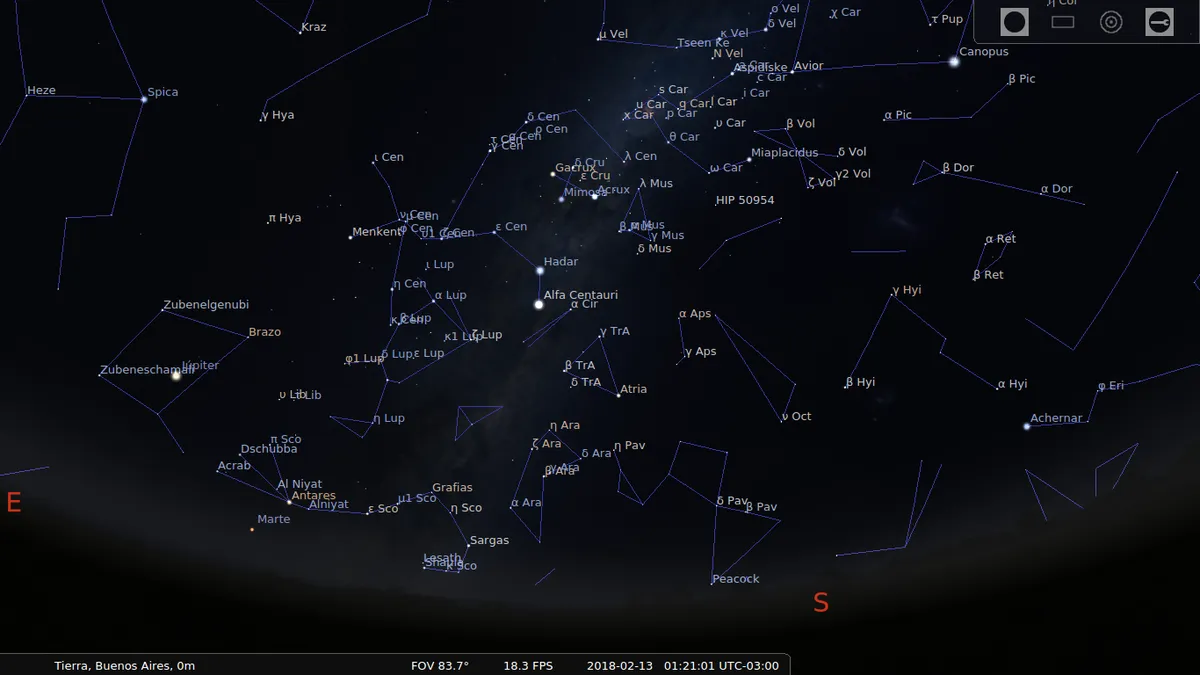
The comparison between these two images allows us to say that with many names it is difficult to observe stars. That's why, although names can be useful, they can be increased or decreased from the configuration easily. So I made a series of changes in the configuration to make it easier to see what Fernando actually observed. This is important because the program will be a good simulator or not depending on how we use it.
If I remove the labels, except for planets, I would see this:
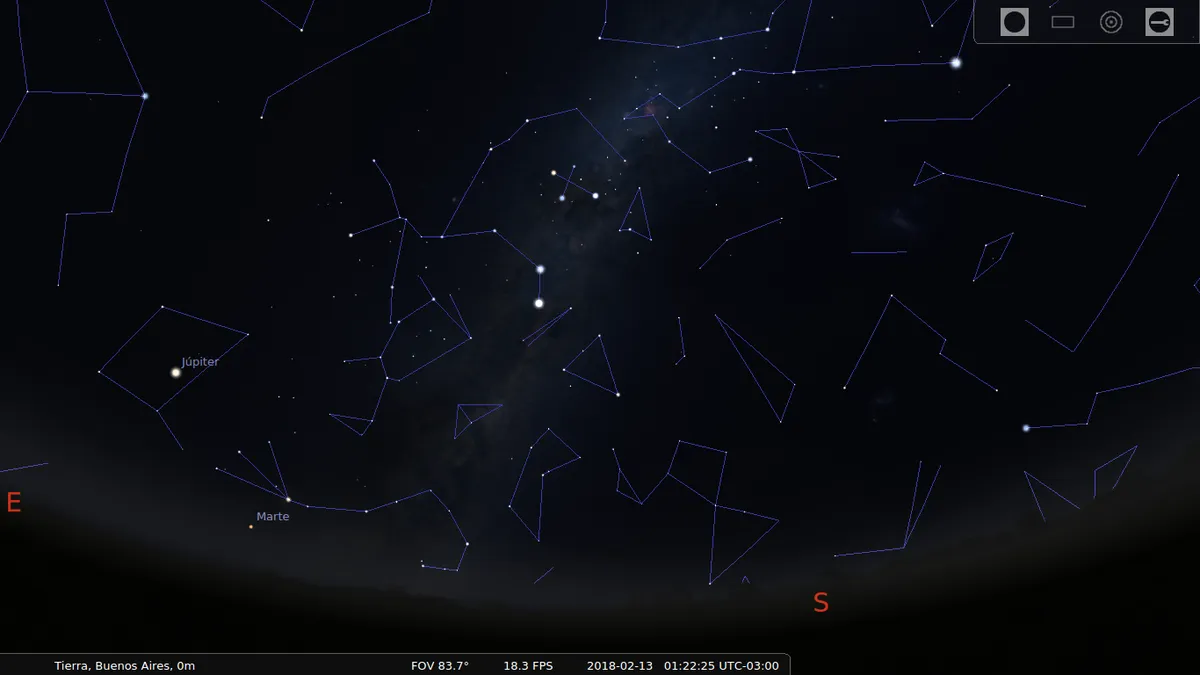
If now I also increase the light pollution (for which it is necessary to uncheck the automatic option and change the value manually) and remove the constellation lines:
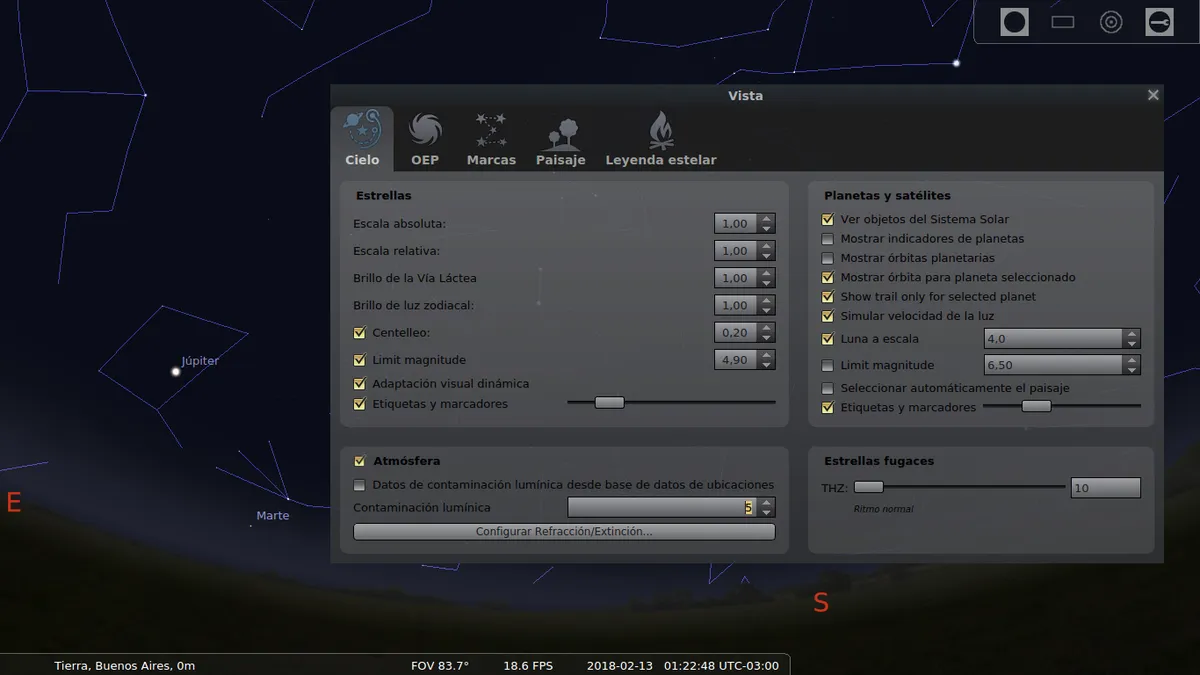
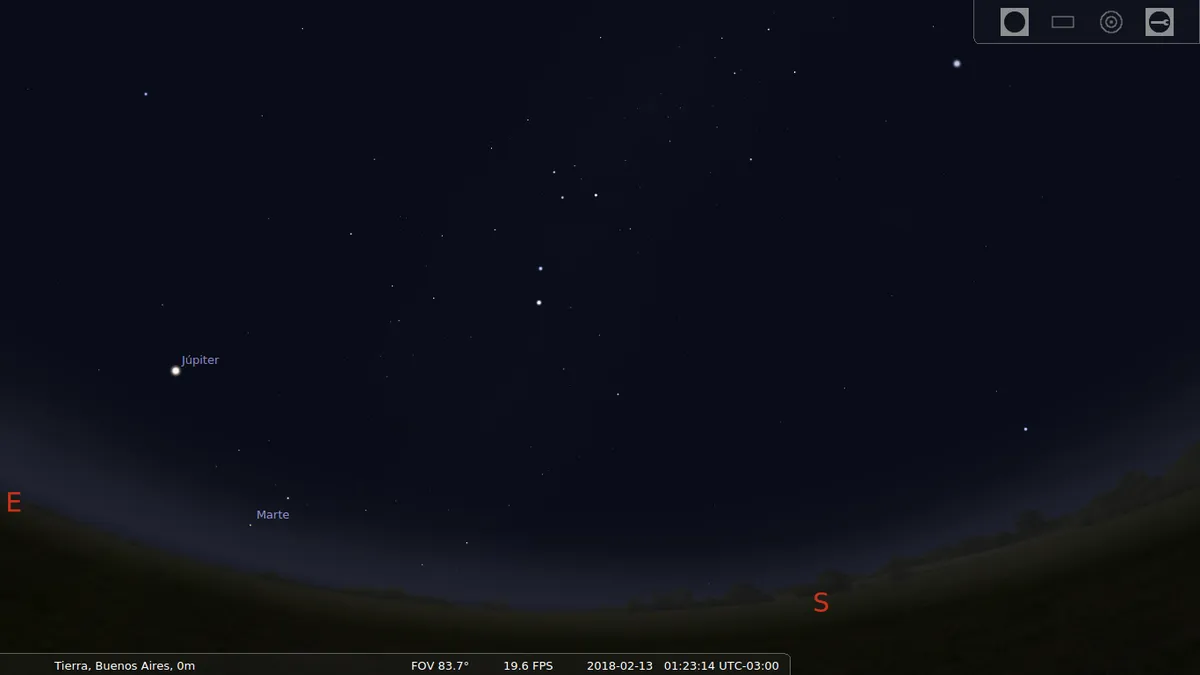
What we see is the Southern Cross, above (although only 3 stars are visible) and "the pointers" Alpha and Beta Centauri, below, which would be the "broken stem". Crux does not have only 4 stars. It is true that to imagine the cross, the 4 main stars are enough, but the constellation is not only the stars that would be seen, in the imagination, joined by an invisible line (in this case, two lines), but they have boundaries within which there are other stars.
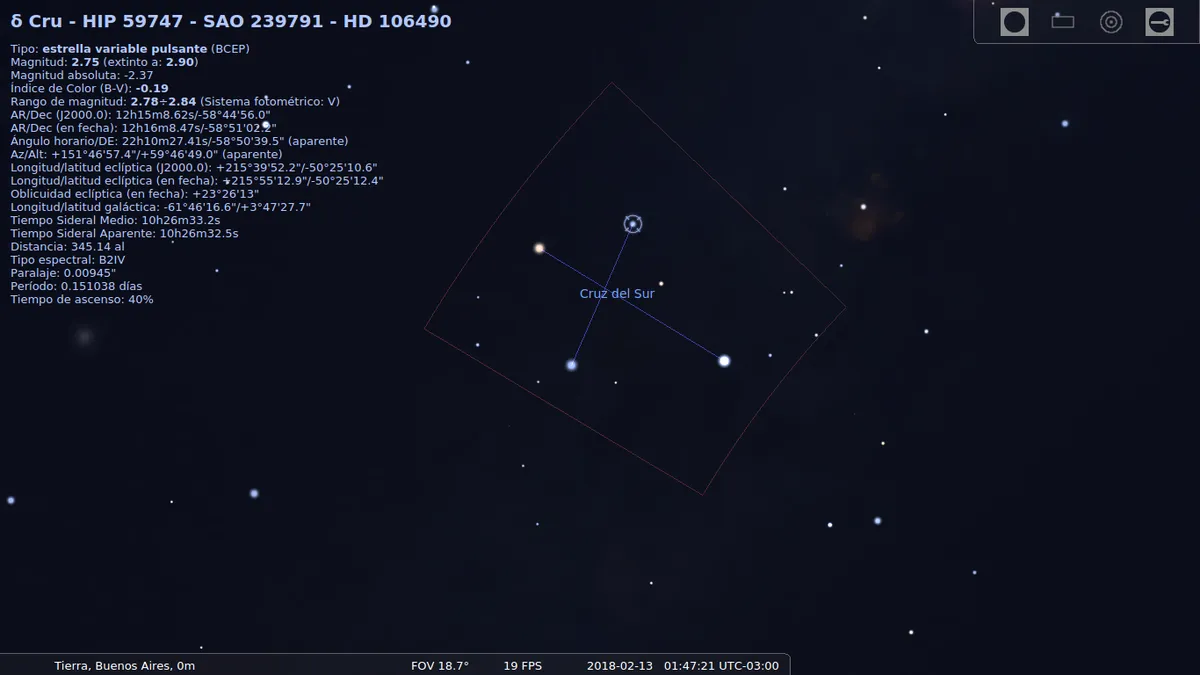
Of the 4 stars that are necessary to compose the cross in the imagination, one is the least bright: delta crucis (Decrux).
From image 3, below the Cross, we see two other very bright stars, which are Alpha and Beta Centauri (genitive of Centaurus). The constellation of Centaurus almost surrounds Crux. The two brightest stars of that constellation are called "pointers" because if we imagine extending the line between both stars, we would reach the minor axis of the Southern Cross. It's as if they "point" to that constellation.
In a not very dark sky, like that of the city of Buenos Aires and Greater Buenos Aires, with a lot of light pollution, it is difficult to perceive the star Decrux, so many people may have trouble detecting the constellation, despite the pointers.
If one does not have this information, it is logical to "see" or for our brain to interpret what we perceive as a "broken-stemmed Y", as is "observed" in image 5. In reality, let's remember, one thing is what we perceive with our eyes and another is what our brain interprets. The eyes do not see "crosses or Y's", they see points of light that our brain interprets in a certain way.
But, with this additional information, we know it is not a "new constellation", but rather it is the Southern Cross - (Decrux) + the pointers. More than a constellation, it's a stellar equation!
FERNANDO'S REPLY
Upon my answer, Fernando wrote to me saying, referring to himself: "I'm a fool, how did I not realize that... sorry for bothering. I invented a non-existent constellation, sorry". No, Fernando, it was not a bother. In fact, I thought it appropriate to write a post about it, so the question was fruitful. But also, someone who lacks some information is not a fool. The mere possession of data does not make you more "intelligent". Information must be shared, because no one is born knowing. The most "obvious" thing may not be so. And I will demonstrate it right away:
ABOUT NON-EXISTENT CONSTELLATIONS
All constellations are imaginary. All of them. The ancient ones and the modern ones. Are there modern constellations? If historical modernity began in the 15th century, yes, since some constellations like Air Pump (Antlia) were invented in the 17th century by Lacaille.
But I will immediately say something incredibly obvious, but which often is not, and I know from experience. Diego Hernández from the Planetarium of the City taught me: we can still imagine any constellations we want!
Diego imagined a nice snail in the sky. I invite readers to do the same. Rest assured, it doesn't violate any law and it's fun. Be creative and, if possible, use a dark sky. From the Federal Capital we see 4 crazy stars...
If inventing constellations (all of which are objectively non-existent) is foolish, then there wouldn't be any. Constellations, beyond their origin and ancient uses, remain useful as a reference, as if they were neighborhoods of a city on a map. But, as I just pointed out, whether in a group (which is more fun) or individually, with a good dark sky, it's nice to invent new constellations. It's a playful thing and observation, which can be done with precision and for scientific purposes, is also a way to entertain ourselves and enjoy. Let's not lose that. Inventing constellations or asterisms, as they are also called, is similar to inventing words in a family environment or among friends. Now, when the readers of this blog look at the sky, we will see your "broken-stemmed Y" constellation, Fernando. And if we use our imagination, we could say it's a person with arms raised, celebrating, or pointing at the sky. It's the constellation of the Observer. The Fernando constellation. I toast to that.
About the images
Screenshots using Stellarium.
http://stellarium.org/es/