Víctor Buso, the amateur astronomer who discovered the supernova, along with two of the researchers, will give a talk at the Planetario de La Plata. Also, Víctor will share his experience at Amigos de la Astronomía. Also, today's Google Doodle, for an astronomer from Mexico.
From the Planetario de La Plata and the Asociación Amigos de la Astronomía of Capital Federal, they invite us to chat with the experienced amateur and the professional astronomers who made the recent discovery. I share below the two press releases:
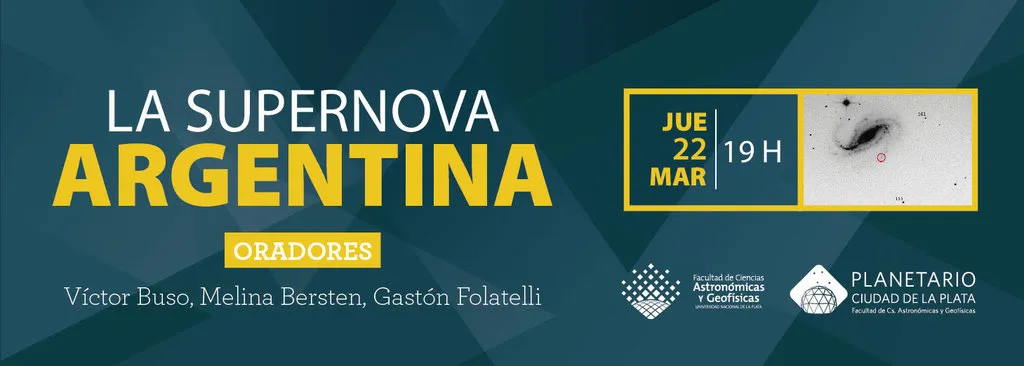
Víctor Buso, Melina Bersten and Gastón Folatelli, the three Argentine astronomers protagonists of the historic discovery of supernova SN2016gkg, will speak at the Planetario Ciudad de La Plata.
The astronomer from Rosario, Víctor Buso, achieved, from the terrace of his house, what astronomers around the world had been seeking for years: to observe the instant of the birth of a supernova. It is a flash of light that occurs just when the explosion of a star is about to emerge from its surface.
This unprecedented discovery was studied by a group of Argentine scientists, astronomers from the Facultad de Ciencias Astronómicas y Geofísicas of the Universidad Nacional de La Plata, and concluded in a publication in the prestigious journal Nature.
We will explain the scientific relevance of the discovery. We will tell the enriching experience of the collaboration between those who study the sky as a hobby and those who do it as a profession.
Everyone is invited!
Address Planetario Ciudad de La Plata
Facultad de Ciencias Astronómicas y Geofísicas
Universidad Nacional de La Plata
Also in Capital Federal at the Asociación Amigos de la Astronomía
The Amigos tell us:
This time, we begin the 2018 lecture series, with a talk by Mr. Víctor Buso, amateur astronomer, who last September 2016, and from his home in the city of Rosario, observed the explosion of a star, in galaxy NGC 613, in the southern constellation of Sculptor. He will tell us the details of his discovery and answer our questions. As always the lectures were given on Saturdays, this time, as an exception, it will be given on SUNDAY, MARCH 25, AT 19 H. AT OUR SOCIAL HEADQUARTERS AT AV. PATRICIAS ARGENTINAS 550. CABA. Admission is free.
For those who attend, I recommend checking the venue's bulletin board to learn about courses that are starting and other activities.
UPDATE: ALSO AT THE PLANETARIO DE LA CIUDAD DE BUENOS AIRES
Lecture on the historic detection of a supernova
March 23, 2018 / 19 h. / Planetario de Buenos Aires “Galileo Galilei”
Av. Sarmiento and Av. Figueroa Alcorta/ Free activity
Registration: www.planetario.gob.ar
ENCUENTROS DE CIENCIA at the Planetario welcomes Víctor Buso, amateur astronomer who made the first documented observation of the birth of a Supernova. He will be accompanied by Melina Bersten and Gastón Folatelli from the Instituto de Astrofísica de La Plata (IALP - CONICET; UNLP) members of the group of astronomers from the Facultad de Cs. Astronómicas y Geofísicas of the UNLP that published a paper on the discovery.
Victor Buso is 58 years old and lives in the southern area of Rosario. Since childhood he has been an astronomy enthusiast. At eleven years old, while his friends played soccer, he built telescopes out of cardboard, wood and tin. Currently on the terrace of his house he has his observatory with professional equipment (telescope, computer, cameras, rotating dome, etc.) In September 2016 he set out to observe a galaxy and days later upon seeing that a pixel was increasing in brightness he decided to take 40 images in a few seconds. He had the sequence, the record and the conviction that it was a supernova.
His images were analyzed by the scientific community. He was not mistaken: he had recorded the first moments of a star's explosion. Although many supernovae have been discovered, until now there was no sequential record of the moment of the explosion.
Buso's great discovery allowed for work led by an interdisciplinary group of Argentine astronomers: Melina Bersten and Gastón Folatelli from the Instituto de Astrofísica de La Plata (IALP - CONICET; UNLP), Federico García from the Instituto Argentino de Radioastronomía (IAR - CONICET; CIC), Omar Benvenuto (IALP) and Mariana Orellana from the Universidad Nacional de Río Negro, Bariloche (UNRN; CONICET). Also co-authors of the publication are the amateur astronomers Víctor Buso and his friend José Luis Sánchez, who contributed follow-up observations of the supernova, from Rosario.
The presentation of the work in Nature, the most prestigious scientific journal in the world, endorses this true feat.
On Friday, March 23, the protagonists of this resounding discovery Victor Buso, Melina Bersten and Gastón Folatelli from the Instituto de Astrofísica de La Plata (IALP - CONICET; UNLP) will present themselves in the main hall of the Planetario.
*As a closing of this new Encuentro de Ciencia, observations of the Moon through telescopes will be held on the access esplanade of the PLANETARIO.
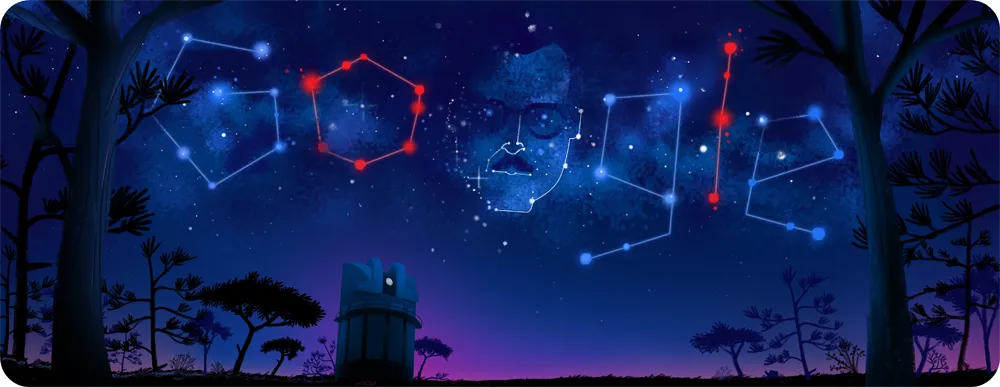
105th anniversary of the birth of Guillermo Haro
Today's Google Doodle is to remember astronomer Guillermo Haro.
If you can observe the sky tonight, look for three aligned stars, very close to each other. They are known as the "Three Sisters" or "Three Marys" and are part of the constellation Orion, representing Orion's belt. They belong to a part of the sky that brought fame to astronomer Guillermo Haro.
Born in Mexico in 1913, Haro grew up during the revolution and graduated in philosophy before embarking on an astronomy career. Among his greatest contributions is the discovery of a type of planetary nebula called Herbig-Haro Objects. He also discovered flare stars in Orion. These contributions led Haro to be elected the first Mexican in the Royal Astronomical Society in 1959.
He also made an impressive catalog of blue stars and discovered a supernova, several novae and a comet.
Guillermo Haro died on April 27, 1988, at the age of 75.
He was married to Elena Poniatowska, an author who wrote the novel "La piel del cielo" in which she recounts Haro's life. A brilliant novel.
https://www.google.com/doodles/guillermo-haros-105th-birthday
Sources and related links
- Planetario UNLP
http://planetario.unlp.edu.ar/ - ASARAMAS
http://www.amigosdelaastronomia.org/
About the images
Doodle: Credit: Google.