Is the universe finite, infinite, or eternal?
Discussions on the concept of infinity
Infinity is a mathematical concept. Mathematics is an exact science, which is the same as saying it is not a social science nor a natural science. Mathematics does not try to understand how nature is. It may seem otherwise, since we can see 2 zebras, 4 people. Wolves gather in packs (they add), businessmen fire workers (subtract), animals reproduce (multiply), through cell division. Mathematical operations, then, seem to arise from natural or social processes. But, where in the natural world is the square root of 2 or the root of -1? In fact, where in nature is a square? I don't mean a natural thing that looks like a square, but a perfect square, that is, a quadrilateral whose sides are IDENTICAL in length, that has 4 right angles (not almost right) and whose diagonals are equal to each other, but of a different size than the sides. That is a square. Now, go out and look for one that is "natural" and see if you can.
Mathematicians don't do that because that is not the goal of mathematics. And that's fine. It doesn't matter if in nature the root of -1 "exists" or not. It is a mathematical concept that is logical and useful.
That this and not another is the goal of mathematics is proven by the fact that divergent series (which are infinite) and which, by definition, have no value, have been given some value, in order to use them. For example, the series 1-1+1-1+1-1... has no value because it is infinite. Provisionally, through partial and accumulated results, it acquires two values: 0 and 1. Which implies that if the series were arbitrarily cut somewhere, a value could indeed be given to it (because it would be finite) and that value will be one of the two indicated above. This series is called Grandi's series. But someone found a "value" for it, despite being infinite: 1/2 (see link below).
Mathematically, the conclusion is logical. But think: If you have a cow and then it dies and then you have another that also dies and so on, does that mean you have 1/2 a cow?
We use the concept of average (arithmetic mean) permanently. For example, it is possible that in a country the average number of children per couple is 3.5. However, it is impossible for 0.5 children to exist. It means that some couples have 3 children and others 4 (or 2 and 5) which is similar (mathematically) to saying that all have 3.5. But 3.5 children is unreal. It is NOT operational in the real world. It is useful, however.
Let's do the same with the concept of infinity. By definition, infinity implies that something starts but does not end. It never ends. Regardless of the concept of cardinality, there is no "beyond" infinity, because beyond would imply, first of all, reaching somewhere. Infinity implies that it is never, ever reached.
Mathematicians say that the series of natural numbers is infinite because we can always IMAGINE a larger number. Indeed, some brilliant mathematicians devised ways to create, that is, invent or imagine ever larger numbers, for example through a tower of exponents.
That we can imagine ever larger numbers, does it mean that an infinity "exists" in natural reality?
Evidently we will never be able to "count" things to infinity, which makes it a non-empirical concept, so one could only try to prove it logically. Imagining things is NOT enough to know if they exist. We can imagine Superman, but he doesn't exist.
THE UNIVERSE FINITE OR INFINITE IN TIME AND SPACE
Could the universe be infinite? This can be thought of in size-distance-length or in time. Furthermore, we could ask whether, regardless of whether the universe is infinite, it contains things in infinite quantity or not. Here I will say immediately that if the universe is infinite, it must have things in infinite quantity.
Let's see:
1-A universe started somehow, with a certain size and does not expand or contract (fixed size, finite space) but exists for infinite time.
2-A universe that expands to infinity in size, but lasts for a finite amount of time.
3-A universe that started at some moment and has been expanding ever since.
In case 1: In such a universe there might never be an infinite number of things simultaneously, but there would be infinite things over time. And certainly that universe would not be infinite in size, but it would be in time.
In case 2: In that universe there could be infinite things for a finite time. For this to occur, if it lasts a finite amount of time, the expansion in space would have to occur at infinite speed. Because if it expanded at a finite speed, it would require infinite time to be infinite in size. Neither of these things would happen because infinite means "that never arrives." Therefore, what would an infinite speed be? A speed "that never arrives."
In either case, if the universe is infinite in time or space, there would be infinite things. I will return to this shortly.
In case 3: The one that seems to be our case, if an infinite amount of time has not yet "passed" since its origin, then it is not infinite in time. Regarding size, it would also be finite, unless it had some moment with infinite expansion speed. If it does not expand at infinite speed, then it would take an infinite amount of time to become infinite in size, that is, it would never happen.
It is clear that the "if an infinite amount of time has not yet passed" is illogical, because that assumes that infinity is ever reached, while by definition it is never reached. Unless everything happens at infinite speed. The limit speed is supposed to be the speed of light. The Theory of Relativity indicates that at such a speed (finite) time would stop completely, therefore, nothing would happen or in any case, everything would happen at infinite speed.
If in such a universe there were 5 stars, "at the end" of such a process there would be infinite stars. Why? Because those stars would be a part of the whole and if the whole is infinite, then the number of stars would be a part of infinity. For mathematics, a part of infinity is... infinity.
It is logically demonstrated by considering half of the natural numbers: Half of the naturals (which are infinite) are the even or odd numbers, which are infinite.
A quarter of infinity is infinity. A thousandth part of infinity is infinity.
But, furthermore: Billions of stars in an infinite universe would be like a breeze in a hurricane, because infinity is much, much greater than a billion. Infinity is more a concept than a number, but it is so large that not even the largest number comes close to it. Graham's number (which is so large it's even hard to explain, made with a tower of exponents) doesn't reach infinity's ankle. I dare say that if the universe were infinite in size with a finite number of stars, such stars would be undetectable. To simplify: in a universe infinite in size, either there is an infinite number of stars (with the consequences I will mention shortly) or the stars, if they were finite in number, would be the same as nothing.
As shown by these reasonings, the idea that the universe is infinite may seem very nice, although when discussing this it is often not clear whether we are talking about size or time, and upon further thought, perhaps the idea is no longer so nice.
As stated, in a universe of infinite size, the things that exist must be infinite, since they would be a part of the whole. Therefore, in an infinite universe there would be infinite stars. If each star emits light and a part of that light reaches us, even if it is a very tiny part, it would be a tiny part multiplied by infinite stars, that is, an infinite amount of light. This is what follows from Olbers' Paradox, despite which, the night is dark and the day is very bright, but not as bright as it would be if an infinite amount of light reached us.
If the universe is expanding, much of that light would be redshifted, meaning it would cease to be visible to the human eye, but it would have temperature. We would live in hell if there were infinite stars, even if the light reaching us were infrared or of longer wavelengths like radio. That the night is dark is an indication that the universe is finite.
THE ISLAND OF WOMEN IN LOVE WITH ME OR HOW A DESIRE CAN BE A NIGHTMARE
On the other hand, it is possible to think that everything that exists is composed of a combination of elementary particles. And we can think that such a combination is not infinite, so some things exist and others do not. Furthermore, those particles interact in a finite way, meaning there is a finite number of possible combinations given the laws of nature. But in an infinite universe, with an infinite number of particles, the combination would be infinite, so there would be... anything. Everything we can think of. Anything, no matter how delusional it seems, would exist, even all the bad things one can imagine.
If this were the case, it would be, first of all, improbable and unverifiable, and besides, there would be no need to do science, since anything can happen. One would only need to know where each thing happens to go to that place compatible with our desires. Perhaps there is an island of beautiful women in love with me, in which case, I would want to go. But since that universe would be infinite, it would take an infinite time to get there, meaning I would never arrive, unless I could travel at infinite speed, in which case time would stop for me, but not for the girls, and upon arrival they would be very old... Or it's possible that those women are crazy about me, but also crazy or cannibals or worse, that they like Maluma, that is, a nightmare...
Do you realize that the idea of an infinite universe might not be so nice?
THE ROMANTIC CONCEPT OF INFINITY
There are two romantic concepts of infinity: those in favor and those against.
But first, we must differentiate infinite from eternal. The infinite has no end, but has a beginning. The eternal has neither beginning nor end.
Those against a finite universe say that a universe that had a beginning is "functional" to religious ideas because if it had an origin without a cause, that is the same as the "unmoved mover." By being against a finite universe, they are in favor of an infinite universe, not realizing that an infinite universe also has an origin. Therefore, being "truly" against would be being in favor of an eternal universe, which at the same time implies without change, that is, without time. Eternal also means that.
On the other hand, does anything natural or social exist that is eternal? Does anything exist that has always existed and will always exist? It is not known for certain what the half-life of the proton is, but it is not eternal. Nature does not seem to produce anything eternal, and society, even less so. Therefore, being in favor of an eternal universe (in time or space?) is also being "functional" to a religious idea, if one considers that some religions postulate that god is eternal. On the other hand, if eternal things existed, they could not be made gradually (because that would imply an infinite amount of time that would never finish happening), but if it existed it would have had to arise as such, eternal, from nothing. That is, the opposite is not the opposite.
Those in favor of a finite universe can think in two ways: this universe has an origin, but it originated from a previous process, which could be another universe, the same universe in a previous period or stage, or something else. In which case, reality would be a succession of processes, without it being clear whether such succession has a beginning and end or not, it would only be clear that this universe has causes that originated it.
Or those in favor of a finite universe that arose from nothing, in a magical way.
If from these preconceptions we are going to choose which theory is better, that is, based on which one fits our prejudices, that is NOT science. Science is trying to understand what reality is like, regardless of whether I like it or not.
I don't like that there are poor people, but despite that I want to understand why there are poor people, not deny them. Besides, denying them doesn't prevent it. Denying them prevents doing something about it, because the causes are unknown.
You cannot choose a theory based on prejudices. It is logical to have reservations about an interpretation of the Big Bang (Standard Cosmological Model) which assumes that the Universe had a "magical" beginning. But being against that and in favor of an "infinite" universe solves nothing; on the contrary, it is as "romantic" as the former, since infinite also implies origin. And if instead one chose an eternal universe, the concept of immutable eternity is incompatible with change and is also a "magical" concept not compatible with known reality.
ON THE ETERNAL
Suppose we choose an eternal but mutable universe, where things happen, but it has no beginning or end, one might ask if it is an eternity in length or in time, although the concept is more associated with time than with space.
If it were used in a spatial sense, something eternal would be that which does not begin or end, or to put it another way, that has no limits or edge. A sphere has no edge, but it is finite in surface and volume. Suppose the universe is a plane, eternal, without beginning or end in length or size, volume or surface. If it has no spatial limits, it implies that nothing exists "outside" such a universe. That is the dominant idea and what is generally called an infinite universe, but if it has no beginning or end it is eternal, not infinite. Such a universe is then a closed system. As far as is known, the early universe had low entropy (it had a lot of order) and has been becoming disordered since then. Everything we know that has order, has it because it arose from something prior. It is difficult to explain why a closed system arose with a lot of order, although the arising would not make much sense if it has no beginning. And if the laws of thermodynamics are correct and disorder in a closed system increases, then, at some point, in such a universe nothing should happen. Everything would stop. It would be a heap of useless energy. And if nothing happens, then it is not eternal in time.
A universe that is not eternal in size would be finite or infinite. If such a universe is also eternal in time, that would imply that there would have to be a time without space, which seems illogical.
Take a bicycle, spin a wheel hard and isolate the bicycle from everything, let nothing interfere, in a vacuum-sealed cube. At some point, the bicycle wheel will stop. In a closed system, useful energy transforms into useless. And things stop happening. Unless energy is added, in which case it ceases to be a closed system. Therefore, a universe eternal in space and time is illogical.
BEGINNINGS AND ENDS IN RELATION TO CHANGE
Time is a measure of change. Some changes can be thought of from both a quantitative and qualitative point of view. One way to think about time is through processes in which the quantitative reaches a limit, which does NOT mean that things stop happening, but that things change in quality, they transform. For example, an egg or zygote forms, develops until... it is born. Being born is a "beginning," but it does not imply that changes stop; they continue: it is a qualitative difference. We call qualitative differences beginning and end. When water boils, the amount of temperature (speed of particles) reaches a critical point and changes quality, from liquid to gas. The fetus changes quality to newborn child, to infant, to adolescent, to young person, to mature person, to elderly person. They are notable, significant changes, in some sense. Childhood begins and ends. There is nothing wrong with things beginning and ending. It is not that the only "good" thing is for things neither to begin nor end. EVERYTHING we know begins and ends and, in general, the beginning of something is the end of something prior.
Being against beginnings and ends is a "romantic" idea, dissociated from reality.
Whether the universe is infinite, eternal, or something else should not be a product of our desire; it is not about choosing "the best," it is about knowing how it is.
The night is dark. For other reasons, which go beyond this post, it is not possible to say that for that reason the universe is necessarily finite (in space or time). But it is quite likely that this universe had a beginning and that it will have some end, which does not suppose the beginning of everything or the end of everything, but the beginning or end of a process, or of a sum of processes. That the universe has a beginning only supposes that at that moment in time and space a qualitative, notable, significant change occurred, which does not imply that there was nothing before.
This also does not mean that people, animals, and plants have multiple lives. What we are sure of is that there is a concrete life which is the one we have. Planning or shaping our emotions around the idea that perhaps there are other lives makes no sense.
INFINITE PROGRESS
If we imagine human society as in permanent progress (there are several data indicating something different), as if humanity were climbing a ladder and climbing each step were an improvement, but that ladder is infinite, it would lead us to defeatism, if we think that:
Being on step 1 would imply having infinite steps ahead; and being on step 1 million would also imply having infinite steps ahead. If it is the same to be on 1 or on 1 million, but to get to the million you have to make great efforts, what is the point of making those efforts if we will be in the same place as before? It's that we will not be in the same place as before. It is not the same to be on 1 as on a million.
What we do know is that when we of today are no longer here, there will be other people. And that it is not the same to live in the Paleolithic as in modernity. And that there are many things left to do. There are many things left to discover and learn. That must be the engine of history: to understand reality in order to overcome it, in a process of change for which we cannot glimpse an end, there is no Eden. Paradise is as unreal as infinity. Either we are content with what we have achieved so far (thanks to the effort of those who preceded us), or we follow the same path of collective progress. An unceasing effort, with no end in sight, but with concrete improvements at every step. And, every certain number of steps, we make a qualitative leap. Eden does not exist, but it is possible to be better. That is worth it, infinitely.
Sources and related links
- Is the world infinite?
https://elpais.com/elpais/2018/05/04/ciencia/1525451650_930385.html - Grandi's series
https://es.wikipedia.org/wiki/Serie_de_Grandi - The largest number ever cited
https://elpais.com/elpais/2017/05/17/el_aleph/1495036614_478342.html
About the images
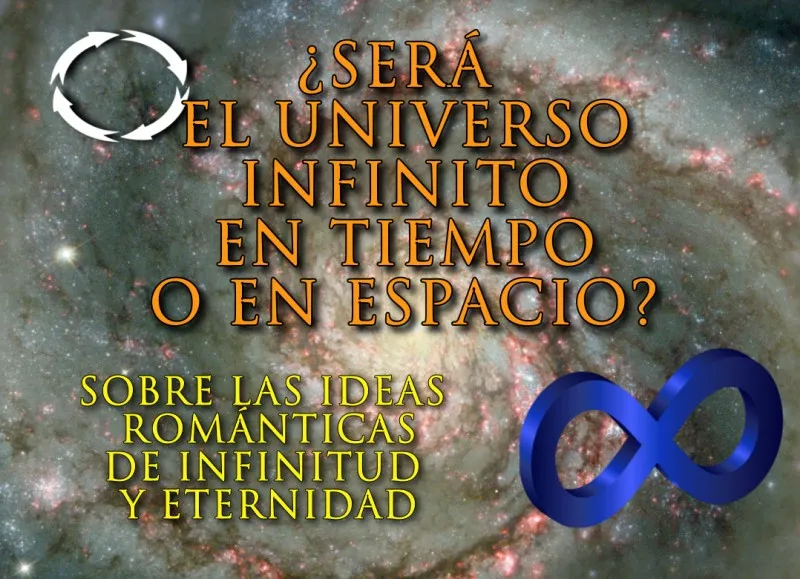
Infinity symbol images from Openclipart.org
Background image: M51 NASA/ESA and The Hubble Heritage Team STScI/AURA.
https://www.spacetelescope.org/images/opo0110a/