Mars is closer. There will be a lunar eclipse on Friday. Two astronomy talks in CABA.
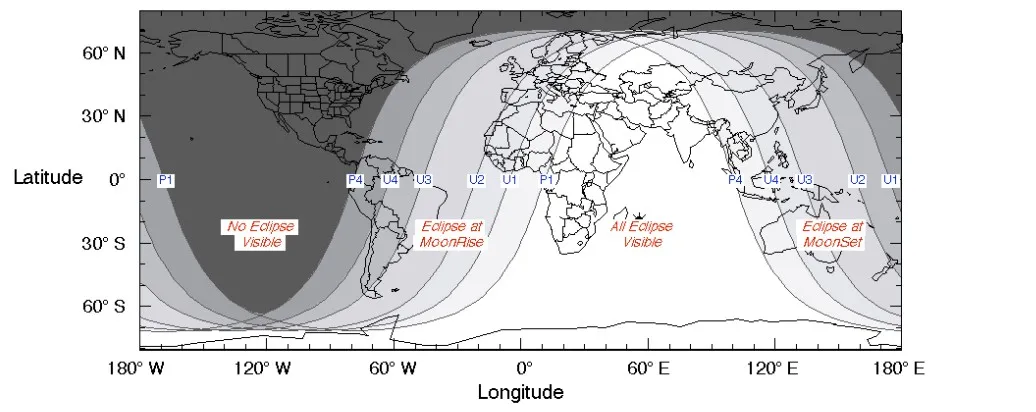
A lunar eclipse will occur on Friday, July 27. Lunar eclipses occur when the natural satellite is in its Full phase, 180º from the Sun (like every full moon) and also the Sun, Earth and Moon are in the same plane.
At what time? The full moon rises when the Sun sets (hence they are 180º apart). It will be from approximately 18:15 hours (Argentina) until 19:30.
It will be visible in totality in parts of Africa, Oceania and Eurasia. Partially, in Brazil, Uruguay, Argentina, Bolivia, Paraguay. In Ecuador, Colombia and Venezuela it will be penumbral. In North America it will not be visible.
The totality will last 1 hour 43 minutes. Is this a lot? It depends. The total lunar eclipse of July 16, 2000 lasted a bit more, 1 hour, 46 minutes. The next one will be on January 21, 2019 and the totality will last 1 hour, 2 minutes, but it will be visible across all of the Americas.
Mars, at short distance
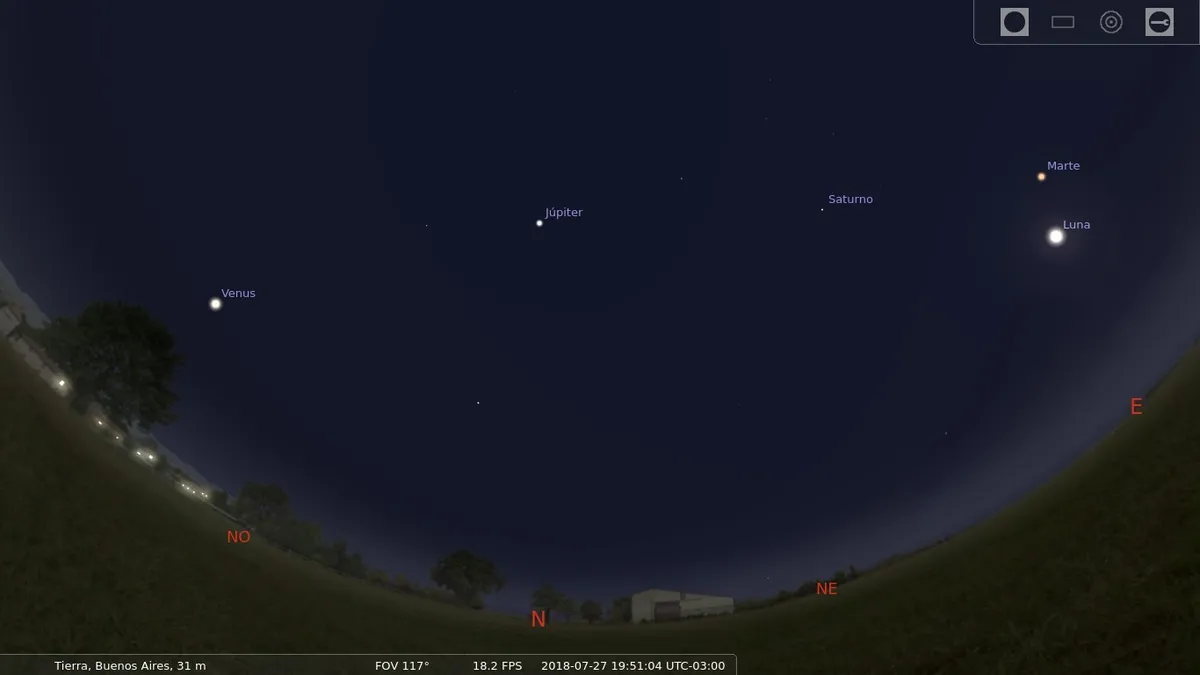
At the same time, Mars is approaching Earth, as anyone who looks up at night will have already noticed. Near the Moon, towards the East, its bright light with the characteristic reddish hue can be seen. Further north, Jupiter and Saturn will also be visible, while Venus will be setting in the West. Mars will be about 57 million km from Earth and its closest approach will be on the 30th of this month, a tiny bit closer.
It will NOT look as big as the full moon, as went viral in 2003, a time when it was somewhat closer, at 56 million km. If it looked that big, it would imply it was much, much closer, generating enormous gravitational consequences. That will not happen.
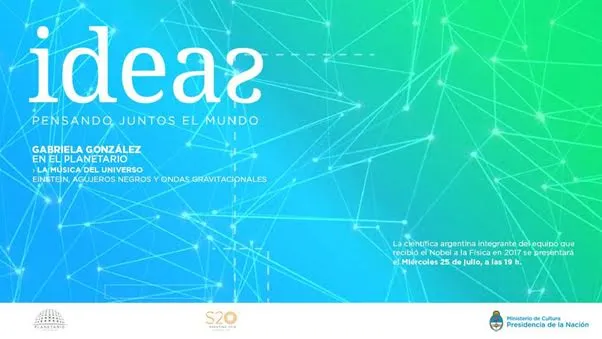
Talk at the Planetarium
The Music of the Universe: EINSTEIN, BLACK HOLES AND GRAVITATIONAL WAVES
Gabriela González will share with the public the secrets of The music of the universe, sounds coming from space as a result of the collision of two black holes more than a billion light-years from Earth.
The speaker, a member of the team that won the Nobel Prize in Physics in 2017, will address the topic in a language accessible to all.
Wednesday, July 25, 19 h.
Free admission
Capacity 250 attendees / RESERVATIONS Check www.planetario.gob.ar
Show Room of the Planetarium
Planetario de Buenos Aires Galileo Galilei
Avda. Figueroa Alcorta and Avda. Sarmiento CABA
More than 100 years ago, Einstein predicted that space-time was dynamic, and there were “gravitational waves” that traveled at the speed of light. On September 14, 2015, the two LIGO observatories in the USA detected for the first time a signal due to gravitational waves traveling through Earth, created about 1,300 million years ago by the final embrace of two black holes an intense interaction similar to that of two tango dancers. Since then, several more signals have been detected, including one with fireworks originating from the collision of two neutron stars, which helps understand the origin of heavy (and precious) metals.
Gabriela Gonzalez will describe the long and incredible history of these discoveries, and the future of this new field of astronomy.
The activity will begin at 19 h. in the Show Room with a detailed description of the sky projected on the dome.
Prior to the conference, it will be presented on the access esplanade of the Planetarium from 17 to 19:
SCIENCE AND LAUGHS Scientific outreach activities for the whole family. Adults and children will have the possibility to find answers to great enigmas of science through experiments they will be able to enjoy a scientific stand up Ideas, Thinking the World Together.
This cycle, organized by the Ministry of Culture of the Nation within the framework of the Argentine presidency of the G20, proposes days of reflection together with intellectuals, scientists and international referents who will participate in the agendas of the Affinity Groups that are part of the G20.
In the 2018 edition of “Ideas, Thinking the World Together”, a series of activities will be developed in different cities of our country, which will culminate in the month of November with the meeting of the leaders of all participating countries.
The planned activities include both participation in the summit itself, as well as in complementary events: keynote lectures, dialogues and artistic presentations. The international speakers, referents in the topics addressed, will be the protagonists of the meetings.
The first of the speakers will be the Argentine scientist Gabriela González, a member of the team that won the Nobel Prize in Physics in 2017.
Gabriela will be in charge of inaugurating “Ideas, Thinking the World Together”, on July 23 in the city of Rosario, and then giving a talk for the whole family on July 25, at the Planetarium of the City of Buenos Aires.
"ONE ABOUT... MARTIANS", at Amigos de la Astronomía
Our planetary neighbor, the red planet Mars, has made us many unfulfilled promises. Both its seasonal color changes (which suggested vegetation) and the presence of polar caps (perhaps water?), which stimulated the possibility that it was inhabited by Martians (maybe intelligent ones) have been replaced by other interpretations, based on space probes that have reached the planet several years ago. However, could there be Martians of “some kind”?
Today we have the scientific and technological tools to explore those questions, beyond the always stimulating fantasy.
Dr. Juan Carlos Forte (UNLP)
Talk at Amigos de la Astronomía
Av. Patricias Argentinas 550 - CABA - Admission is free and open.
Saturday, July 28, 2018, at 19:00 hours.
The information about the events at the Planetarium and Amigos de la Astronomía was provided by those institutions.
Sources and related links
- NASA Eclipse
eclipse.gsfc.nasa.gov/eclipse.html
"Eclipse Predictions by Fred Espenak, NASA/GSFC Emeritus" - Asociación Argentina Amigos de la Astronomía
https://www.amigosdelaastronomia.org/ - Planetario Galileo Galilei
www.planetario.gob.ar
About the images
NASA Eclipse by Fred Espenak.
Stellarium https://www.stellarium.org/es