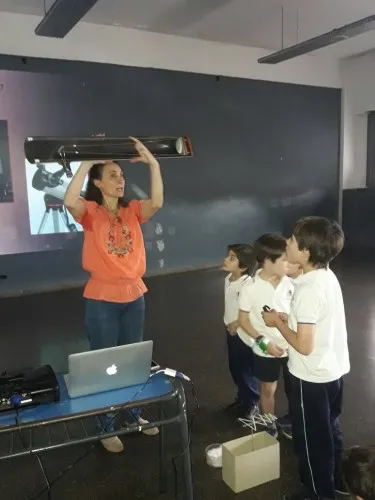
Astronomers as runners of space-time.

On another occasion I have said that the main engine of the sciences is actually the same one that drives other activities, like the 100-meter dash: the attempt to surpass oneself. We do these things because we can, because we have the physical and intellectual capacities to do so. One might think these activities are useless, that they serve no purpose. However, two reflections are in order:
1-They serve to satisfy our desire for self-improvement, which includes the desire to know, in the sciences.
2-Not making use of these capacities would be a waste.
This does not mean, of course, that with knowledge in hand, people do not try to solve concrete problems.
Another possible comparison between sports and astronomy is that in both cases it seems we live in the age of records: both in the world championships of each sporting discipline, as well as in the Olympic Games, records are set; while astronomers find the most distant supernovae, the brightest ones, and manage to observe the most distant past. Will we be able to continue observing the increasingly distant past, just as records are broken in athletics?
COSMOLOGY AND THE INSPECTION OF THE PAST
In the latest IAR (Instituto Argentino de Radioastronomía) Newsletter, Dr. Gustavo Romero publishes a text on "Modern cosmology in 10 questions". In question 8 he says this:
8. Was there a first instant?
If time is continuous, there was not. Let the reader think of the interval [1, 0]. Suppose that the inverses of those numbers represent instants, and that 1 is "the present" and 0 is not included because division by zero gives "infinity". There is no first instant. However close a number is to zero, there will always be one closer. However, the interval is finite (its measure is 1). We do not know if time is continuous. Probably, on a very small scale, it is not. It is possible that time, space-time actually, emerges from more basic and timeless entities. The study of that problem is called "quantum gravity".
In case it is not understood, I will say it in my own words: The interval 0-1 can be considered finite, if we use only the natural numbers, since there is no natural number between the two, so to go from 0 to 1 I need one step, therefore, the difference is 1.
However, if we take the real numbers (which include rational and irrational numbers), the interval 0-1 is infinite, since between both values there are infinite real numbers: 0.01; 0.001; 0.00001; and so on ad infinitum.
THE PROGRESSION OF SPORTING RECORDS
Although there are exceptions, it is possible to find a trend in sporting progress since the 20th century:
According to the Wikipedia entry on the progression of the world record for the men's 100 meters, at the beginning of the last century, 1912, the 100m record was 10.6s.
Fifty years later, 1962, the mark was lowered to 10s. That is, a progress of 0.6s in 50 years.
Another fifty years later, 2012, Usain Bolt's 2009 record of 9.58s is still valid. That is to say, in those 50 years, a progress of 0.42s was achieved.
This seems to be a trend that can be summarized as it takes more and more (time) to achieve the same amount of progress.
One might ask, given that human capacities are finite, will Olympic records ever come to an end?
And the answer also has to do, as in the previous cosmological case, with the way of dividing time, whether using natural or real numbers.
Since we can divide time as much as we want (I will review this later), then it is possible that in the future, new records will be tiny, increases or decreases of 0.00001 meters or seconds, depending on the activity, for example number of meters in the high jump or seconds in races.
It seems that the effort required to achieve the same level or amount of progress achieved before is exponential.
It is like advancing with a headwind and with a tailwind: in the first case it costs us more to walk the same distance, and as a consequence, we take longer, since one way to measure work is in relation to the time spent to produce something, the objective value of things.
ASTRONOMICAL PROGRESSION TOWARDS THE PAST
Let's take Dr. Romero's idea and imagine a number line of time starting at 0. And suppose that until now, astronomers have managed to get as close as 1 with their observations. Perhaps it will happen as with sports records: maybe within 50 years, progress will be made and we will "advance" towards the past, say to 0.9997.
Observatories are being built in different wavelengths, with cutting-edge technology, enormous in some cases. The technical advance in time measurement was fundamental for the progress of sports records, since with analog clocks it is difficult to measure below the second.
Similarly, telescopes 4 centuries ago, analog photography first and then digital, and techniques like adaptive optics and interferometry have driven modern astronomy to unsuspected limits. But, again, progress also seems to require more and more effort.
THE QUANTIFICATION OF TIME
The 20th century, then, brought electronics and the more precise division of time. But it also brought quantum theory, which is not only a branch of physics, but a general idea that puts the concept of continuity in crisis. A sheet or a tablecloth seem to be continuous surfaces, but we know they are actually composed of threads, which would be their "minimum unit".
Theoretical physicists consider that both space and time would be quantized, that is, there would be "minimum units" that cannot be divided. If that were the case, it would not be a technical limit, but an empirical one. That is called the "Planck scale".
Does this mean that in the very distant future, athletes will no longer be able to break records if they manage to reach that scale?
THE CHRONON ATHLETES
As long as the 100-meter race is run by biological human beings, it does not seem possible to run that distance in a chronon, a term indicating the smallest amount of time that can be measured= 5.39x10-44s, the Planck time. That is 0, followed by 43 zeros and a 5. 0.00000000000000000000000000000000000000000005 seconds.
It does not seem that the physical, biological characteristics, our muscles, tendons and skeleton would ever allow us to achieve such speed.
And although electronic implants are already seen in the human body, it also does not seem possible that, in the long run, such "pseudohumans," quasi-androids, could manage to run 100 meters in a chronon. Blade Runner would be just a sample button.
THE UNATTAINABLE LIMITS
On the other hand, it is possible that another limit exists, beyond the Planck scale, the convergent limit.
In mathematics, a series can be infinite and convergent, when the summation gets closer and closer to a finite number, as happens in: 1+1/2+1/4+1/8+1/16+1/32...
Since it is a sum, the result should increase, although each time what is added is a smaller value (half) of the previous one. But the provisional values, although they increase, get closer and closer to 2, without ever reaching it.
Don't take my word for it, use a calculator and you'll see this:
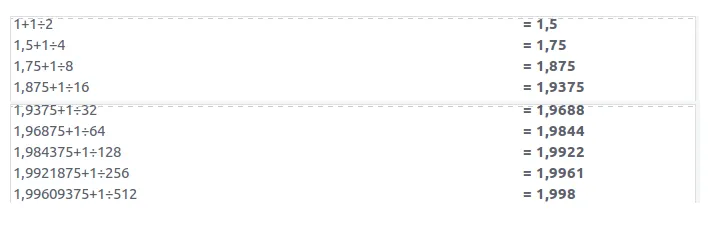
I believe it is possible that something similar happens in athletics. Although progress is made as records are improved, they will have a limit, although perhaps it is never reached.
And it wouldn't be far-fetched that we could also use the analogy in cosmology. If astrophysicists are, in the comparison, runners of curved spacetime, even if they manage to "advance" further and further into the past, they require greater effort than before to progress the same relative amounts.
On the other hand, in the early Universe, in a fraction of a second, there was possibly a greater number of interactions than today in a year in the same volume of space. Where the simple becomes complex, "a small step for the individual is a giant leap for mankind".
More than celebrating the first moon landing, a true International Day of Fraternity, it should celebrate the possibility that, collectively, we can overcome our limits, in a race that has a goal, but no finish.
Sources and related links
- IAR Bulletin
http://www.iar.unlp.edu.ar/boletin/bol-jun18.htm - Wikipedia Annex: Progression of the world record in the men's 100 meters flat
https://es.wikipedia.org/wiki/Anexo:Progresi%C3%B3n_de_la_plusmarca_mundial_de_los_100_m_lisos_masculino - Space Runner
https://www.youtube.com/watch?v=3D57cMZ9PNs