On space speed and the power and limits of discovery.
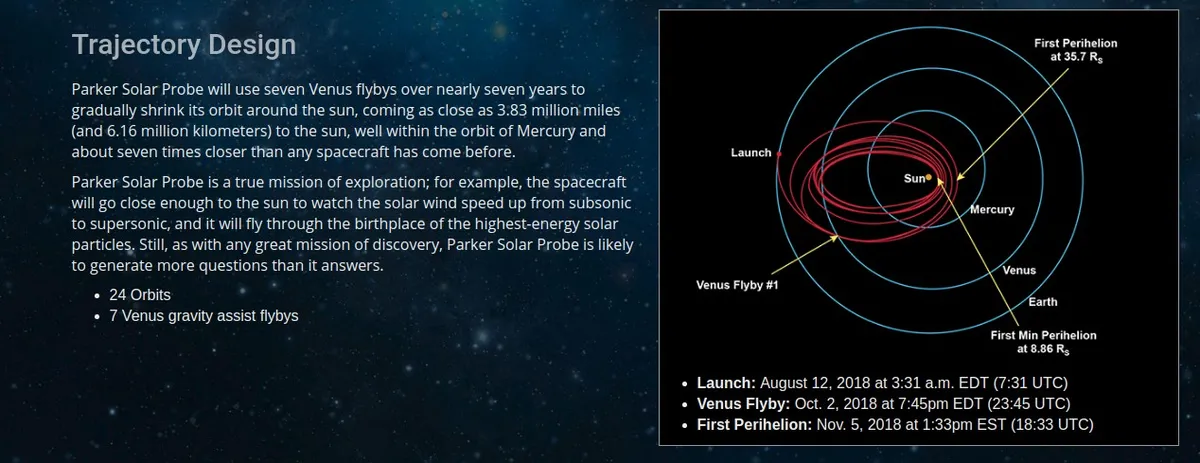
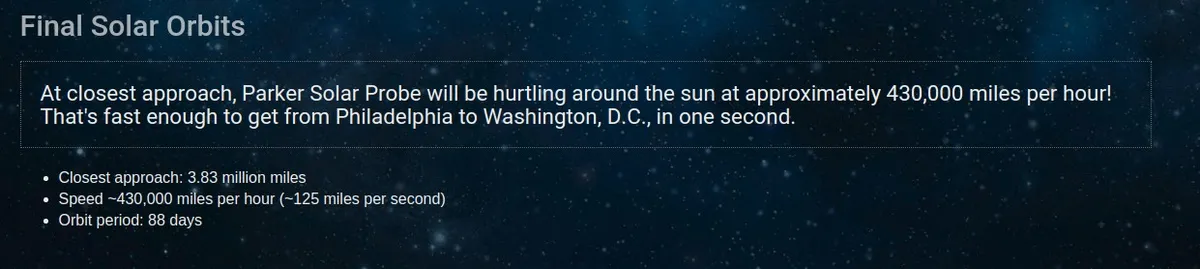
As we already know, on August 12 NASA launched the Parker probe which will head to the Sun. According to the US agency, after seven flybys of Venus, the probe will get very close to the Sun and will acquire a final speed close to 700,000 km/h.
I want us to stop and think about that speed. It is not the speed given by the impulse of a rocket, but rather such acceleration is reached thanks to the gravitational thrust of Venus, several times in a row. But, in any case, that is the maximum speed reached by a human spacecraft. Is it a lot? It depends on what for.
Speeds and discoveries
It is interesting to think about speeds in the context of the search for ET life. It is feasible that some form of simple, microbial life exists in the Solar System or that it existed and remains as a fossil. In both cases, it would be an extraordinary discovery. It is possible that such a discovery will occur in the coming decades because progress has been made in the exploration of Mars and there are missions planned to the moons of Jupiter and Saturn, where some form of microorganism could also proliferate.
However, beyond the Sun, things get complicated. The closest star system to Earth, Alpha Centauri, which is known to have at least one planet, lies 4 light-years away, which is equivalent to the length a beam of light would travel at the only possible speed: the speed of light, of almost 300,000 km/s in empty space. If we multiply that amount by 60 we will have the distance traveled in one minute. If we multiply that result by another 60, we get the distance in 1 hour. That times 24, the length in one day. Times 365, in one year. And if we multiply by 4, in 4 years. Total: 37,843,200,000,000, that is, more than thirty-seven trillion kilometers.
How long would it take the fastest spacecraft built, the Parker Solar Probe, to travel that distance?
If it travels at 700,000 km/h we can divide both figures, and the result will be in hours: a little more than 54 million hours. If we divide it by 24, we will make the equivalence to days and if we divide that by 365, in years. Total= 6,171 years.
Microbes cannot be discovered with a telescope, which is an instrument suitable for observing large objects at great distances. Therefore, to find simple life you have to go to the surface of planets or moons. Going to the closest planet, outside the Solar System, is today, impossible. Until much better propulsion systems are developed, reaching an exoplanet with a surface probe is beyond current human reach.
THE IMPLAUSIBLE VISITORS
Since the Roswell incident, more than 50 years ago, it has been said that ETs visit us with spaceships, the UFOs. It is unlikely that, the universe being so large, they come from the closest star system, but let's assume that is the case. From Proxima Centauri there are, as we said, 4 light-years. If a civilization of equal technological advancement to humans existed there, it would take them 6000 years to get here. It is implausible that, if that were the case, they have been visiting us regularly for decades.
If they came from farther away, it would be even more difficult.
We should then assume that if they visit us frequently they must have a propulsion technology much better than the human one, but not just a little better, but thousands of times better.
If that were the case, why have they been playing hide-and-seek for decades? It is not plausible that they are afraid of us.
But perhaps they are like anthropologists or biologists who come to study us without interfering. If that were the case, that is, if they want to go unnoticed, they should not have problems with a technology so superior that it could be undetectable to human eyes and radars. But many people say they see UFOs everywhere, all the time! Again, it is not plausible.
And that, if we consider the minimum distance, that is, assuming they came from the closest star system to Earth, composed of three stars, which also implies a system with large tidal forces, not very stable, and therefore, not very plausible that it has had stability for billions of years for intelligent life to flourish as on Earth.
And even less plausible is to think that with such technological advancement, the USA the greatest military power (which however lost in Vietnam), could have captured an ET and have it in area 51 or in hangar 18!
This idea is ingrained in mass culture. As an example, Megadeth has a song (and a video) called Hangar 18 (a movie was also made with that name).
THE EXTRAORDINARY POSSIBLE DISCOVERIES
The extraordinary statements about UFOs and ET beings visiting us are fantasy or science fiction. But the science of the real is also out of the ordinary: the Parker probe will reach 6 million km from the Sun, which is a short distance in relation to the 150 million km that separate the Earth from the Star (on average).
The main objective of the mission is to study the solar wind, charged particles that travel at high speed and that were predicted by a certain Eugene N. Parker in 1958, when not many took him seriously and hence the name of the spacecraft, the first to be named after a person who is still alive.
It was not merely an imaginary assumption, but the use of data, calculations and inference that led him to that conclusion. Four years later, with the Mariner 2 probe to Venus, energetic particles were detected in the not-so-empty space, that which is now called the solar wind.

Studying the corona and the solar wind with better data will generate a better understanding of solar weather, which affects Earth.
This data will not be obtained all at once, nor very quickly. The mission is planned until 2025, after 24 orbits of 88 days, and the spacecraft will have to defend itself from temperatures greater than a thousand degrees Celsius. It is scheduled to fly by Venus for the first time in October and reach its first perihelion in November. It is not the first spacecraft to fly by the Sun, but it will be the one that gets closest. In comparison, it will be 7 times closer to the star than the Helios probe.
In summary, scientific reality is as extraordinary as imagination, but it is true. And it is much harder to formulate theories that explain what is not understood and to be able to test it empirically than to make a music video with rubber dolls.
Sources and related links
- Parker Solar Probe at The Johns Hopkins University Applied Physics Laboratory
http://parkersolarprobe.jhuapl.edu/ - NASA
https://www.nasa.gov/content/goddard/parker-solar-probe-humanity-s-first-visit-to-a-star - Dynamics of the Interplanetary Gas and Magnetic Fields.
Parker, E. N.
Astrophysical Journal, vol. 128, p.664
DOI: 10.1086/146579
NYT: NASA’s Parker Solar Probe Is Named for Him. 60 Years Ago, No One Believed His Ideas About the Sun.
https://www.nytimes.com/2018/08/10/science/eugene-parker-solar-wind-nasa-probe.html
Parker Solar Probe Launches on NASA Voyage to ‘Touch the Sun’
https://www.nytimes.com/2018/08/11/science/parker-solar-probe-launch.html
About the images
Photo credit: Joshua Lott for The New York Times.